QUESTION IMAGE
Question
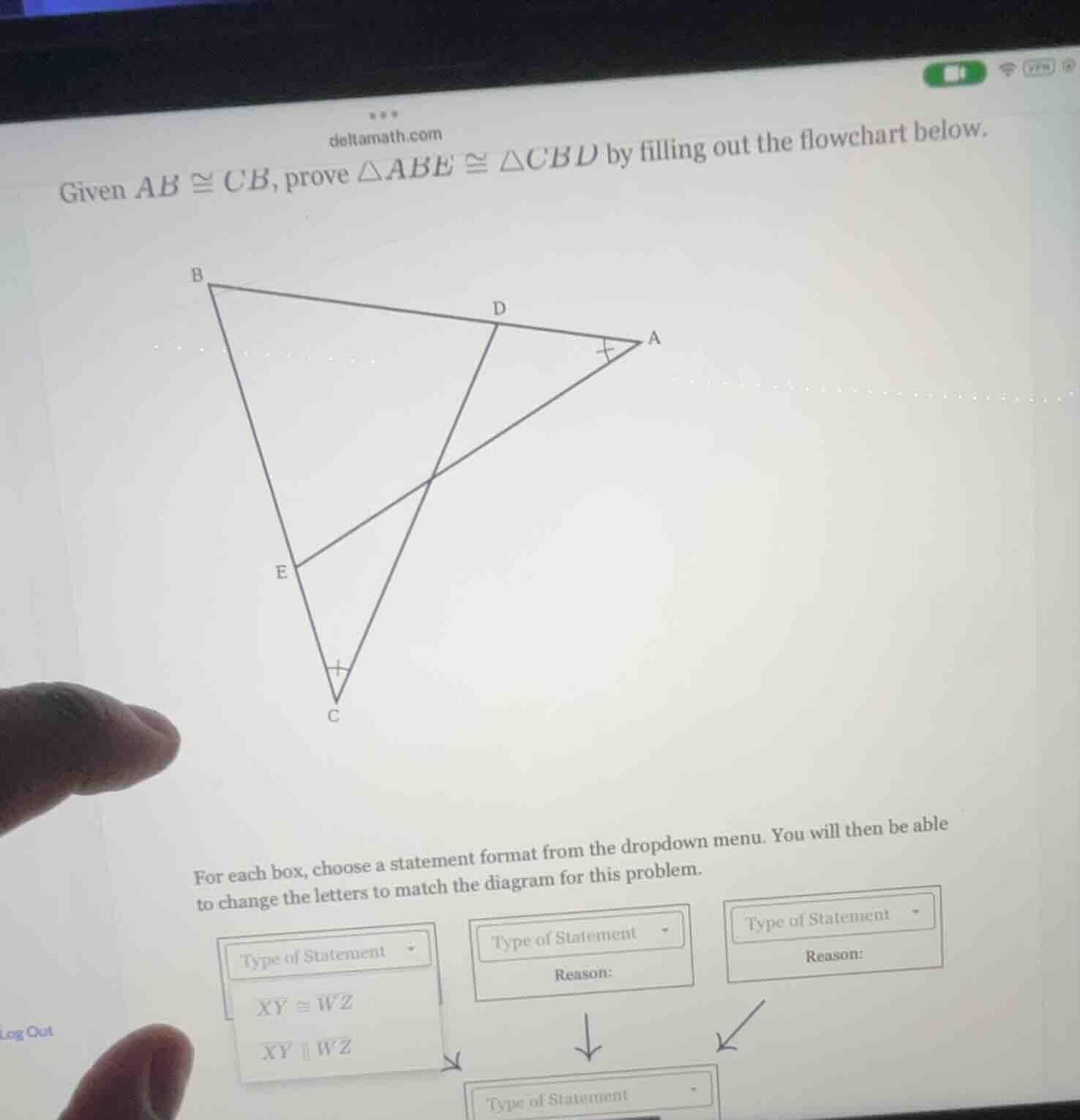
deltamath.com given ( ab cong cb ), prove ( \triangle abe cong \triangle cbd ) by filling out the flowchart below. for each box, choose a statement format from the dropdown menu. you will then be able to change the letters to match the diagram for this problem. log out
Step1: Identify Given Information
We know \( AB \cong CB \) (given). Also, from the diagram, \( \angle A \cong \angle C \) (marked with congruency symbols). And \( \angle B \) is common to both \( \triangle ABE \) and \( \triangle CBD \), so \( \angle B \cong \angle B \) (Reflexive Property of Congruence).
Step2: Determine Congruence Criterion
We have two angles and the included side (ASA - Angle - Side - Angle) or two angles and a non - included side (AAS - Angle - Angle - Side). Let's check:
- \( \angle A \cong \angle C \) (given by the marks on the diagram)
- \( AB \cong CB \) (given)
- \( \angle B \cong \angle B \) (Reflexive Property)
So, by the ASA (Angle - Side - Angle) Congruence Criterion, \( \triangle ABE \cong \triangle CBD \).
For the flowchart:
- First box (statement about sides/angles): \( AB \cong CB \) (Type of Statement: \( XY \cong WZ \) - modified to \( AB \cong CB \)), Reason: Given.
- Second box (angle statement): \( \angle A \cong \angle C \) (Type of Statement: \( XY \cong WZ \) - but for angles, we can consider the congruency of angles; alternatively, if the dropdown has angle congruency, but since the given dropdown has \( XY \cong WZ \) (for segments) and \( XY \parallel WZ \) (for parallel lines), we note that \( \angle A \) and \( \angle C \) are marked congruent, so we can state \( \angle A \cong \angle C \) (treating it as a congruent angle pair, similar to segment congruence in the dropdown format, maybe the system allows modifying the letters). Reason: Given (from the diagram marks).
- Third box (angle statement): \( \angle B \cong \angle B \), Reason: Reflexive Property of Congruence.
Then the conclusion: \( \triangle ABE \cong \triangle CBD \) by ASA.

Snap & solve any problem in the app
Get step-by-step solutions on Sovi AI
Photo-based solutions with guided steps
Explore more problems and detailed explanations
To prove \( \triangle ABE \cong \triangle CBD \):
- Statement: \( AB \cong CB \), Reason: Given.
- Statement: \( \angle A \cong \angle C \), Reason: Given (diagram marks).
- Statement: \( \angle B \cong \angle B \), Reason: Reflexive Property.
By the ASA (Angle - Side - Angle) Congruence Postulate, \( \triangle ABE \cong \triangle CBD \).