QUESTION IMAGE
Question
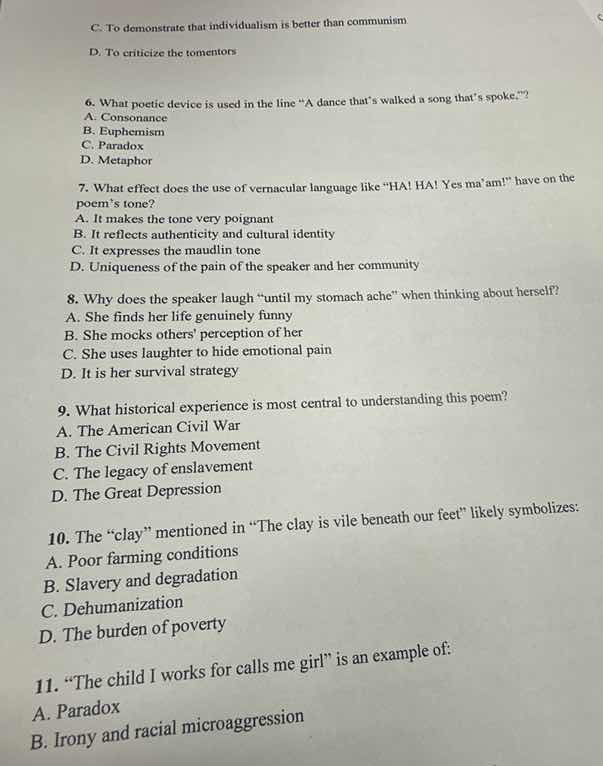
c. to demonstrate that individualism is better than communism
d. to criticize the tormentors
- what poetic device is used in the line \a dance that’s walked a song that’s spoke.\?
a. consonance
b. euphanism
c. paradox
d. metaphor
- what effect does the use of vernacular language like \ha! ha! yes ma’am\ have on the
poem’s tone?
a. it makes the tone very poignant
b. it reflects authenticity and cultural identity
c. it expresses the maudlin tone
d. uniqueness of the pain of the speaker and her community
- why does the speaker laugh \until my stomach ache\ when thinking about herself?
a. she finds her life genuinely funny
b. she mocks others’ perception of her
c. she uses laughter to hide emotional pain
d. it is her survival strategy
- what historical experience is most central to understanding this poem?
a. the american civil war
b. the civil rights movement
c. the legacy of enslavement
d. the great depression
- \the clay\ mentioned in \the clay is vile beneath our feet\ likely symbolizes:
a. poor farming conditions
b. slavery and degradation
c. dehumanization
d. the burden of poverty
- \the child i works for calls me girl\ is an example of:
a. paradox
b. irony and racial microaggression
- The line pairs two unrelated art forms (dance and song) with actions not typical to them, creating a contradictory yet meaningful statement, which is a paradox.
- Vernacular language like "HA! HA! Yes ma'am!" is everyday, regional speech that shows the speaker's real cultural background and authenticity.
- Laughing until physical pain in the context of a poem about marginalization is a common way to mask unspoken emotional hurt.
- The poem's themes of being dehumanized, forced labor, and intergenerational trauma align most closely with the legacy of enslavement of African Americans.
- "Clay" as a vile substance under the feet represents the dehumanizing, oppressive experience of being reduced to something base, tied to enslavement and degradation.
- An adult being called "girl" by someone they work for is an ironic power dynamic and a subtle racial slight (microaggression) that undermines the speaker's dignity.

Snap & solve any problem in the app
Get step-by-step solutions on Sovi AI
Photo-based solutions with guided steps
Explore more problems and detailed explanations
- C. Paradox
- B. It reflects authenticity and cultural identity
- C. She uses laughter to hide emotional pain
- C. The legacy of enslavement
- B. Slavery and degradation
- B. Irony and racial microaggression