QUESTION IMAGE
Question
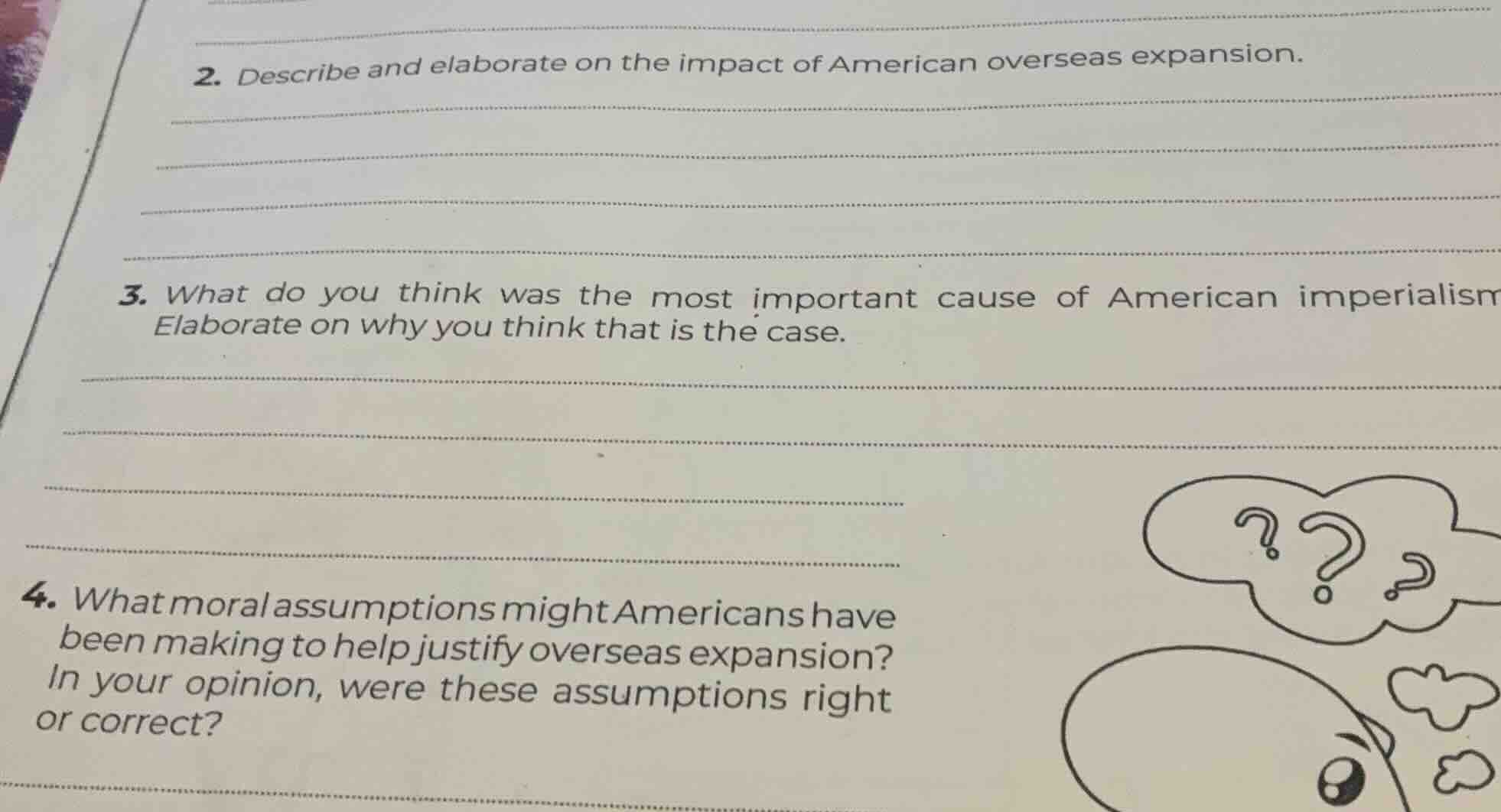
- describe and elaborate on the impact of american overseas expansion.
- what do you think was the most important cause of american imperialism? elaborate on why you think that is the case.
- what moral assumptions might americans have been making to help justify overseas expansion? in your opinion, were these assumptions right or correct?
Response
Question 2: Describe and elaborate on the impact of American overseas expansion.
Brief Explanations
American overseas expansion (imperialism) had multifaceted impacts:
- Economic: Opened new markets (e.g., sugar in Hawaii, trade in Asia) and access to raw materials (e.g., Philippines’ resources). U.S. businesses expanded globally, boosting exports and investment.
- Political: Established U.S. as a global power, with territories (e.g., Puerto Rico, Guam) and naval bases (e.g., Hawaii, Philippines) projecting influence. It shifted U.S. from regional to global politics, involved in international conflicts (e.g., Spanish - American War).
- Cultural/Social: Imposed American values, education, and systems on territories, often disrupting local cultures. Led to cultural exchange but also cultural imperialism (e.g., English language spread, American - style governance in colonies).
- Global Relations: Sparked tensions with European powers (competing for colonies) and anti - imperialist movements in colonized regions (e.g., Philippine - American War, Hawaiian resistance).
Brief Explanations
A key cause was economic motivation (competition for markets/raw materials):
- Post - Civil War industrial growth created surplus goods (e.g., manufactured products) and needed new markets. Overseas colonies (e.g., Philippines, Hawaii) offered captive markets for U.S. goods.
- Access to raw materials (e.g., sugar, minerals) in colonies fueled industrial production. For example, Hawaii’s sugar plantations supplied U.S. markets, and Philippine resources supported manufacturing.
- Naval expansion (e.g., Mahan’s “The Influence of Sea Power upon History”) aimed to protect trade routes, linking economic goals to imperialist expansion (e.g., building a canal in Panama to secure Pacific - Atlantic trade). Other causes (e.g., cultural “manifest destiny,” strategic security) were secondary; economic needs drove the scale and urgency of imperialism, as businesses and government aligned to secure economic dominance.
Brief Explanations
Moral assumptions included:
- “White Man’s Burden” (Cultural Superiority): Belief that Americans (as “civilized” whites) had a duty to “uplift” “lesser” cultures (e.g., teaching Western values, governance to Filipinos/Hawaiians).
- Manifest Destiny (Divine Mission): Extended the idea of spreading American “liberty”/“democracy” globally, seeing expansion as God - ordained to civilize the world.
- Racial Hierarchy: Viewed non - white, non - Western peoples as inferior, justifying domination (e.g., Hawaiian monarchy seen as “backward,” needing U.S. “guidance”).
These assumptions were incorrect:
- “Cultural superiority” ignored the richness and validity of local cultures (e.g., Hawaiian culture, Philippine traditions).
- “Manifest Destiny” imposed American systems forcefully, violating self - determination (e.g., Philippine independence aspirations crushed).
- Racial hierarchy was a baseless, discriminatory ideology that dehumanized colonized peoples.

Snap & solve any problem in the app
Get step-by-step solutions on Sovi AI
Photo-based solutions with guided steps
Explore more problems and detailed explanations
The impact of American overseas expansion was far - reaching:
- Economic: Created new markets and resource access, boosting U.S. trade and business growth.
- Political: Elevated U.S. to global power status via territorial control and military bases.
- Cultural: Imposed American norms while enabling cultural exchange, yet disrupted local cultures.
- Global Relations: Sparked great - power tensions and anti - imperialist resistance.