QUESTION IMAGE
Question
describe the end behavior and the per
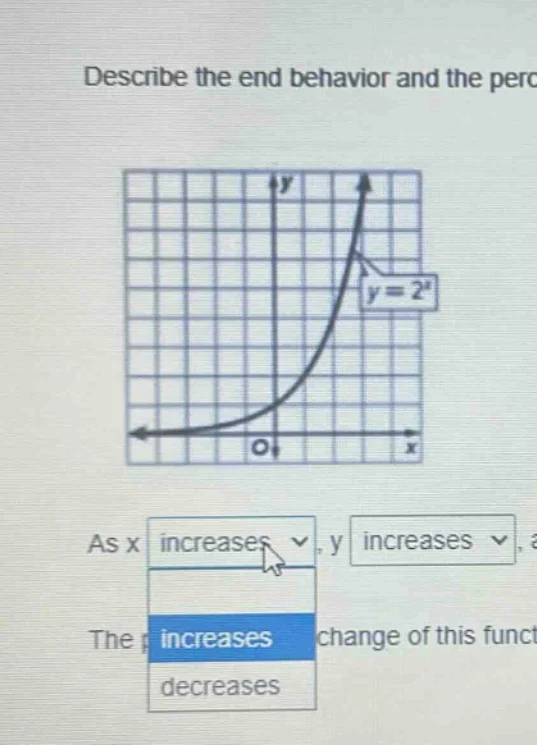
as x increases , y increases ,
the change of this funct
Step1: Analyze end behavior as \( x \to +\infty \)
For the function \( y = 2^x \), as \( x \) increases (moves towards positive infinity), we evaluate the limit \( \lim_{x \to +\infty} 2^x \). Since the base \( 2>1 \), exponential functions with base \( >1 \) grow without bound as \( x \to +\infty \), so \( y \) increases.
Step2: Analyze end behavior as \( x \to -\infty \)
As \( x \) decreases (moves towards negative infinity), we evaluate \( \lim_{x \to -\infty} 2^x=\lim_{x \to -\infty}\frac{1}{2^{|x|}} \). As \( |x| \) becomes large, \( 2^{|x|} \) becomes large, so \( \frac{1}{2^{|x|}} \) approaches 0. So as \( x \) decreases (goes to \( -\infty \)), \( y \) approaches 0 (decreases towards 0). But from the given dropdown, when \( x \) increases, \( y \) increases. Also, for the percent change (or rate of change) of exponential functions \( y = a^x \) (\( a>0,a
eq1 \)), the percent change is constant in terms of relative growth, but since the function is increasing as \( x \) increases (for \( a > 1 \)), the absolute change and the function value both increase as \( x \) increases.

Snap & solve any problem in the app
Get step-by-step solutions on Sovi AI
Photo-based solutions with guided steps
Explore more problems and detailed explanations
As \( x \) increases, \( y \) increases. The function \( y = 2^x \) (an exponential function with base \( 2>1 \)) has the end - behavior that as \( x\to+\infty \), \( y\to+\infty \) (so \( y \) increases as \( x \) increases) and as \( x\to-\infty \), \( y\to0 \) (so \( y \) approaches 0 as \( x \) decreases). For the behavior as \( x \) increases, the correct choice for the relationship between \( x \) increasing and \( y \) is that \( y \) increases.