QUESTION IMAGE
Question
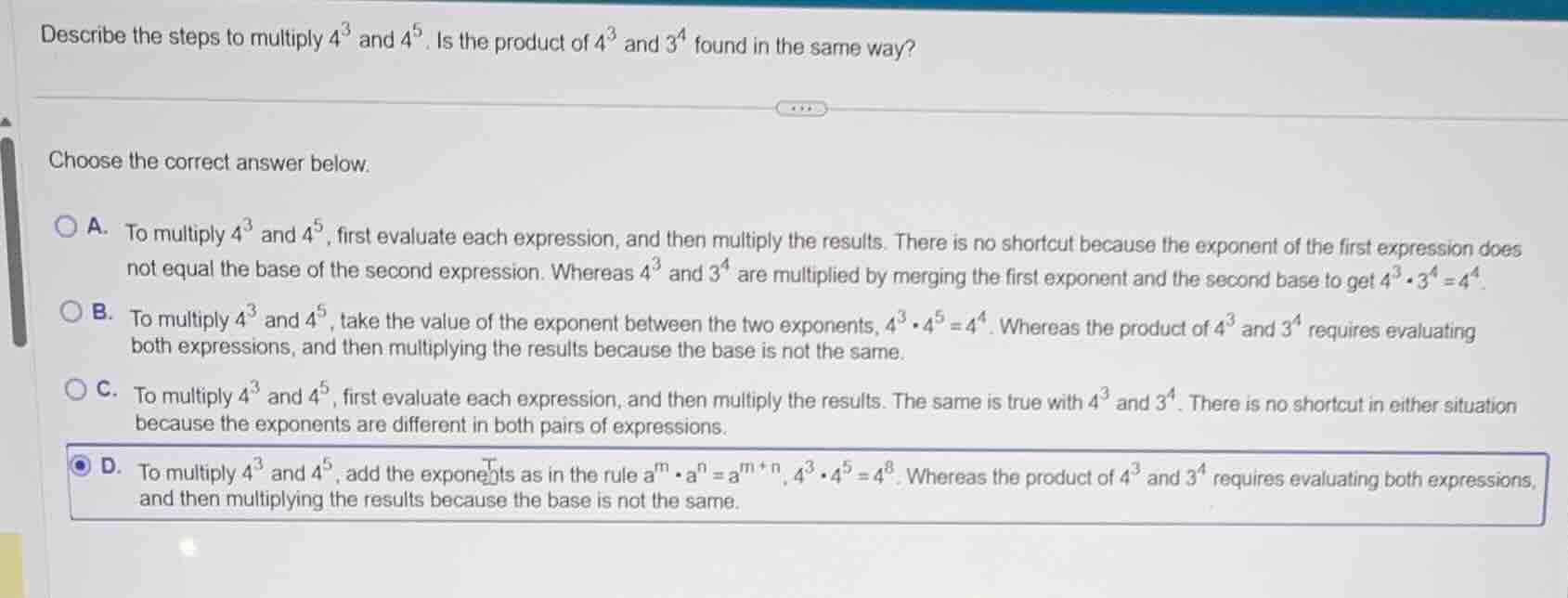
describe the steps to multiply $4^3$ and $4^5$. is the product of $4^3$ and $3^4$ found in the same way?
choose the correct answer below.
a. to multiply $4^3$ and $4^5$, first evaluate each expression, and then multiply the results. there is no shortcut because the exponent of the first expression does not equal the base of the second expression. whereas $4^3$ and $3^4$ are multiplied by merging the first exponent and the second base to get $4^3\cdot 3^4 = 4^4$.
b. to multiply $4^3$ and $4^5$, take the value of the exponent between the two exponents, $4^3\cdot 4^5 = 4^4$. whereas the product of $4^3$ and $3^4$ requires evaluating both expressions, and then multiplying the results because the base is not the same.
c. to multiply $4^3$ and $4^5$, first evaluate each expression, and then multiply the results. the same is true with $4^3$ and $3^4$. there is no shortcut in either situation because the exponents are different in both pairs of expressions.
d. to multiply $4^3$ and $4^5$, add the exponents as in the rule $a^m\cdot a^n = a^{m + n}$, $4^3\cdot 4^5 = 4^8$. whereas the product of $4^3$ and $3^4$ requires evaluating both expressions, and then multiplying the results because the base is not the same.
To multiply \(4^3\) and \(4^5\), we use the exponent rule for multiplying powers with the same base: \(a^m \cdot a^n = a^{m + n}\). So \(4^3 \cdot 4^5 = 4^{3+5}=4^8\). For \(4^3\) and \(3^4\), since the bases (4 and 3) are different, we can't use this exponent rule. We need to evaluate each expression (\(4^3 = 64\), \(3^4 = 81\)) and then multiply the results (\(64\times81\)). Option D correctly describes this: using the exponent rule for same - base powers for \(4^3\) and \(4^5\), and evaluating then multiplying for \(4^3\) and \(3^4\) because of different bases. Option A is wrong as there is a shortcut (the exponent rule) for same - base powers. Option B has an incorrect rule for multiplying \(4^3\) and \(4^5\). Option C is wrong as there is a shortcut for same - base powers.

Snap & solve any problem in the app
Get step-by-step solutions on Sovi AI
Photo-based solutions with guided steps
Explore more problems and detailed explanations
D. To multiply \(4^{3}\) and \(4^{5}\), add the exponents as in the rule \(a^{m}\cdot a^{n}=a^{m + n}\), \(4^{3}\cdot4^{5}=4^{8}\). Whereas the product of \(4^{3}\) and \(3^{4}\) requires evaluating both expressions, and then multiplying the results because the base is not the same.