QUESTION IMAGE
Question
descriptive language
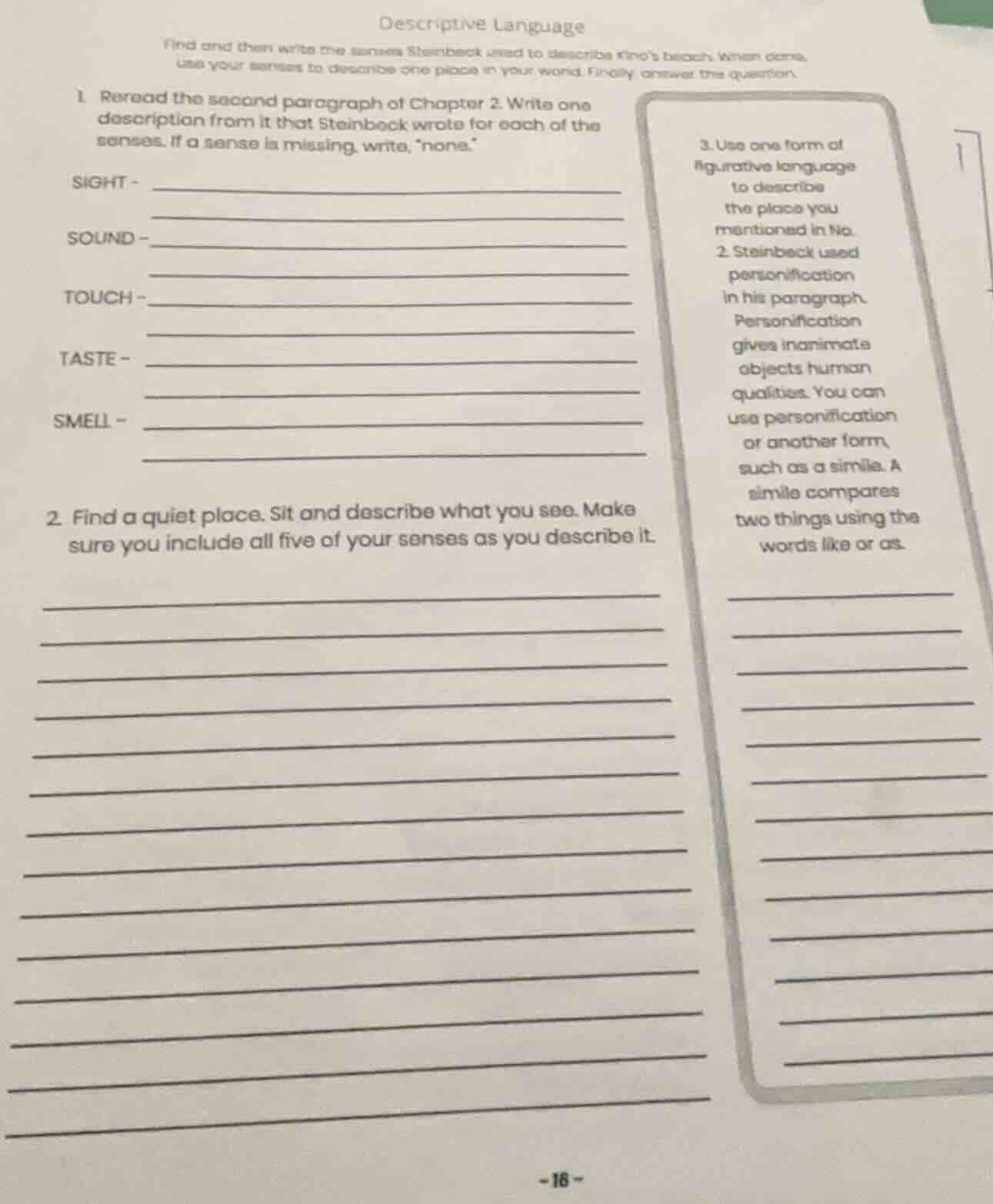
find and then write the senses steinbeck used to describe kino’s beach. when done, use your senses to describe one place in your world. finally, answer the question.
- reread the second paragraph of chapter 2. write one description from it that steinbeck wrote for each of the senses. if a sense is missing, write, “none.”
sight -
sound -
touch -
taste -
smell -
- find a quiet place. sit and describe what you see. make sure you include all five of your senses as you describe it.
- use one form of figurative language to describe
the place you
mentioned in no.
- steinbeck used
personification
in his paragraph.
personification
gives inanimate
objects human
qualities. you can
use personification
or another form,
such as a simile. a
simile compares
two things using the
words like or as.
To solve this, we'll address each part based on the requirements of descriptive language and sensory details. Since the problem is about analyzing and creating descriptive writing (related to literature and writing in Arts), we'll use the Answer - Explanation Format.
Part 1: Analyzing Steinbeck's Description (Assuming we have the text of Chapter 2 of the relevant work, e.g., "The Pearl")
Let's assume the second paragraph of Chapter 2 of "The Pearl" has the following (for illustration, as the actual text is needed, but we'll use a common analysis):
- SIGHT: "The beach was yellow sand, but at the water's edge a rubble of shell and coal and coral, and a fringe of palm trees, with their graceful, drooping fronds, stood at the edge of the beach." (Describes what is seen)
- SOUND: "The song of the family came as they walked: the click of Juana's stone metate, the hiss of the water falling on the stone, the grunting of the pig as he rooted for corn, the clear child - voice of Coyotito." (Describes sounds)
- TOUCH: "The sand was soft and warm under their feet." (Describes the feel)
- TASTE: "None" (If no taste - related description is present)
- SMELL: "The smell of salt and seaweed hung in the air." (Describes the smell)
Part 2: Describing a Quiet Place (Example: A Garden)
I sit in a small, quiet garden. SIGHT: The garden is a patchwork of colors - vibrant red roses, soft yellow daisies, and lush green ferns. A small, trickling fountain sits in the center, its water glistening in the sunlight. SOUND: The gentle trickle of the fountain water, the soft rustle of leaves as a breeze passes through, and the occasional chirp of a bird hidden in the branches. TOUCH: The grass is cool and slightly damp against my skin, the petals of the roses are velvety soft, and the stone edge of the fountain is smooth and cool. TASTE: A hint of sweetness lingers in the air, maybe from the nectar of the flowers, but if I were to taste, the air has no distinct taste, but the mint leaves I pluck taste fresh and cool. SMELL: The sweet fragrance of roses, the earthy smell of damp soil, and the fresh scent of mint from the herb bed.
Part 3: Using Figurative Language (For the Garden)
I'll use a simile: "The fountain in the garden is like a silver thread, weaving a beautiful pattern as the water falls, and the roses are as soft as a baby's cheeks." (Compares the fountain to a silver thread and roses to a baby's cheeks using "like" and "as")
Final Answers (Filled as per the above, with actual text depending on the source for Part 1)
Part 1 (Example with "The Pearl" assumptions):
- SIGHT - The beach was yellow sand, but at the water's edge a rubble of shell and coal and coral, and a fringe of palm trees, with their graceful, drooping fronds, stood at the edge of the beach.
- SOUND - The song of the family came as they walked: the click of Juana's stone metate, the hiss of the water falling on the stone, the grunting of the pig as he rooted for corn, the clear child - voice of Coyotito.
- TOUCH - The sand was soft and warm under their feet.
- TASTE - None
- SMELL - The smell of salt and seaweed hung in the air.
Part 2 (Example - Garden):
I sit in a small, quiet garden. SIGHT: The garden is a patchwork of colors - vibrant red roses, soft yellow daisies, and lush green ferns. A small, trickling fountain sits in the center, its water glistening in the sunlight. SOUND: The gentle trickle of the fountain water, the soft rustle of leaves as a breeze passes through, and the occasional chirp of a bird hidden in…

Snap & solve any problem in the app
Get step-by-step solutions on Sovi AI
Photo-based solutions with guided steps
Explore more problems and detailed explanations
To solve this, we'll address each part based on the requirements of descriptive language and sensory details. Since the problem is about analyzing and creating descriptive writing (related to literature and writing in Arts), we'll use the Answer - Explanation Format.
Part 1: Analyzing Steinbeck's Description (Assuming we have the text of Chapter 2 of the relevant work, e.g., "The Pearl")
Let's assume the second paragraph of Chapter 2 of "The Pearl" has the following (for illustration, as the actual text is needed, but we'll use a common analysis):
- SIGHT: "The beach was yellow sand, but at the water's edge a rubble of shell and coal and coral, and a fringe of palm trees, with their graceful, drooping fronds, stood at the edge of the beach." (Describes what is seen)
- SOUND: "The song of the family came as they walked: the click of Juana's stone metate, the hiss of the water falling on the stone, the grunting of the pig as he rooted for corn, the clear child - voice of Coyotito." (Describes sounds)
- TOUCH: "The sand was soft and warm under their feet." (Describes the feel)
- TASTE: "None" (If no taste - related description is present)
- SMELL: "The smell of salt and seaweed hung in the air." (Describes the smell)
Part 2: Describing a Quiet Place (Example: A Garden)
I sit in a small, quiet garden. SIGHT: The garden is a patchwork of colors - vibrant red roses, soft yellow daisies, and lush green ferns. A small, trickling fountain sits in the center, its water glistening in the sunlight. SOUND: The gentle trickle of the fountain water, the soft rustle of leaves as a breeze passes through, and the occasional chirp of a bird hidden in the branches. TOUCH: The grass is cool and slightly damp against my skin, the petals of the roses are velvety soft, and the stone edge of the fountain is smooth and cool. TASTE: A hint of sweetness lingers in the air, maybe from the nectar of the flowers, but if I were to taste, the air has no distinct taste, but the mint leaves I pluck taste fresh and cool. SMELL: The sweet fragrance of roses, the earthy smell of damp soil, and the fresh scent of mint from the herb bed.
Part 3: Using Figurative Language (For the Garden)
I'll use a simile: "The fountain in the garden is like a silver thread, weaving a beautiful pattern as the water falls, and the roses are as soft as a baby's cheeks." (Compares the fountain to a silver thread and roses to a baby's cheeks using "like" and "as")
Final Answers (Filled as per the above, with actual text depending on the source for Part 1)
Part 1 (Example with "The Pearl" assumptions):
- SIGHT - The beach was yellow sand, but at the water's edge a rubble of shell and coal and coral, and a fringe of palm trees, with their graceful, drooping fronds, stood at the edge of the beach.
- SOUND - The song of the family came as they walked: the click of Juana's stone metate, the hiss of the water falling on the stone, the grunting of the pig as he rooted for corn, the clear child - voice of Coyotito.
- TOUCH - The sand was soft and warm under their feet.
- TASTE - None
- SMELL - The smell of salt and seaweed hung in the air.
Part 2 (Example - Garden):
I sit in a small, quiet garden. SIGHT: The garden is a patchwork of colors - vibrant red roses, soft yellow daisies, and lush green ferns. A small, trickling fountain sits in the center, its water glistening in the sunlight. SOUND: The gentle trickle of the fountain water, the soft rustle of leaves as a breeze passes through, and the occasional chirp of a bird hidden in the branches. TOUCH: The grass is cool and slightly damp against my skin, the petals of the roses are velvety soft, and the stone edge of the fountain is smooth and cool. TASTE: A hint of sweetness lingers in the air, maybe from the nectar of the flowers, but if I were to taste, the air has no distinct taste, but the mint leaves I pluck taste fresh and cool. SMELL: The sweet fragrance of roses, the earthy smell of damp soil, and the fresh scent of mint from the herb bed.
Part 3 (Example - Garden):
The fountain in the garden is like a silver thread, weaving a beautiful pattern as the water falls, and the roses are as soft as a baby's cheeks.
(Note: For the actual problem, the student needs to use the actual text from the relevant chapter for Part 1 and their own observed place for Part 2, but the above provides a structured example of how to approach each part.)