QUESTION IMAGE
Question
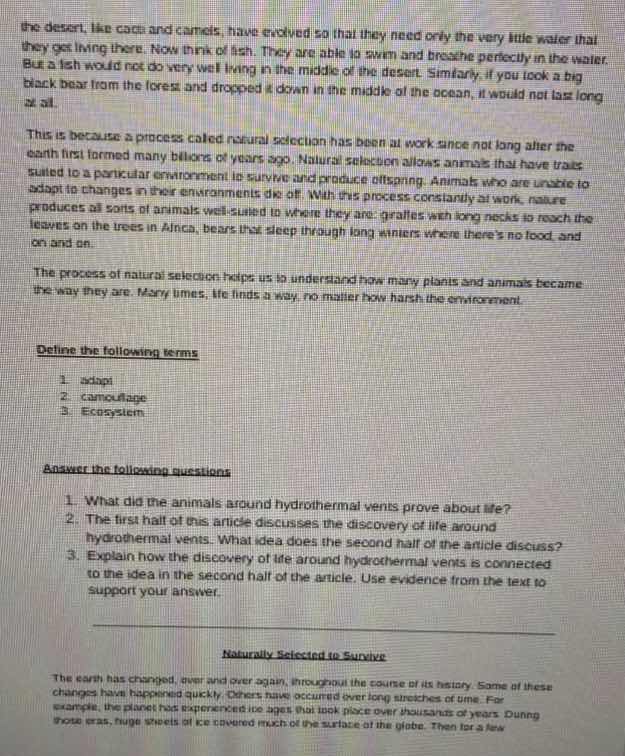
the desert, like cats and camels, have evolved so that they need only the very little water that they get living there. now think of fish. they are able to swim and breathe perfectly in the water. but a fish would not do very well living in the middle of the desert. similarly, if you took a big black bear from the forest and dropped it down in the middle of the ocean, it would not last long at all.this is because a process called natural selection has been at work since not long after the earth first formed many billions of years ago. natural selection allows animals that have traits suited to a particular environment to survive and produce offspring. animals who are unable to adapt to changes in their environments die off. with this process constantly at work, nature produces all sorts of animals well-suited to where they are: giraffes with long necks to reach the leaves on the trees in africa, bears that sleep through long winters where theres no food, and on and on.the process of natural selection helps us to understand how many plants and animals became the way they are. many times, life finds a way, no matter how harsh the environment.define the following terms1. adapt2. camouflage3. ecosystemanswer the following questions1. what did the animals around hydrothermal vents prove about life?2. the first half of this article discusses the discovery of life around hydrothermal vents. what idea does the second half of the article discuss?3. explain how the discovery of life around hydrothermal vents is connected to the idea in the second half of the article. use evidence from the text to support your answer.naturally selected to survivethe earth has changed, ever and again, throughout the course of its history. some of these changes have happened quickly. others have occurred over long stretches of time. for example, the planet has experienced ice ages that took place over thousands of years. during those eras, huge sheets of ice covered much of the surface of the globe. then for a few
Term Definitions:
- adapt: Refers to the process where organisms develop traits that help them survive and reproduce in their specific environment over time.
- camouflage: A trait or adaptation that allows an organism to blend in with its surroundings, helping it avoid predators or hunt prey more effectively.
- Ecosystem: A community of living organisms (plants, animals, microbes) interacting with each other and their non-living physical environment (air, water, soil) as a single functional unit.
Question Answers:
- The text does not provide information about hydrothermal vents, so this cannot be answered with the given content.
- The first half of the provided text uses examples of desert animals, fish, and forest birds to introduce the concept of organisms being suited to their environments. The second half explicitly discusses the process of natural selection, how it drives these adaptations, and its role in shaping species over time.
- The provided text does not mention hydrothermal vents at all, so no connection can be established between their associated life discovery and the natural selection concept in the text.

Snap & solve any problem in the app
Get step-by-step solutions on Sovi AI
Photo-based solutions with guided steps
Explore more problems and detailed explanations
Term Definitions:
- adapt: Develop environment-suited survival traits
- camouflage: Blend into surroundings for survival
- Ecosystem: Interacting living + non-living environmental community
Question Answers:
- No information provided in the text to answer this.
- The second half discusses natural selection, the process that causes organisms to be suited to their environments.
- No information about hydrothermal vents is present in the text, so no connection can be made.