QUESTION IMAGE
Question
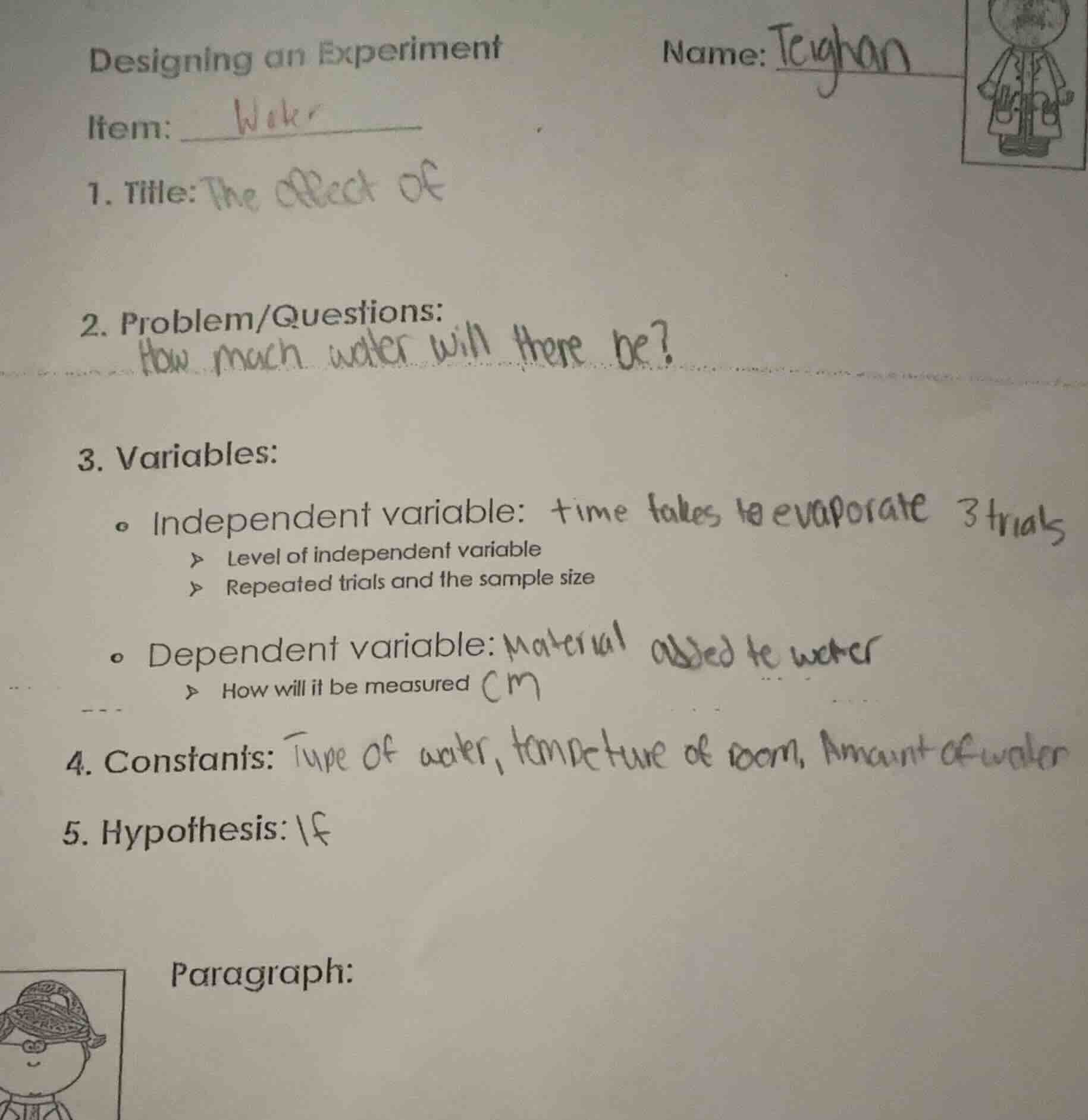
designing an experiment
name: teighan
item: water
- title: the affect of
- problem/questions: how much water will there be?
- variables:
- independent variable: time takes to evaporate 3 trials
- level of independent variable
- repeated trials and the sample size
- dependent variable: material added to water
- how will it be measured cm
- constants: type of water, temperature of room, amount of water
- hypothesis: if
paragraph:
Brief Explanations
This is a science experiment design focused on water evaporation. First, we refine the incomplete sections to align with proper experimental structure:
- The title should clearly link the independent and dependent variables.
- The problem question should be specific to the experiment's focus.
- Correct variable assignments: the independent variable is what we change, dependent is what we measure.
- The hypothesis uses an if-then structure to predict the outcome.
- The paragraph summarizes the experiment's purpose and plan.

Snap & solve any problem in the app
Get step-by-step solutions on Sovi AI
Photo-based solutions with guided steps
Explore more problems and detailed explanations
- Title: The Effect of Evaporation Time on Remaining Water Volume
- Problem/Questions: How does the length of evaporation time affect the volume of remaining water?
- Variables:
- Independent variable: Evaporation time (levels: 1 hour, 3 hours, 6 hours; repeated trials: 3 trials per time level, sample size = 3)
- Dependent variable: Volume of remaining water (measured in milliliters (mL) using a graduated cylinder)
- Hypothesis: If evaporation time increases, then the volume of remaining water will decrease, because longer exposure allows more water molecules to escape into the air.
- Paragraph: This experiment will test how evaporation time impacts the amount of water left. We will start with the same type and volume of water in identical containers, kept at a constant room temperature. We will let the water evaporate for 1, 3, and 6 hour intervals, repeating each interval 3 times. After each interval, we will measure the remaining water volume. We predict that as the evaporation time gets longer, less water will remain in the containers.