QUESTION IMAGE
Question
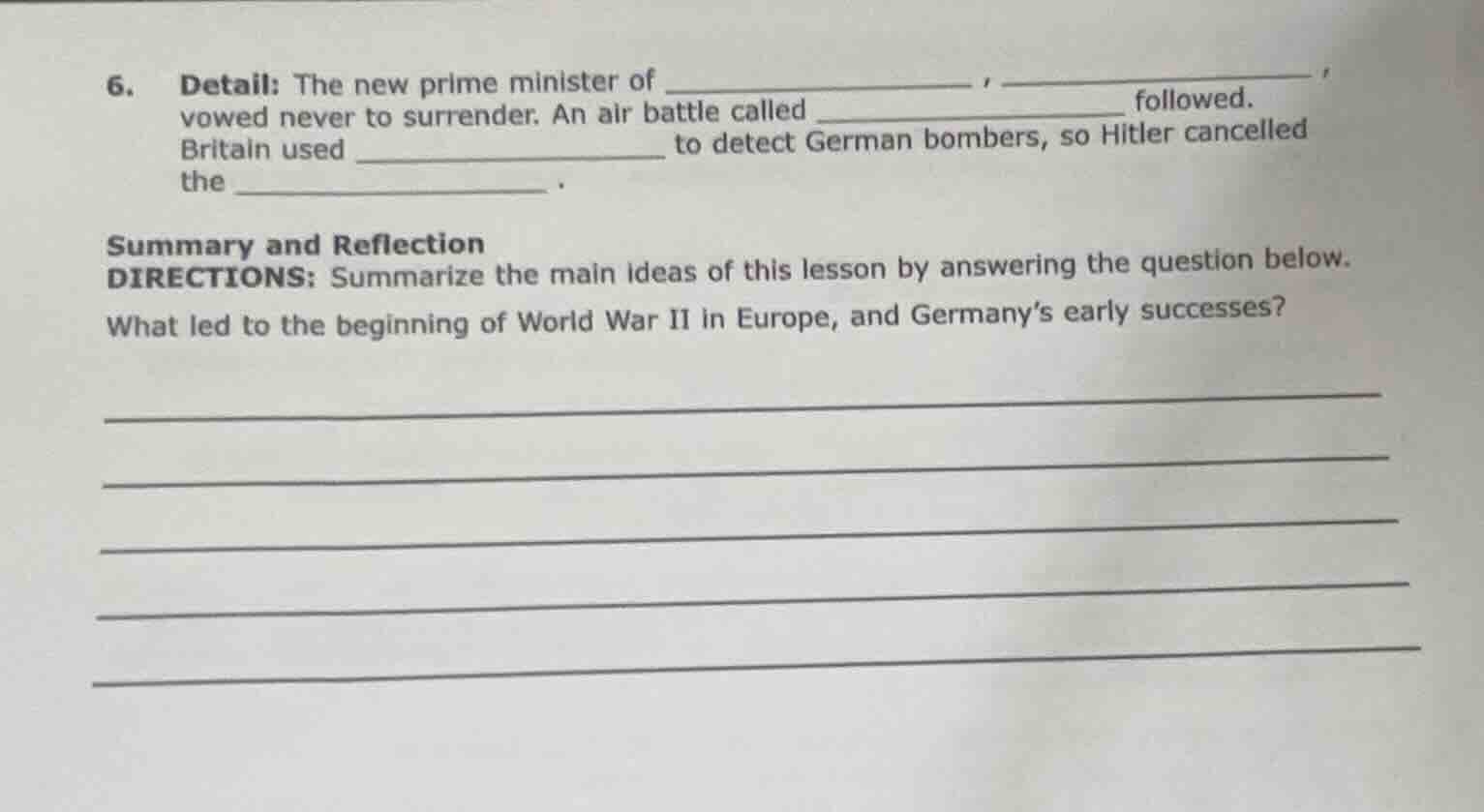
- detail: the new prime minister of _____________, ___________, vowed never to surrender. an air battle called ___________ followed. britain used ___________ to detect german bombers, so hitler cancelled the _____________ .
summary and reflection
directions: summarize the main ideas of this lesson by answering the question below.
what led to the beginning of world war ii in europe, and germanys early successes?
First, fill in the detail blanks with key WWII Britain-related facts. For the summary, outline the core causes of WWII in Europe and Germany's early strategic advantages.
For the detail section: The UK's prime minister during the Battle of Britain was Winston Churchill, who refused surrender. The air battle was the Battle of Britain, Britain used radar to detect bombers, and Hitler cancelled Operation Sea Lion (the planned invasion of Britain).
For the summary: WWII in Europe began due to Nazi Germany's expansionist policies (Anschluss, invasion of Czechoslovakia, then Poland in 1939), failure of appeasement by Western powers, and the Molotov-Ribbentrop Pact. Germany's early successes came from the blitzkrieg (lightning war) tactic, superior air and armor coordination, and unpreparedness of Allied forces.

Snap & solve any problem in the app
Get step-by-step solutions on Sovi AI
Photo-based solutions with guided steps
Explore more problems and detailed explanations
Detail Section:
The new prime minister of Great Britain (the United Kingdom), Winston Churchill, vowed never to surrender. An air battle called the Battle of Britain followed.
Britain used radar to detect German bombers, so Hitler cancelled the Operation Sea Lion.
Summary and Reflection:
World War II in Europe began primarily because of Nazi Germany's aggressive territorial expansion: starting with the annexation of Austria (Anschluss), the takeover of Czechoslovakia, and the 1939 invasion of Poland, which prompted Britain and France to declare war. Additionally, the policy of appeasement by Western powers allowed Hitler to grow his military and ambitions without early pushback, and the Molotov-Ribbentrop Pact gave Germany a free hand to invade Poland without fear of Soviet intervention.
Germany's early successes stemmed from its innovative blitzkrieg (lightning war) tactic, which combined fast-moving armored divisions, close air support, and rapid infantry advances to overwhelm enemy forces quickly. Many Allied nations were militarily unprepared and lacked coordinated defenses against this new warfare style, allowing Germany to conquer most of Western Europe by 1940.