QUESTION IMAGE
Question
details
no additional details were added for this assignment.
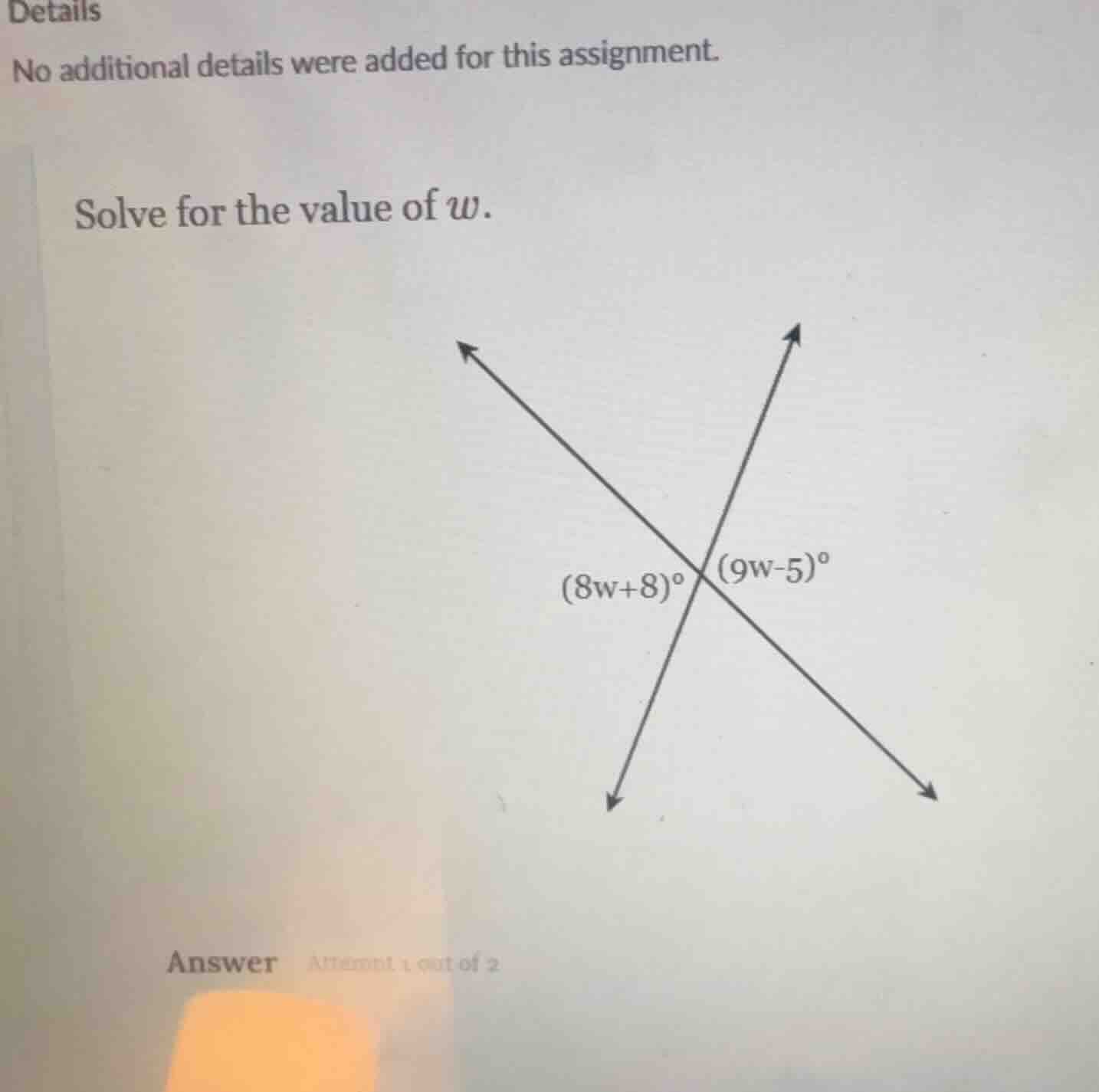
solve for the value of w.
(8w+8)° (9w-5)°
answer attempt 1 out of 2
Step1: Identify the relationship
The two angles \((8w + 8)^\circ\) and \((9w - 5)^\circ\) are adjacent and form a linear pair? Wait, no, actually, when two lines intersect, vertical angles are equal? Wait, no, looking at the diagram, these two angles are adjacent and form a linear pair? Wait, no, actually, if you look at the intersection of two lines, the adjacent angles that are supplementary? Wait, no, wait, the two angles \((8w + 8)^\circ\) and \((9w - 5)^\circ\) are actually vertical angles? Wait, no, no, when two lines intersect, vertical angles are equal. Wait, but in this case, maybe they are supplementary? Wait, no, let's check. Wait, the two angles given are adjacent and form a linear pair? Wait, no, actually, when two lines intersect, the sum of adjacent angles is \(180^\circ\), but if they are vertical angles, they are equal. Wait, looking at the diagram, the two angles \((8w + 8)^\circ\) and \((9w - 5)^\circ\) are adjacent and form a linear pair? Wait, no, maybe they are equal? Wait, no, let's think again. Wait, when two lines intersect, vertical angles are equal. Wait, but in this case, maybe the two angles are supplementary? Wait, no, let's check the problem again. Wait, the diagram shows two intersecting lines, and the two angles \((8w + 8)^\circ\) and \((9w - 5)^\circ\) are adjacent and form a linear pair? Wait, no, actually, if you look at the angles, they are adjacent and form a linear pair, so their sum is \(180^\circ\)? Wait, no, wait, maybe they are equal? Wait, no, let's see. Wait, maybe I made a mistake. Wait, the two angles are adjacent and form a linear pair, so \( (8w + 8) + (9w - 5) = 180 \)? Wait, no, that can't be. Wait, no, actually, when two lines intersect, the vertical angles are equal. Wait, maybe the two angles are vertical angles? Wait, no, the diagram shows two intersecting lines, and the two angles \((8w + 8)^\circ\) and \((9w - 5)^\circ\) are adjacent and form a linear pair? Wait, no, maybe they are equal. Wait, let's check the problem again. Wait, the problem says "Solve for the value of \( w \)". Let's assume that the two angles are equal (vertical angles). Wait, but let's check: if \( 8w + 8 = 9w - 5 \), then solving for \( w \):
Step2: Set the equation
Assuming the two angles are equal (vertical angles), so:
\( 8w + 8 = 9w - 5 \)
Step3: Solve for \( w \)
Subtract \( 8w \) from both sides:
\( 8 = w - 5 \)
Add 5 to both sides:
\( w = 13 \)
Wait, let's check. If \( w = 13 \), then \( 8w + 8 = 8*13 + 8 = 104 + 8 = 112 \), and \( 9w - 5 = 9*13 - 5 = 117 - 5 = 112 \). Oh, so they are equal. So the two angles are vertical angles, so they are equal. So the equation is \( 8w + 8 = 9w - 5 \).
Step1: Set the equation (correct)
Since the two angles are vertical angles (opposite angles formed by intersecting lines), they are equal. So:
\( 8w + 8 = 9w - 5 \)
Step2: Solve for \( w \)
Subtract \( 8w \) from both sides:
\( 8 = w - 5 \)
Add 5 to both sides:
\( w = 13 \)

Snap & solve any problem in the app
Get step-by-step solutions on Sovi AI
Photo-based solutions with guided steps
Explore more problems and detailed explanations
\( \boxed{13} \)