QUESTION IMAGE
Question
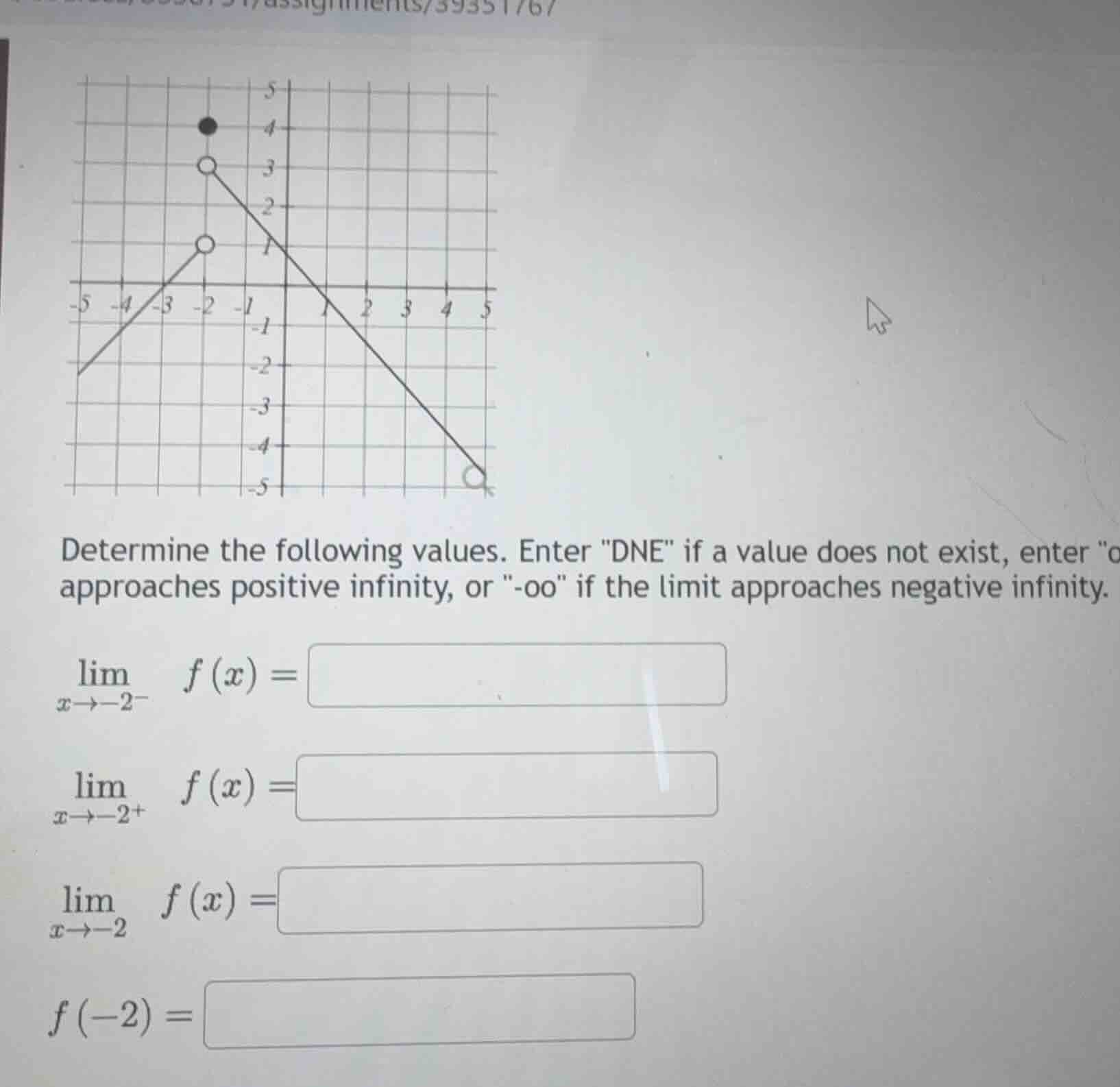
determine the following values. enter \dne\ if a value does not exist, enter \ approaches positive infinity, or \-oo\ if the limit approaches negative infinity. \\(\lim\limits_{x\to -2^{-}} f(x) = \\) \\(\lim\limits_{x\to -2^{+}} f(x) =\\) \\(\lim\limits_{x\to -2} f(x) =\\) \\(f(-2) = \\)
Step1: Find left limit at $x=-2$
Observe the graph as $x$ approaches $-2$ from values less than $-2$: the line approaches $1$.
$\lim_{x \to -2^-} f(x) = 1$
Step2: Find right limit at $x=-2$
Observe the graph as $x$ approaches $-2$ from values greater than $-2$: the line approaches $3$.
$\lim_{x \to -2^+} f(x) = 3$
Step3: Check overall limit at $x=-2$
For the overall limit to exist, left and right limits must be equal. Since $1
eq 3$, the limit does not exist.
$\lim_{x \to -2} f(x) = \text{DNE}$
Step4: Find $f(-2)$
Observe the filled dot at $x=-2$: its $y$-value is $4$.
$f(-2) = 4$

Snap & solve any problem in the app
Get step-by-step solutions on Sovi AI
Photo-based solutions with guided steps
Explore more problems and detailed explanations
$\lim_{x \to -2^-} f(x) = 1$
$\lim_{x \to -2^+} f(x) = 3$
$\lim_{x \to -2} f(x) = \text{DNE}$
$f(-2) = 4$