QUESTION IMAGE
Question
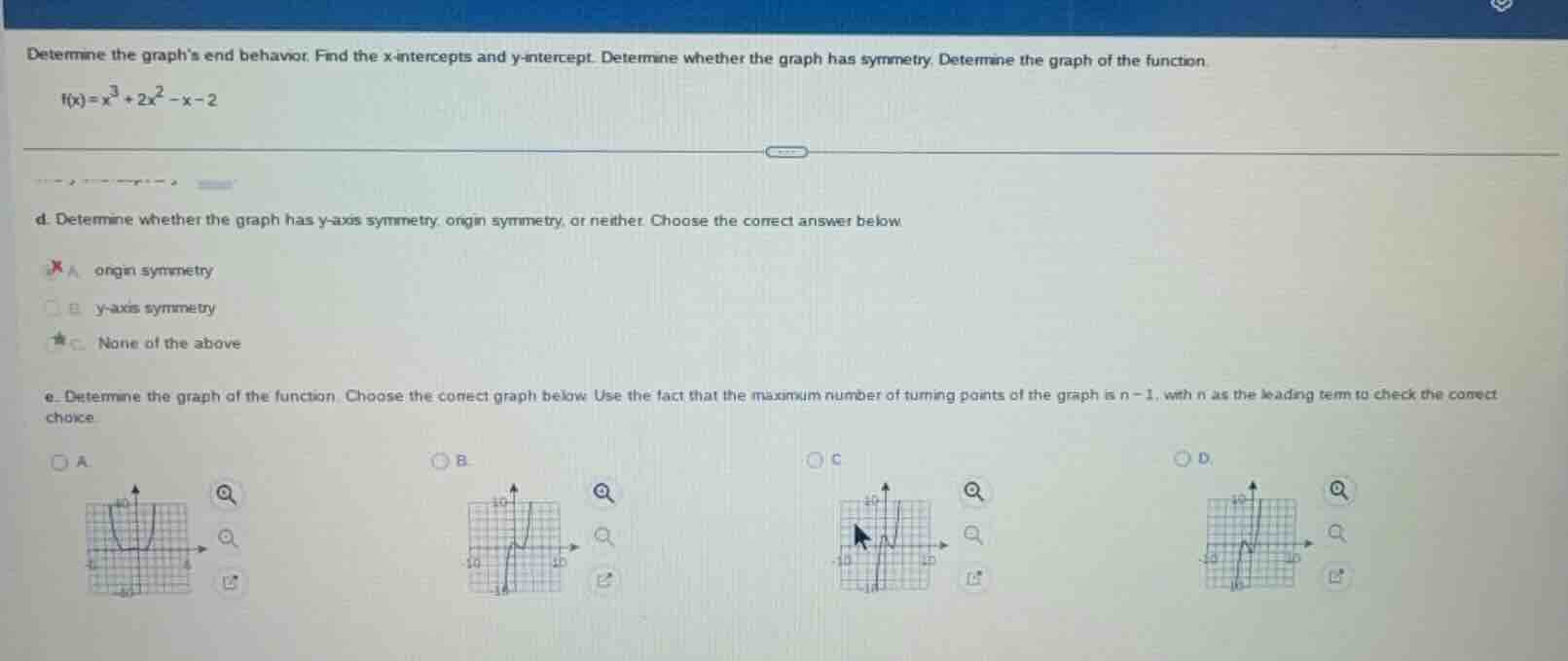
determine the graphs end behavior. find the x-intercepts and y-intercept. determine whether the graph has symmetry. determine the graph of the function.
$f(x)=x^3 + 2x^2 - x - 2$
d. determine whether the graph has y-axis symmetry, origin symmetry, or neither. choose the correct answer below
a origin symmetry
b y-axis symmetry
c none of the above
e. determine the graph of the function. choose the correct graph below. use the fact that the maximum number of turning points of the graph is $n - 1$, with $n$ as the leading term to check the correct choice.
a.
graph
b.
graph
c.
graph
d.
graph
Part d:
To check for y - axis symmetry, we substitute \(x\) with \(-x\) in the function \(f(x)=x^{3}+2x^{2}-x - 2\) and see if \(f(-x)=f(x)\).
\(f(-x)=(-x)^{3}+2(-x)^{2}-(-x)-2=-x^{3}+2x^{2}+x - 2\), which is not equal to \(f(x)=x^{3}+2x^{2}-x - 2\), so no y - axis symmetry.
To check for origin symmetry, we substitute \(x\) with \(-x\) and see if \(f(-x)=-f(x)\).
\(-f(x)=-x^{3}-2x^{2}+x + 2\), and \(f(-x)=-x^{3}+2x^{2}+x - 2\), which is not equal to \(-f(x)\), so no origin symmetry. Thus, the graph has neither.
The function \(f(x)=x^{3}+2x^{2}-x - 2\) has degree 3, so the graph should have at most 2 turning points. The y - intercept is \((0, - 2)\) and x - intercepts at \(x=-2,x=-1,x = 1\). The end - behavior (as \(x
ightarrow\infty\), \(f(x)
ightarrow\infty\); as \(x
ightarrow-\infty\), \(f(x)
ightarrow-\infty\)) and the intercepts match Graph B.

Snap & solve any problem in the app
Get step-by-step solutions on Sovi AI
Photo-based solutions with guided steps
Explore more problems and detailed explanations
C. None of the above
Part e:
First, find the degree of the function \(f(x)=x^{3}+2x^{2}-x - 2\). The degree \(n = 3\) (the highest power of \(x\)). The maximum number of turning points is \(n - 1=3 - 1 = 2\).
The y - intercept: when \(x = 0\), \(f(0)=0^{3}+2(0)^{2}-0 - 2=-2\), so the y - intercept is \((0,-2)\).
The x - intercepts: solve \(x^{3}+2x^{2}-x - 2 = 0\). Factor by grouping: \(x^{2}(x + 2)-1(x + 2)=(x^{2}-1)(x + 2)=(x - 1)(x + 1)(x + 2)=0\). So the x - intercepts are \(x=-2,x=-1,x = 1\).
The leading term is \(x^{3}\), so as \(x
ightarrow\infty\), \(f(x)
ightarrow\infty\) and as \(x
ightarrow-\infty\), \(f(x)
ightarrow-\infty\).
Now, analyze the graphs:
- Graph A: It looks like a parabola (degree 2), but our function is degree 3, so A is out.
- Graph B: The y - intercept is \((0,-2)\) (matches our calculation), x - intercepts at \(x=-2,x=-1,x = 1\) (matches), and the number of turning points is 2 (since \(n - 1 = 2\)), and the end - behavior (as \(x
ightarrow\infty\), \(y
ightarrow\infty\); as \(x
ightarrow-\infty\), \(y
ightarrow-\infty\)) matches.
- Graph C: The y - intercept does not seem to be \((0,-2)\), so C is out.
- Graph D: The y - intercept does not seem to be \((0,-2)\), so D is out.