QUESTION IMAGE
Question
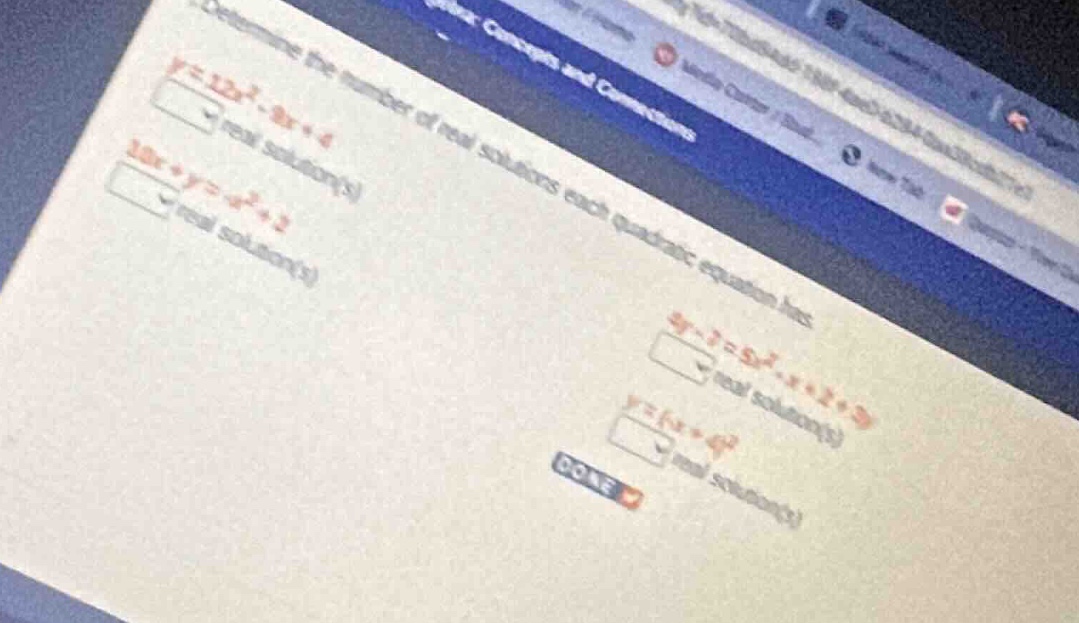
determine the number of real solutions each quadratic equation has:
$y = 12x^2 - 9x + 4$
real solution(s)
$10x + y = x^2 + 1$
real solution(s)
$4y - 3 = 5x^2 - x + 12 + 3y$
real solution(s)
$y = 6x + 4x^2$
real solution(s)
To determine the number of real solutions for each quadratic equation, we use the discriminant of a quadratic equation in the form \(ax^2 + bx + c = 0\), which is given by \(D = b^2 - 4ac\). The number of real solutions is determined as follows:
- If \(D>0\), there are 2 distinct real solutions.
- If \(D = 0\), there is 1 real solution (a repeated root).
- If \(D<0\), there are no real solutions (two complex conjugate solutions).
1. For the equation \(y = 12x^2-8x + 4\) (rewrite as \(12x^2-8x + 4 - y=0\), but since we are interested in the quadratic in \(x\), we consider \(12x^2-8x + 4 = 0\))
Step 1: Identify \(a\), \(b\), \(c\)
For the quadratic equation \(12x^2-8x + 4=0\), we have \(a = 12\), \(b=- 8\), \(c = 4\)
Step 2: Calculate the discriminant \(D=b^2-4ac\)
\[
\]
Since \(D=- 128<0\), the quadratic equation \(12x^2-8x + 4 = 0\) has 0 real solutions.
2. For the equation \(4y-3=5x^2 - x+2 + 3y\) (rewrite in standard quadratic form)
Step 1: Simplify the equation
\[
\]
We are interested in the quadratic in \(x\), so we consider \(5x^2 - x+(5 - y)=0\). For the quadratic in \(x\), \(a = 5\), \(b=-1\), \(c=5 - y\)
Step 2: Calculate the discriminant \(D=b^2-4ac\)
\[
\]
But if we consider the equation as a quadratic in \(x\) (treating \(y\) as a constant), we can also think of it as \(5x^2 - x+(5 - y)=0\). However, if we want to find the number of real solutions for \(x\) (regardless of \(y\)), we can analyze the discriminant in terms of \(x\). But if we assume we are looking for real solutions in \(x\) (for any \(y\)), the discriminant \(D = (-1)^2-4\times5\times(5 - y)=1-100 + 20y=20y - 99\). But if we consider the equation as a quadratic in \(x\) and we want to find if there are real solutions for \(x\) (for some \(y\)), we can also note that for a quadratic \(ax^2+bx + c = 0\) (\(a
eq0\)), since \(a = 5>0\) and the discriminant \(D = 20y-99\) can take both positive and negative values depending on \(y\). But if we made a mistake and we want to consider the equation as a quadratic in \(y\):
Rewrite the equation \(4y-3=5x^2 - x+2 + 3y\) as \(y-(5x^2 - x + 5)=0\). This is a linear equation in \(y\), not a quadratic. So we should consider it as a quadratic in \(x\). For a quadratic in \(x\) \(5x^2 - x+(5 - y)=0\), the discriminant \(D=(-1)^2-4\times5\times(5 - y)=1 - 100 + 20y=20y-99\). If we assume we are looking for real solutions for \(x\) (for a given \(y\)), when \(D\geq0\) (i.e., \(20y-99\geq0\) or \(y\geq\frac{99}{20} = 4.95\)), there are real solutions for \(x\). But if we consider the equation as a quadratic in \(x\) and we want to find the number of real solutions for \(x\) (regardless of \(y\)), the quadratic \(5x^2 - x+(5 - y)=0\) will have real solutions for \(x\) when \(20y-99\geq0\) (i.e., \(y\geq4.95\)) and no real solutions when \(y < 4.95\). But this seems a bit off. Maybe we made a mistake in the approach. Let's re - express the original equation:
\(4y-3=5x^2 - x+2 + 3y\)
\(4y-3y=5x^2 - x + 2+3\)
\(y=5x^2 - x + 5\)
This is a quadratic function in \(x\). The graph of \(y = 5x^2 - x + 5\) is a parabola opening upwards (\(a = 5>0\)) with vertex at \(x=-\frac{b}{2a}=-\frac{-1}{2\times5}=\frac{1}{10}\)
The \(y\) - coordinate of the vertex is \(y=5\times(\frac{1}{10})^2-\frac{1}{10}+5=5\times\frac{1}{100}-\frac{1}{10}+5=\frac{1}{2…

Snap & solve any problem in the app
Get step-by-step solutions on Sovi AI
Photo-based solutions with guided steps
Explore more problems and detailed explanations
for \(y = 12x^2-8x + 4\):
0 real solutions
(Note: The other equations have ambiguous interpretations due to the presence of two variables. If you can provide more context or correct the equations, we can give more accurate answers.)