QUESTION IMAGE
Question
determining components of an exponential function
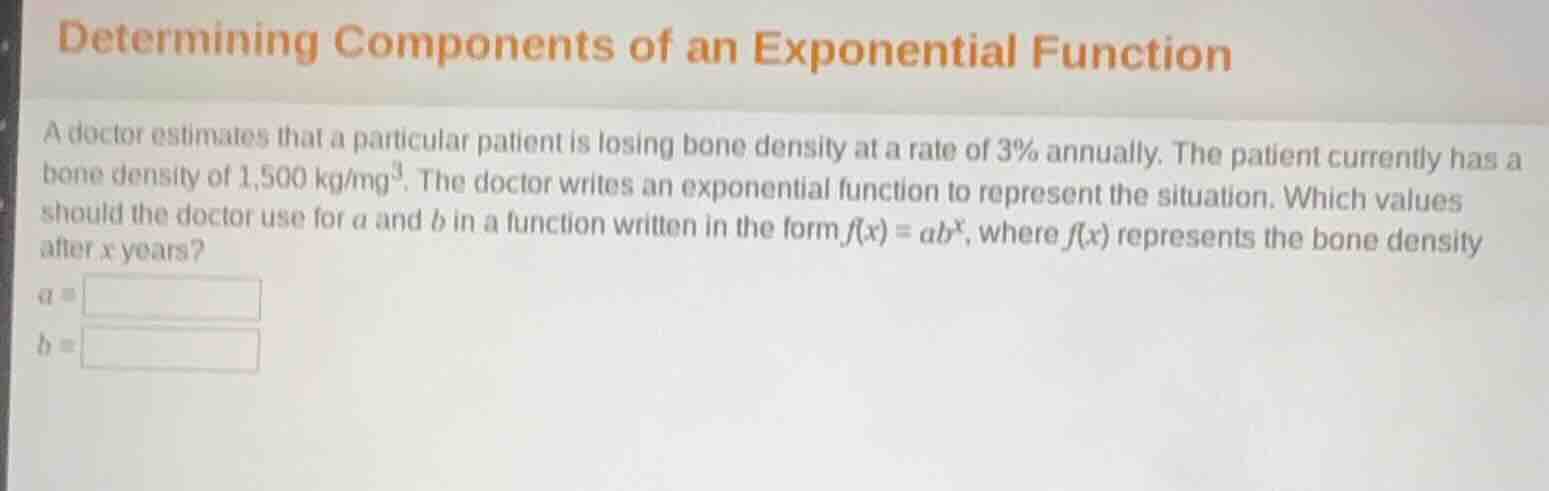
a doctor estimates that a particular patient is losing bone density at a rate of 3% annually. the patient currently has a bone density of 1,500 kg/mg³. the doctor writes an exponential function to represent the situation. which values should the doctor use for a and b in a function written in the form f(x) = abˣ, where f(x) represents the bone density after x years?
a =
b =
Step1: Determine the value of \(a\)
In the exponential function \(f(x)=ab^{x}\), \(a\) represents the initial amount. The patient currently has a bone density of \(1500\space kg/mg^{3}\), so \(a = 1500\).
Step2: Determine the value of \(b\)
The patient is losing bone density at a rate of \(3\%\) annually. This means the remaining bone density each year is \(100\% - 3\%=97\% = 0.97\). In the exponential decay formula, \(b\) is the factor by which the quantity changes each time period. So \(b = 0.97\).

Snap & solve any problem in the app
Get step-by-step solutions on Sovi AI
Photo-based solutions with guided steps
Explore more problems and detailed explanations
\(a = 1500\)
\(b = 0.97\)