QUESTION IMAGE
Question
determining two - variable linear inequalities with no solution
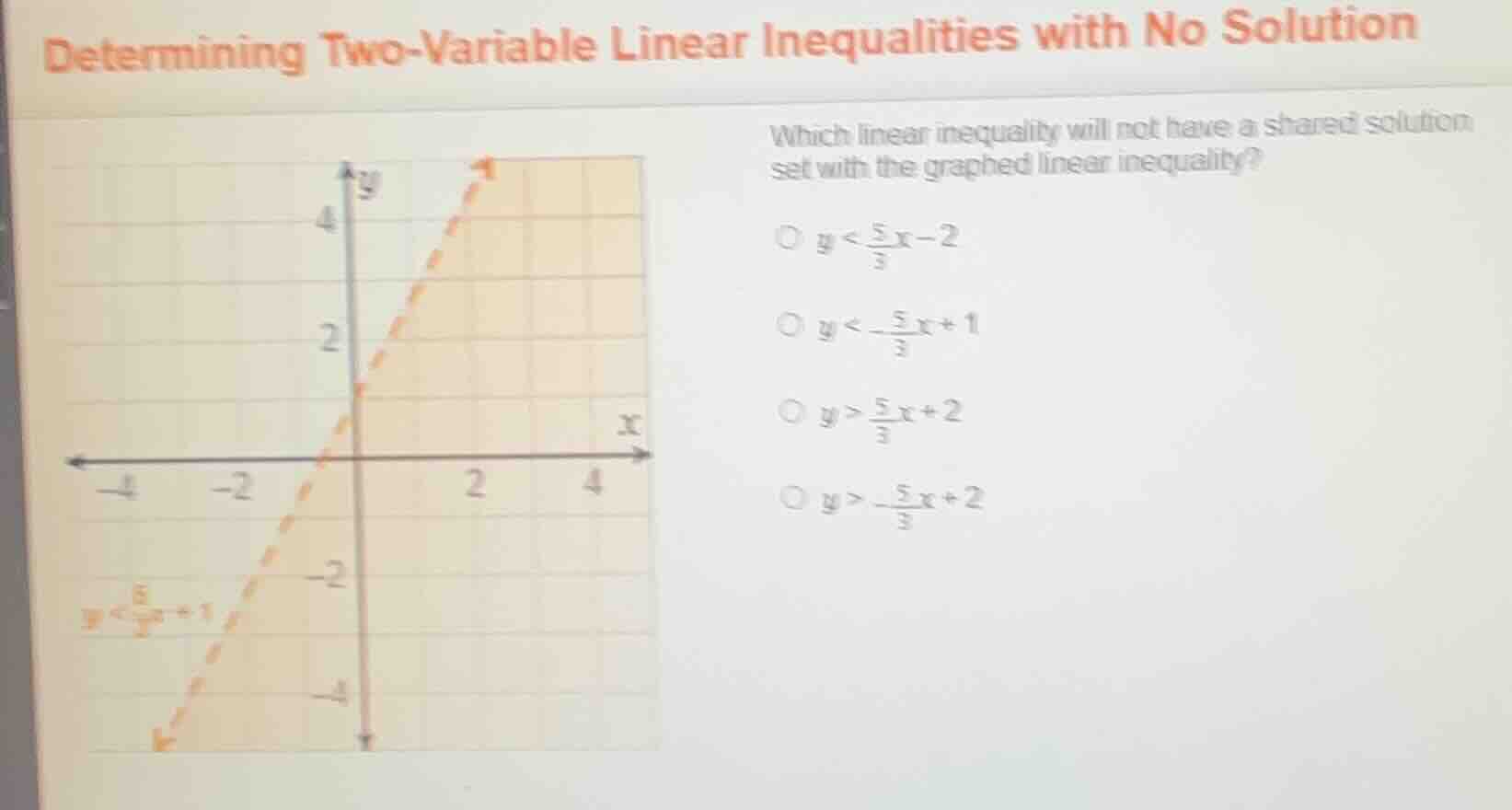
which linear inequality will not have a shared solution set with the graphed linear inequality?
\\(\bigcirc\\) \\(y < \frac{5}{3}x - 2\\)
\\(\bigcirc\\) \\(y < -\frac{5}{3}x + 1\\)
\\(\bigcirc\\) \\(y > \frac{5}{3}x + 2\\)
\\(\bigcirc\\) \\(y > -\frac{5}{3}x + 2\\)
Step1: Identify graphed inequality
The graphed inequality is $y < \frac{5}{3}x + 1$. It has a slope of $\frac{5}{3}$, dashed line, shaded below the line.
Step2: Analyze parallel inequalities
Inequalities with no shared solution must be parallel (same slope) and their shaded regions never overlap. Parallel to the graphed line means slope $\frac{5}{3}$.
Step3: Check option C
The inequality $y > \frac{5}{3}x + 2$ has the same slope $\frac{5}{3}$. Its line is above the graphed line, and it shades above itself, while the graphed one shades below its line. These regions never overlap.
Step4: Eliminate other options
- Option A: $y < \frac{5}{3}x - 2$ shares shaded area below its line, overlapping with the graphed inequality.
- Options B/D: Have slope $-\frac{5}{3}$, not parallel, so their regions will intersect with the graphed one.

Snap & solve any problem in the app
Get step-by-step solutions on Sovi AI
Photo-based solutions with guided steps
Explore more problems and detailed explanations
C. $y > \frac{5}{3}x + 2$