QUESTION IMAGE
Question
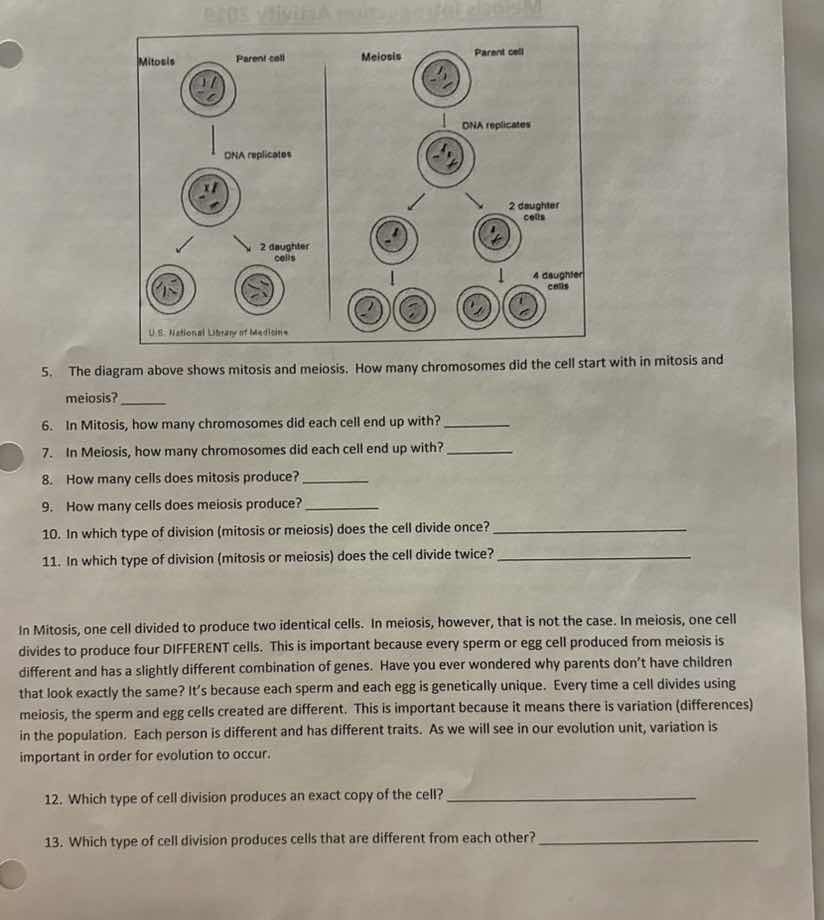
- the diagram above shows mitosis and meiosis. how many chromosomes did the cell start with in mitosis and meiosis? ______
- in mitosis, how many chromosomes did each cell end up with? ______
- in meiosis, how many chromosomes did each cell end up with? ______
- how many cells does mitosis produce? ______
- how many cells does meiosis produce? ______
- in which type of division (mitosis or meiosis) does the cell divide once? ______
- in which type of division (mitosis or meiosis) does the cell divide twice? ______
in mitosis, one cell divided to produce two identical cells. in meiosis, however, that is not the case. in meiosis, one cell divides to produce four different cells. this is important because every sperm or egg cell produced from meiosis is different and has a slightly different combination of genes. have you ever wondered why parents dont have children that look exactly the same? its because each sperm and each egg is genetically unique. every time a cell divides using meiosis, the sperm and egg cells created are different. this is important because it means there is variation (differences) in the population. each person is different and has different traits. as we will see in our evolution unit, variation is important in order for evolution to occur.
- which type of cell division produces an exact copy of the cell? ______
- which type of cell division produces cells that are different from each other? ______
- For question 5: The parent cell in both mitosis and meiosis has 4 chromosomes, as seen in the initial diagrams.
- For question 6: Mitosis produces identical daughter cells with the same chromosome number as the parent.
- For question 7: Meiosis reduces the chromosome number by half to produce haploid cells.
- For question 8: The mitosis diagram shows 2 final daughter cells.
- For question 9: The meiosis diagram shows 4 final daughter cells.
- For question 10: Mitosis only has one round of cell division to make 2 cells.
- For question 11: Meiosis has two rounds of division to make 4 cells.
- For question 12: Mitosis creates genetically identical copies of the parent cell.
- For question 13: Meiosis creates genetically unique, non-identical cells.

Snap & solve any problem in the app
Get step-by-step solutions on Sovi AI
Photo-based solutions with guided steps
Explore more problems and detailed explanations
- 4 chromosomes
- 4 chromosomes
- 2 chromosomes
- 2 cells
- 4 cells
- Mitosis
- Meiosis
- Mitosis
- Meiosis