QUESTION IMAGE
Question
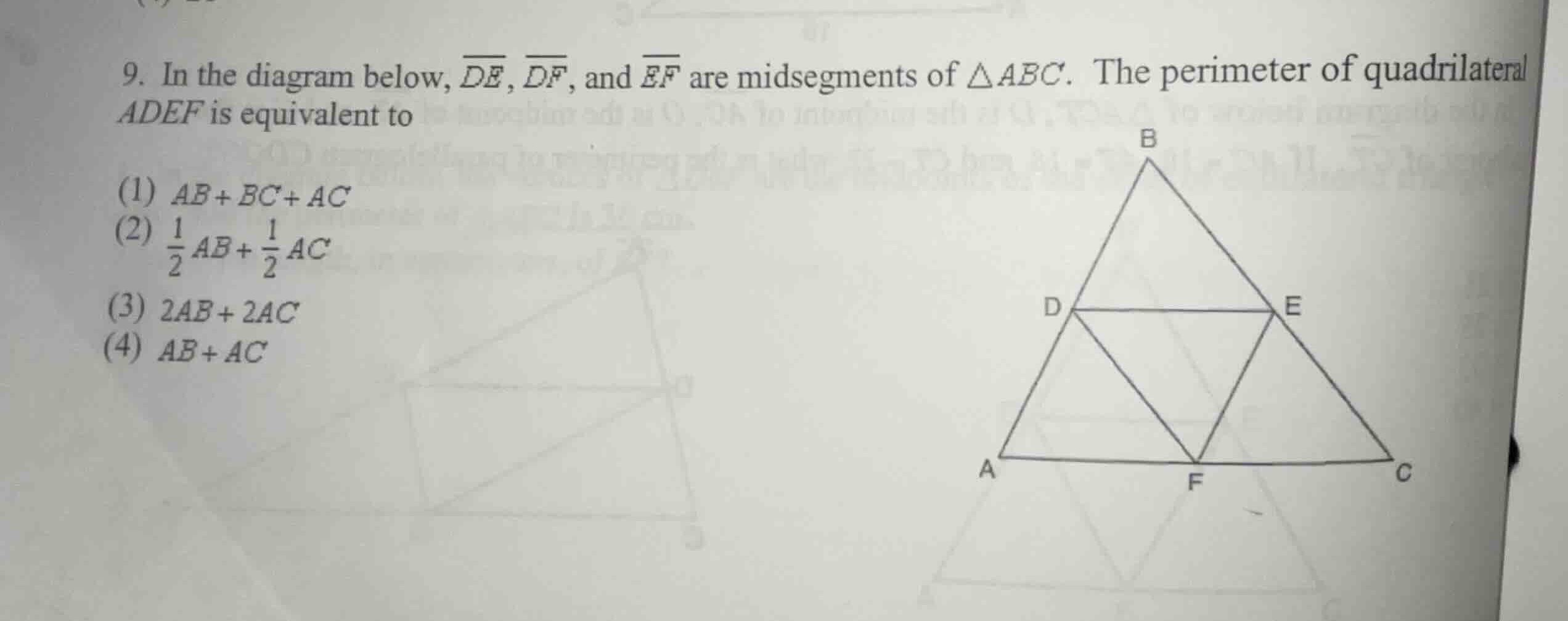
- in the diagram below, \\(\overline{de}\\), \\(\overline{df}\\), and \\(\overline{ef}\\) are midsegments of \\(\triangle abc\\). the perimeter of quadrilateral \\(adef\\) is equivalent to\
(1) \\(ab + bc + ac\\)\
(2) \\(\frac{1}{2}ab + \frac{1}{2}ac\\)\
(3) \\(2ab + 2ac\\)\
(4) \\(ab + ac\\)
Step1: Recall Midsegment Theorem
The Midsegment Theorem states that the midsegment of a triangle is parallel to the third side and half as long. So, for $\triangle ABC$:
- $DE$ is a midsegment, so $DE = \frac{1}{2}AC$ and $DE \parallel AC$.
- $DF$ is a midsegment, so $DF = \frac{1}{2}BC$ (not directly needed here) and $DF \parallel BC$.
- $EF$ is a midsegment, so $EF = \frac{1}{2}AB$ and $EF \parallel AB$.
Also, since $D$, $E$, $F$ are midpoints, $AD = \frac{1}{2}AB$ and $AF = \frac{1}{2}AC$ (wait, no: actually, $D$ is midpoint of $AB$, $E$ midpoint of $BC$, $F$ midpoint of $AC$. So $AD = \frac{1}{2}AB$, $AF = \frac{1}{2}AC$? Wait, no, let's correct: $D$ is midpoint of $AB$, so $AD = DB = \frac{1}{2}AB$. $F$ is midpoint of $AC$, so $AF = FC = \frac{1}{2}AC$. $E$ is midpoint of $BC$, so $BE = EC = \frac{1}{2}BC$.
Now, quadrilateral $ADEF$: let's identify its sides. Sides are $AD$, $DE$, $EF$, and $FA$ (wait, $ADEF$: vertices are $A$, $D$, $E$, $F$. So sides: $AD$, $DE$, $EF$, $FA$? Wait, no: $A$ to $D$, $D$ to $E$, $E$ to $F$, $F$ to $A$. So:
- $AD$: since $D$ is midpoint of $AB$, $AD = \frac{1}{2}AB$.
- $DE$: midsegment, so $DE = \frac{1}{2}AC$ (because $DE$ is midsegment of $\triangle ABC$ with respect to $AC$: $D$ mid $AB$, $E$ mid $BC$, so $DE \parallel AC$ and $DE = \frac{1}{2}AC$).
- $EF$: midsegment, so $EF = \frac{1}{2}AB$ (because $E$ mid $BC$, $F$ mid $AC$, so $EF \parallel AB$ and $EF = \frac{1}{2}AB$).
- $FA$: since $F$ is midpoint of $AC$, $FA = \frac{1}{2}AC$.
Now, perimeter of $ADEF$ is $AD + DE + EF + FA$.
Substitute the values:
$AD = \frac{1}{2}AB$, $DE = \frac{1}{2}AC$, $EF = \frac{1}{2}AB$, $FA = \frac{1}{2}AC$.
So perimeter $= \frac{1}{2}AB + \frac{1}{2}AC + \frac{1}{2}AB + \frac{1}{2}AC$.
Combine like terms:
$(\frac{1}{2}AB + \frac{1}{2}AB) + (\frac{1}{2}AC + \frac{1}{2}AC) = AB + AC$.
Step2: Verify the result
Let's check the options:
- Option (1): $AB + BC + AC$ is perimeter of $\triangle ABC$, not $ADEF$. Eliminate.
- Option (2): $\frac{1}{2}AB + \frac{1}{2}AC$ is too small. Eliminate.
- Option (3): $2AB + 2AC$ is too big. Eliminate.
- Option (4): $AB + AC$ matches our calculation.

Snap & solve any problem in the app
Get step-by-step solutions on Sovi AI
Photo-based solutions with guided steps
Explore more problems and detailed explanations
(4) \( AB + AC \)