QUESTION IMAGE
Question
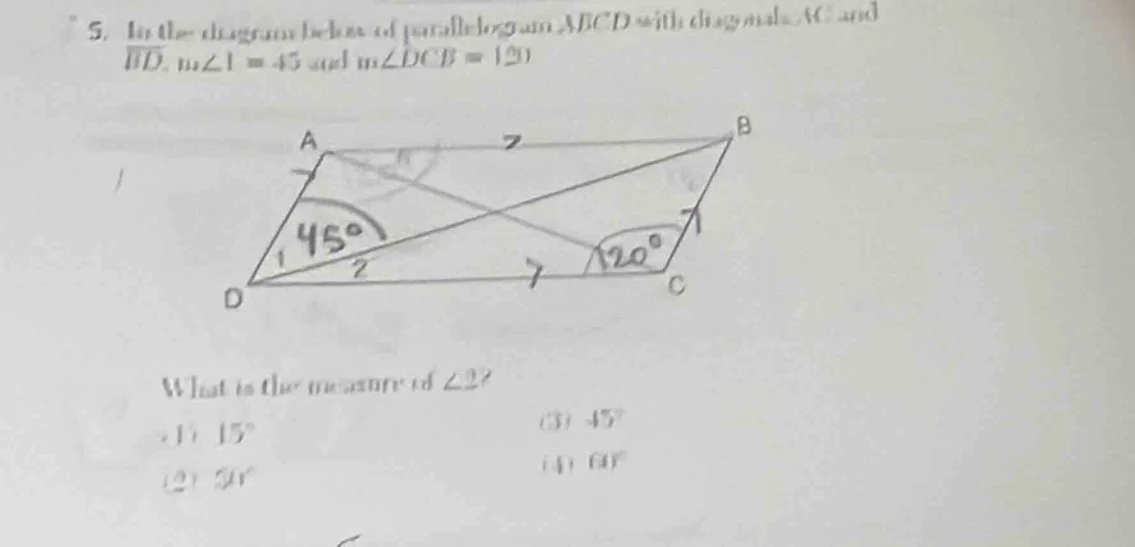
- in the diagram below of parallelogram abcd with diagonals ac and bd, m∠1 = 45 and m∠dcb = 120
what is the measure of ∠2?
(1) 15° (3) 45°
(2) 30° (4) 60°
Step1: Recall properties of parallelograms
In a parallelogram \(ABCD\), \(AB \parallel DC\) and \(AD \parallel BC\). Also, consecutive angles in a parallelogram are supplementary, but here we use the property that \(AD \parallel BC\), so \(\angle ADC + \angle DCB = 180^\circ\) (consecutive interior angles). But we also know that in \(\triangle DBC\) or using angle relationships in the parallelogram. Wait, first, let's find \(\angle ADC\). Since \(ABCD\) is a parallelogram, \(\angle ADC + \angle DCB = 180^\circ\) (consecutive angles of parallelogram are supplementary). Given \(\angle DCB = 120^\circ\), so \(\angle ADC = 180^\circ - 120^\circ = 60^\circ\).
Step2: Find \(\angle 2\)
We know that \(\angle ADC = \angle 1 + \angle 2\). Given \(\angle 1 = 45^\circ\) and \(\angle ADC = 60^\circ\) (from step 1). So, \(\angle 2 = \angle ADC - \angle 1 = 60^\circ - 45^\circ = 15^\circ\)? Wait, no, wait. Wait, in a parallelogram, \(AD \parallel BC\), so \(\angle ADB = \angle DBC\) (alternate interior angles). But maybe I made a mistake. Wait, let's re-examine. The angle \(\angle DCB = 120^\circ\), so \(\angle ADC = 60^\circ\) (since consecutive angles in parallelogram are supplementary: \(180 - 120 = 60\)). Then, \(\angle ADC\) is composed of \(\angle 1\) and \(\angle 2\), so \(\angle 1 + \angle 2 = 60^\circ\). Given \(\angle 1 = 45^\circ\), then \(\angle 2 = 60 - 45 = 15^\circ\)? But wait, the options have 15°, 30°, 45°, 60°. Wait, maybe I messed up the angle. Wait, no, maybe the angle \(\angle DCB\) is 120°, so \(\angle ABC = 120^\circ\), \(\angle DAB = 120^\circ\)? No, wait, no: in a parallelogram, opposite angles are equal, and consecutive angles are supplementary. So \(\angle A = \angle C\), \(\angle B = \angle D\), and \(\angle A + \angle B = 180^\circ\). Wait, \(\angle DCB\) is \(\angle C\), so \(\angle A = 120^\circ\), \(\angle D = 60^\circ\) (since \(\angle D\) and \(\angle C\) are consecutive angles, so \(\angle D + \angle C = 180\), so \(\angle D = 60\)). Then \(\angle D = \angle 1 + \angle 2 = 45 + \angle 2 = 60\), so \(\angle 2 = 15\). But the options include 15° as option (1). Wait, but let's check again. Alternatively, maybe the triangle: in \(\triangle DBC\), we can use the fact that \(AB \parallel DC\), so \(\angle ABD = \angle BDC\) (alternate interior angles). But maybe another approach. Wait, the angle at C is 120°, so the angle at D (angle ADC) is 60°, as consecutive angles. Then angle ADC is split into angle 1 (45°) and angle 2, so angle 2 is 60 - 45 = 15°. So the measure of angle 2 is 15°, which is option (1).

Snap & solve any problem in the app
Get step-by-step solutions on Sovi AI
Photo-based solutions with guided steps
Explore more problems and detailed explanations
(1) \(15^\circ\)