QUESTION IMAGE
Question
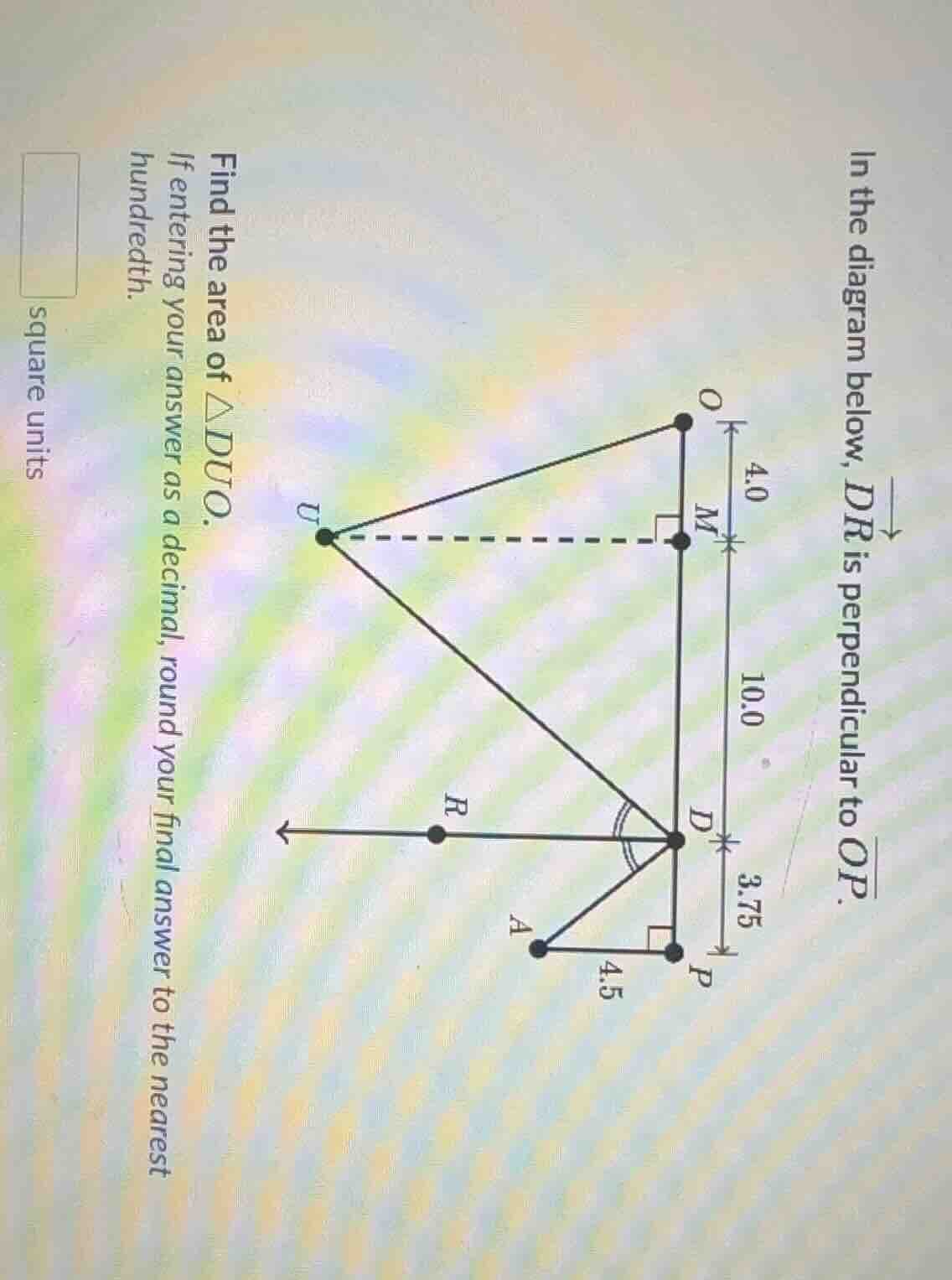
in the diagram below, $overleftrightarrow{dr}$ is perpendicular to $overline{op}$.
find the area of $\triangle duo$.
if entering your answer as a decimal, round your final answer to the nearest hundredth.
square units
Step1: Determine the base of the triangle
The base of \(\triangle DUO\) is the length of \(OD\). From the diagram, \(OM = 4.0\) and \(MD = 10.0\), so \(OD=OM + MD=4.0 + 10.0 = 14.0\).
Step2: Determine the height of the triangle
We can find the height using similar triangles or the given right - angled triangle with base \(3.75\) and height \(4.5\) and the right - angled triangle related to \(\triangle DUO\). Since \(\triangle APD\) and \(\triangle UMO\) (or the triangle related to the height of \(\triangle DUO\)) are similar (because of the right angles and the parallel lines), we can set up a proportion. Let the height of \(\triangle DUO\) be \(h\). We know that \(\frac{h}{4.5}=\frac{14.0}{3.75}\) (by the property of similar right - angled triangles: corresponding sides are proportional). Solving for \(h\), we get \(h=\frac{4.5\times14.0}{3.75}\).
First, calculate \(4.5\times14.0 = 63\). Then, \(h=\frac{63}{3.75}=16.8\).
Alternatively, we can also note that the height of \(\triangle DUO\) can be found by considering the horizontal and vertical distances. The length of \(OM = 4.0\), \(MD = 10.0\), so the total base from \(O\) to \(D\) is \(14.0\). The small right - angled triangle has base \(3.75\) and height \(4.5\). The ratio of the base of the large triangle (\(OD = 14.0\)) to the base of the small triangle (\(3.75\)) is \(\frac{14.0}{3.75}\). Then the height of the large triangle (height of \(\triangle DUO\)) is the height of the small triangle (\(4.5\)) multiplied by this ratio.
Step3: Calculate the area of the triangle
The formula for the area of a triangle is \(A=\frac{1}{2}\times base\times height\). Here, the base \(b = 14.0\) and the height \(h = 16.8\). So, \(A=\frac{1}{2}\times14.0\times16.8\).
First, calculate \(14.0\times16.8 = 235.2\). Then, \(\frac{1}{2}\times235.2 = 117.6\). Wait, this is wrong. Wait, we made a mistake in the height calculation. Let's use another approach.
Wait, actually, the height of \(\triangle DUO\) can be found as follows: The length of \(OM = 4.0\), \(MD = 10.0\), so \(OD=14.0\). The right - angled triangle with legs \(3.75\) and \(4.5\) and the right - angled triangle with base \(OD = 14.0\) and height \(h\) (height of \(\triangle DUO\)) are similar because \(\angle APD=\angle UMD = 90^{\circ}\) and \(\angle ADP=\angle UDM\) (common angle). So, \(\frac{h}{4.5}=\frac{14.0}{3.75}\) is incorrect. The correct proportion is \(\frac{h}{4.5}=\frac{4.0 + 10.0}{3.75}\)? No, the correct similar triangles: \(\triangle APD\) (right - angled at \(P\)) and \(\triangle UMD\) (right - angled at \(M\)). So, \(\frac{AP}{UM}=\frac{PD}{MD}\). We know that \(AP = 4.5\), \(PD = 3.75\), \(MD = 10.0\). Wait, no, let's look at the diagram again. The segment \(UM\) is the height of \(\triangle DUO\) (since \(UM\) is perpendicular to \(OD\) as \(UM\) is a dashed line and \(OD\) is a straight line with a right angle at \(M\)). Wait, the length \(OM = 4.0\), \(MD = 10.0\), and the triangle \(APD\) has \(AP = 4.5\), \(PD = 3.75\). Since \(\triangle APD\sim\triangle UMD\) (both right - angled, \(\angle ADP=\angle UDM\)), then \(\frac{UM}{AP}=\frac{MD}{PD}\). So, \(\frac{UM}{4.5}=\frac{10.0}{3.75}\). Then \(UM=\frac{4.5\times10.0}{3.75}=\frac{45}{3.75}=12.0\). Wait, now we see the mistake earlier. The base for the similar triangle should be \(MD = 10.0\) (the segment from \(M\) to \(D\)) and \(PD = 3.75\) (the segment from \(P\) to \(D\)).
So, if \(\frac{UM}{4.5}=\frac{10.0}{3.75}\), then \(UM=\frac{4.5\times10.0}{3.75}=12.0\). Then the base of \(\triangle DUO\) is \(OD = OM+MD=4.0 + 10.0 = 14.0\), and the height…

Snap & solve any problem in the app
Get step-by-step solutions on Sovi AI
Photo-based solutions with guided steps
Explore more problems and detailed explanations
\(84.00\)