QUESTION IMAGE
Question
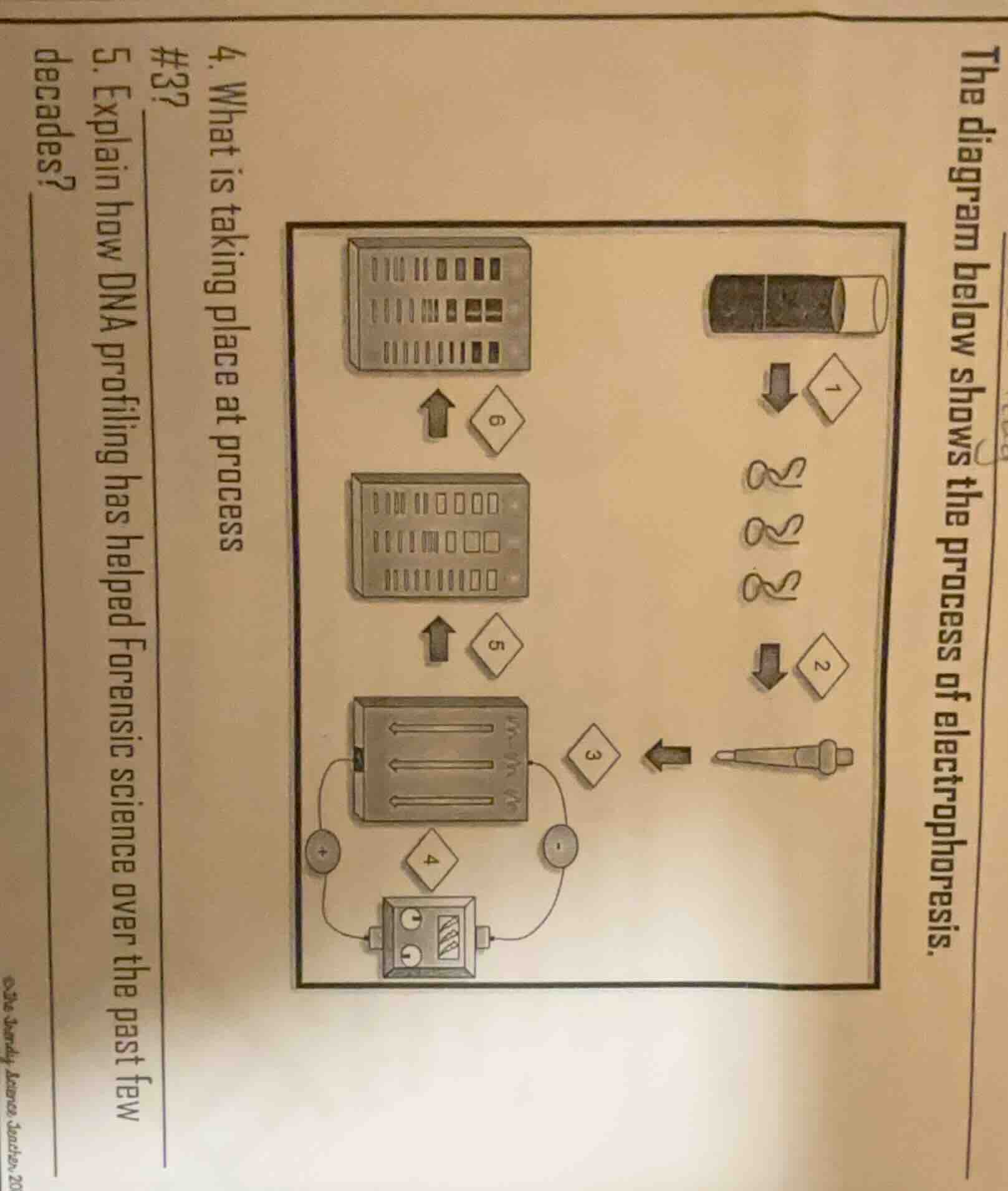
the diagram below shows the process of electrophoresis.
- what is taking place at process #3?
- explain how dna profiling has helped forensic science over the past few decades?
Question 4: What is taking place at process #3?
To determine process #3 in the electrophoresis diagram, we analyze the steps of gel electrophoresis (used in DNA analysis like profiling). Process #3 likely involves loading the DNA sample (after extraction and possibly PCR amplification) into the wells of the agarose gel. This is a key step before running the gel with an electric current. The pipette in the diagram suggests sample loading (adding DNA fragments, maybe after PCR or extraction, into the gel wells).
- Accurate Identification: DNA profiling (using techniques like STR analysis) provides a unique genetic "fingerprint" for individuals (except identical twins), allowing precise identification of suspects, victims, or missing persons.
- Cold Case Resolution: Old cases with limited evidence (e.g., old biological samples) can be re - examined with DNA profiling, leading to new leads and convictions.
- Exoneration of Innocents: DNA evidence can prove innocence, correcting wrongful convictions by showing a suspect’s DNA does not match crime - scene evidence.
- Linking Crimes: Similar DNA profiles across multiple crime scenes help link serial crimes or criminal networks, aiding investigations.
- Forensic Efficiency: Faster and more accessible DNA analysis (e.g., PCR - based methods) speeds up casework, reducing time to solve crimes and bring justice.

Snap & solve any problem in the app
Get step-by-step solutions on Sovi AI
Photo-based solutions with guided steps
Explore more problems and detailed explanations
Process #3 is the loading of the DNA sample (or DNA fragments, possibly after PCR amplification) into the wells of the agarose gel, preparing it for electrophoresis.