QUESTION IMAGE
Question
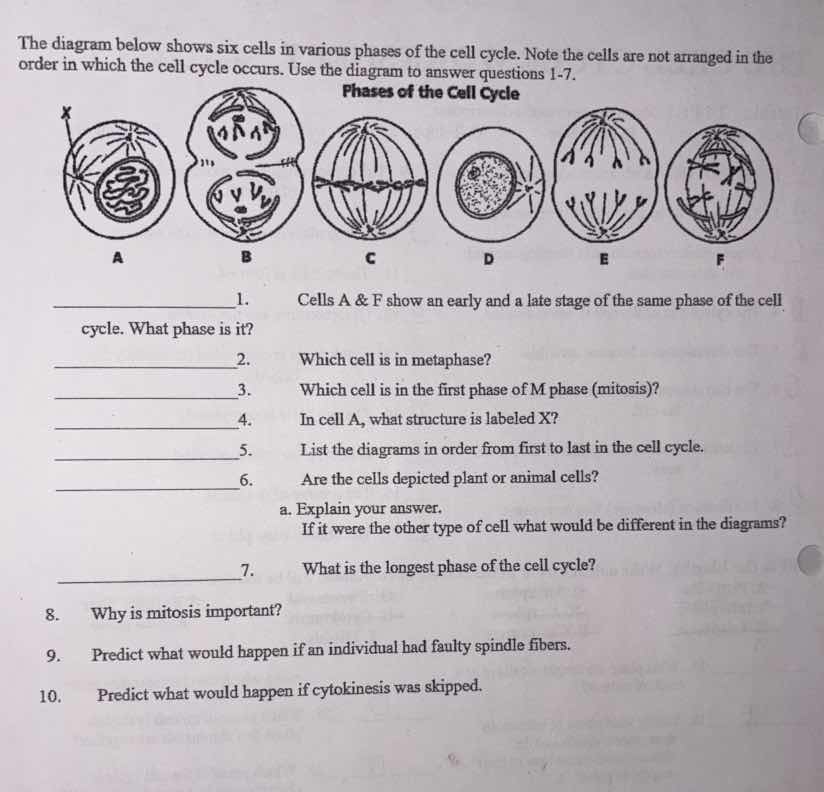
the diagram below shows six cells in various phases of the cell cycle. note the cells are not arranged in the order in which the cell cycle occurs. use the diagram to answer questions 1 - 7.
phases of the cell cycle
- cells a & f show an early and a late stage of the same phase of the cell cycle. what phase is it?
- which cell is in metaphase?
- which cell is in the first phase of m phase (mitosis)?
- in cell a, what structure is labeled x?
- list the diagrams in order from first to last in the cell cycle.
- are the cells depicted plant or animal cells?
a. explain your answer.
if it were the other type of cell what would be different in the diagrams?
- what is the longest phase of the cell cycle?
- why is mitosis important?
- predict what would happen if an individual had faulty spindle fibers.
- predict what would happen if cytokinesis was skipped.
Brief Explanations
- Cells A (chromosomes condensing, spindle forming) and F (chromosomes aligned at cell equator with fully formed spindle) are stages of prophase (early and late prophase/prometaphase).
- Metaphase is defined by chromosomes lined up at the cell's metaphase plate, which matches cell C.
- The first phase of mitosis (M phase) is prophase, which is cell A (chromosomes condensing, spindle apparatus beginning to form).
- Structure X in cell A is the spindle fiber (or microtubule), which forms early in mitosis to move chromosomes.
- The cell cycle order starts with interphase (cell D, non-dividing, nucleus intact), then prophase (A), late prophase/prometaphase (F), metaphase (C), anaphase (E), telophase/cytokinesis (B).
- The cells have centrioles (visible in A, D) and pinch in at the cell membrane during cytokinesis (cell B), which are animal cell traits. Plant cells have a cell wall and form a cell plate instead of pinching.
- Interphase, where the cell grows, replicates DNA, and prepares for division, takes up ~90% of the cell cycle.
- Mitosis produces genetically identical daughter cells, critical for growth, replacing damaged cells, and asexual reproduction in some organisms.
- Spindle fibers move chromosomes during mitosis; faulty fibers would cause chromosomes to not separate properly, leading to aneuploidy (cells with incorrect chromosome numbers).
- Cytokinesis splits the cytoplasm into two cells. Skipping it results in a single cell with two nuclei and double the normal amount of organelles/cytoplasm.

Snap & solve any problem in the app
Get step-by-step solutions on Sovi AI
Photo-based solutions with guided steps
Explore more problems and detailed explanations
- Prophase
- Cell C
- Cell A
- Spindle fiber (or spindle microtubule)
- D → A → F → C → E → B
- a. Animal cells. They have centrioles and show cleavage furrow formation (pinching) during cytokinesis, no cell wall is visible.
b. If they were plant cells, the diagrams would show a rigid cell wall, and cytokinesis would form a cell plate instead of a cleavage furrow.
- Interphase
- Mitosis is important for growth of multicellular organisms, repair of damaged tissues, and asexual reproduction in some organisms, as it produces genetically identical daughter cells.
- Faulty spindle fibers would cause chromosomes to fail to separate properly during anaphase, resulting in daughter cells with an abnormal number of chromosomes (aneuploidy), which can lead to genetic disorders or cell death.
- If cytokinesis was skipped, the cell would not split into two daughter cells, resulting in a single cell with two distinct nuclei and double the normal amount of cytoplasm and organelles.