QUESTION IMAGE
Question
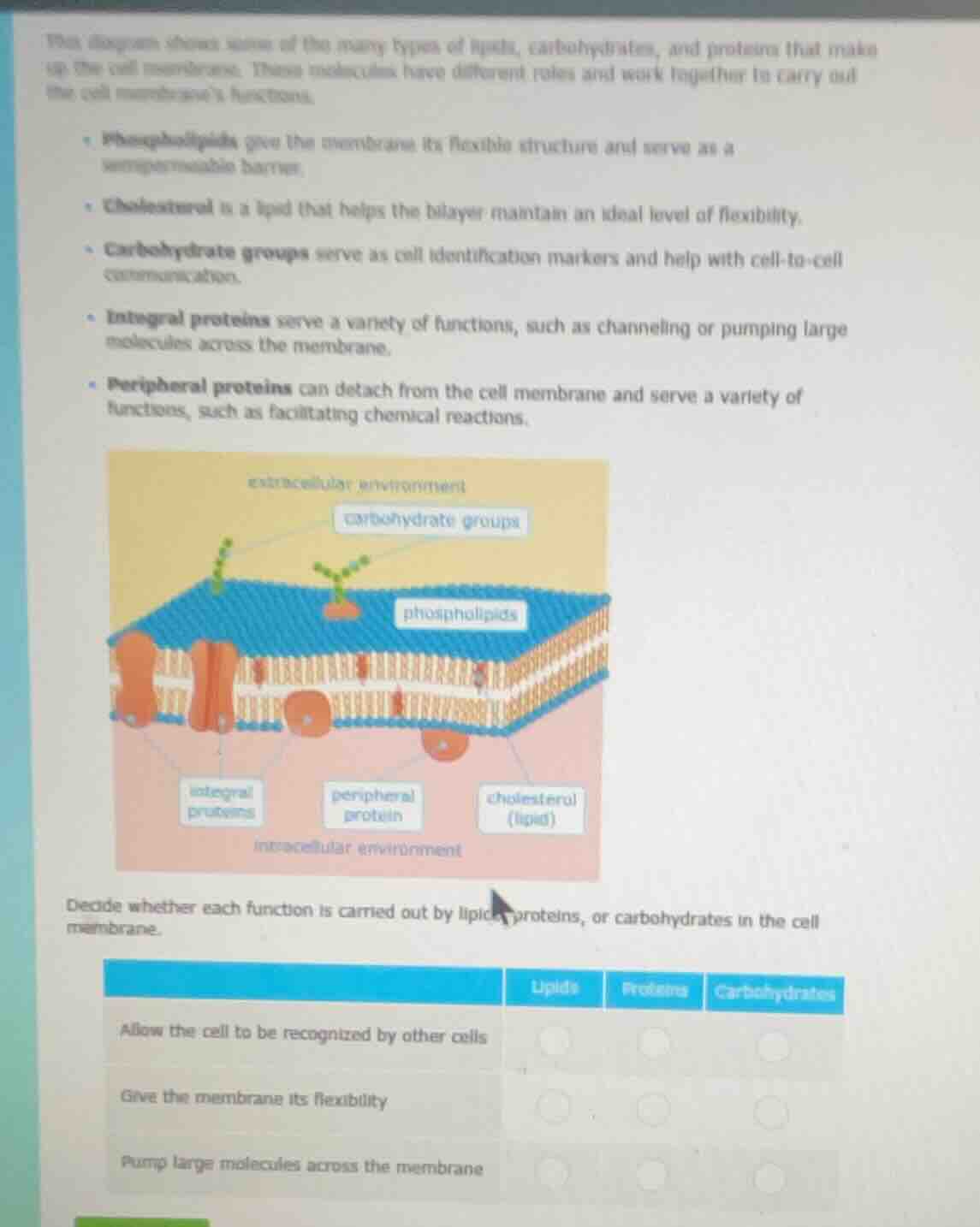
this diagram shows some of the many types of lipids, carbohydrates, and proteins that make up the cell membrane. these molecules have different roles and work together to carry out the cell membrane’s functions.
- phospholipids give the membrane its flexible structure and serve as a semipermeable barrier.
- cholesterol is a lipid that helps the bilayer maintain an ideal level of flexibility.
- carbohydrate groups serve as cell identification markers and help with cell - to - cell communication.
- integral proteins serve a variety of functions, such as channeling or pumping large molecules across the membrane.
- peripheral proteins can detach from the cell membrane and serve a variety of functions, such as facilitating chemical reactions.
diagram of cell membrane showing extracellular environment, carbohydrate groups, phospholipids, integral proteins, peripheral protein, cholesterol (lipid), and intracellular environment
decide whether each function is carried out by lipids, proteins, or carbohydrates in the cell membrane.
| lipids | proteins | carbohydrates | |
|---|---|---|---|
| give the membrane its flexibility | |||
| pump large molecules across the membrane |
Response
For "Allow the cell to be recognized by other cells":
- From the text, "Carbohydrate groups serve as cell identification markers and help with cell - to - cell communication." So this function is carried out by carbohydrates. So we mark the "Carbohydrates" column for this row.
For "Give the membrane its flexibility":
- The text says "Phospholipids give the membrane its flexible structure and serve as a semipermeable barrier" and "Cholesterol is a lipid that helps the bilayer maintain an ideal level of flexibility." Both phospholipids and cholesterol are lipids. So this function is carried out by lipids. So we mark the "Lipids" column for this row.
For "Pump large molecules across the membrane":
- The text states "Integral proteins serve a variety of functions, such as channeling or pumping large molecules across the membrane." So this function is carried out by proteins. So we mark the "Proteins" column for this row.
| Function | Lipids | Proteins | Carbohydrates |
|---|---|---|---|
| Give the membrane its flexibility | ✔️ | ||
| Pump large molecules across the membrane | ✔️ |

Snap & solve any problem in the app
Get step-by-step solutions on Sovi AI
Photo-based solutions with guided steps
Explore more problems and detailed explanations
For "Allow the cell to be recognized by other cells":
- From the text, "Carbohydrate groups serve as cell identification markers and help with cell - to - cell communication." So this function is carried out by carbohydrates. So we mark the "Carbohydrates" column for this row.
For "Give the membrane its flexibility":
- The text says "Phospholipids give the membrane its flexible structure and serve as a semipermeable barrier" and "Cholesterol is a lipid that helps the bilayer maintain an ideal level of flexibility." Both phospholipids and cholesterol are lipids. So this function is carried out by lipids. So we mark the "Lipids" column for this row.
For "Pump large molecules across the membrane":
- The text states "Integral proteins serve a variety of functions, such as channeling or pumping large molecules across the membrane." So this function is carried out by proteins. So we mark the "Proteins" column for this row.
| Function | Lipids | Proteins | Carbohydrates |
|---|---|---|---|
| Give the membrane its flexibility | ✔️ | ||
| Pump large molecules across the membrane | ✔️ |