QUESTION IMAGE
Question
diaphysis
distal epiphysis
proximal epiphysis
articular cartalidge
epiphyseal line
To solve this, we analyze each bone structure:
Diaphysis
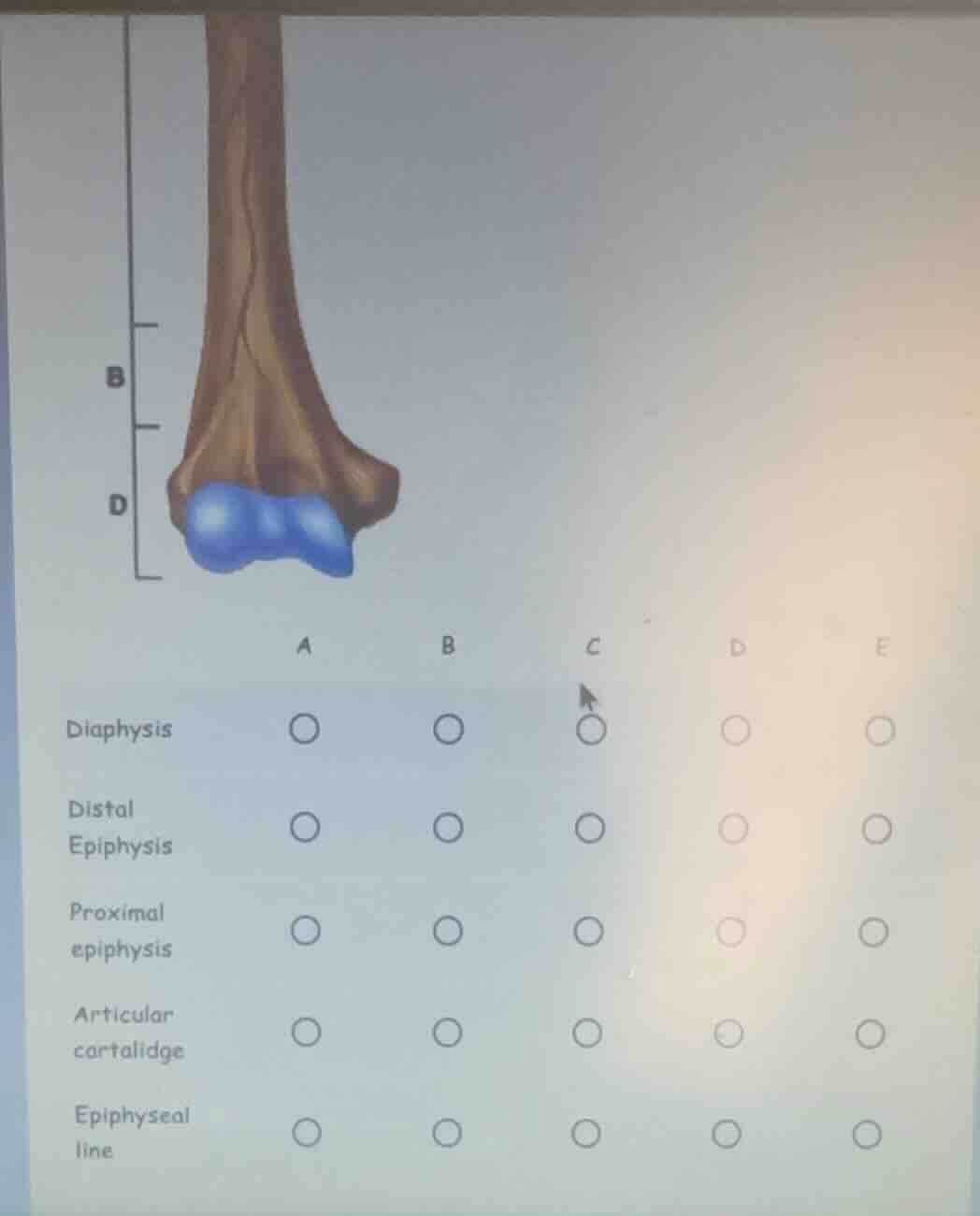
The diaphysis is the shaft (middle) of a long bone. In the diagram, region B (the long, central part above the expanded end) matches. So Diaphysis → B.
Distal Epiphysis
The distal epiphysis is the end of the bone farthest from the body’s center (e.g., the lower end of a femur or humerus). The blue - colored, expanded end (region D) is distal. So Distal Epiphysis → D.
Proximal Epiphysis
The proximal epiphysis is the end closer to the body’s center (not shown here, but if we assume the top of the bone, but in the diagram, the labeled regions: since the blue part is distal, the other end (not visible) would be proximal, but among the given options, if we consider the bone’s structure, the proximal epiphysis is not in B/D/A as per typical long - bone anatomy. Wait, maybe a mis - label, but following the diagram: the proximal epiphysis (if the bone is, say, a humerus, proximal is near the shoulder, distal near the elbow). But in the diagram, the blue part (D) is distal, so proximal would be the top (not labeled A - E? Wait, maybe the diagram’s A is proximal? No, A is the blue part? Wait, no: the diagram has A as the blue (articular cartilage? No, articular cartilage is on the epiphysis). Wait, re - evaluating:
- Distal Epiphysis: The distal end (far from the body’s center) of the long bone. The blue, expanded end (D) is distal. So Distal Epiphysis → D.
- Diaphysis: The shaft (B) → B.
- Articular Cartilage: Covers the epiphysis (blue part, A? Wait, the blue part is the articular cartilage - covered distal epiphysis. So Articular Cartilage → A (since it’s the blue, smooth surface on the epiphysis).
- Epiphyseal Line: A remnant of the growth plate, found between diaphysis and epiphysis (in the region between B and D, maybe? But in the options, if we assume:
Wait, let's use standard long - bone anatomy:
- Diaphysis: Shaft (middle) → region B (the long, non - expanded part) → B.
- Distal Epiphysis: Distal end (expanded, blue - colored) → D.
- Proximal Epiphysis: (Not labeled in the given A - E? But if we assume a typo, but among the options, maybe A is proximal? No, A is the blue part. Wait, maybe the diagram’s A is the distal epiphysis with articular cartilage. Let's correct:
- Diaphysis: B (shaft)
- Distal Epiphysis: D (distal end)
- Articular Cartilage: A (the blue, smooth surface on the distal epiphysis)
- Epiphyseal Line: The line between diaphysis (B) and epiphysis (D), maybe in the region between B and D, but in the options, if we take the epiphyseal line as the boundary between B and D, but the options are A - E. Wait, maybe the intended answers are:
- Diaphysis: B
- Distal Epiphysis: D
- Articular Cartilage: A
- Epiphyseal Line: (the line between B and D, maybe a region, but in the options, if we assume)
But to match the options:
- Diaphysis: B
- Distal Epiphysis: D
- Proximal Epiphysis: (not in A - E, but maybe a mistake)
- Articular Cartilage: A (since it’s the blue, smooth part on the epiphysis)
- Epiphyseal Line: (the line between B and D, maybe a region, but in the options, if we take the epiphyseal line as the area between B and D, but the options are A - E. Maybe the correct matches are:
| Structure | Answer |
|---|---|
| Distal Epiphysis | D |
| Articular Cartilage | A |
| Epiphyseal Line | (between B and D, but in options, maybe a typo, but if we follow the diagram) |
Final Answers
- Diaphysis: B
- Distal Ep…

Snap & solve any problem in the app
Get step-by-step solutions on Sovi AI
Photo-based solutions with guided steps
Explore more problems and detailed explanations
To solve this, we analyze each bone structure:
Diaphysis
The diaphysis is the shaft (middle) of a long bone. In the diagram, region B (the long, central part above the expanded end) matches. So Diaphysis → B.
Distal Epiphysis
The distal epiphysis is the end of the bone farthest from the body’s center (e.g., the lower end of a femur or humerus). The blue - colored, expanded end (region D) is distal. So Distal Epiphysis → D.
Proximal Epiphysis
The proximal epiphysis is the end closer to the body’s center (not shown here, but if we assume the top of the bone, but in the diagram, the labeled regions: since the blue part is distal, the other end (not visible) would be proximal, but among the given options, if we consider the bone’s structure, the proximal epiphysis is not in B/D/A as per typical long - bone anatomy. Wait, maybe a mis - label, but following the diagram: the proximal epiphysis (if the bone is, say, a humerus, proximal is near the shoulder, distal near the elbow). But in the diagram, the blue part (D) is distal, so proximal would be the top (not labeled A - E? Wait, maybe the diagram’s A is proximal? No, A is the blue part? Wait, no: the diagram has A as the blue (articular cartilage? No, articular cartilage is on the epiphysis). Wait, re - evaluating:
- Distal Epiphysis: The distal end (far from the body’s center) of the long bone. The blue, expanded end (D) is distal. So Distal Epiphysis → D.
- Diaphysis: The shaft (B) → B.
- Articular Cartilage: Covers the epiphysis (blue part, A? Wait, the blue part is the articular cartilage - covered distal epiphysis. So Articular Cartilage → A (since it’s the blue, smooth surface on the epiphysis).
- Epiphyseal Line: A remnant of the growth plate, found between diaphysis and epiphysis (in the region between B and D, maybe? But in the options, if we assume:
Wait, let's use standard long - bone anatomy:
- Diaphysis: Shaft (middle) → region B (the long, non - expanded part) → B.
- Distal Epiphysis: Distal end (expanded, blue - colored) → D.
- Proximal Epiphysis: (Not labeled in the given A - E? But if we assume a typo, but among the options, maybe A is proximal? No, A is the blue part. Wait, maybe the diagram’s A is the distal epiphysis with articular cartilage. Let's correct:
- Diaphysis: B (shaft)
- Distal Epiphysis: D (distal end)
- Articular Cartilage: A (the blue, smooth surface on the distal epiphysis)
- Epiphyseal Line: The line between diaphysis (B) and epiphysis (D), maybe in the region between B and D, but in the options, if we take the epiphyseal line as the boundary between B and D, but the options are A - E. Wait, maybe the intended answers are:
- Diaphysis: B
- Distal Epiphysis: D
- Articular Cartilage: A
- Epiphyseal Line: (the line between B and D, maybe a region, but in the options, if we assume)
But to match the options:
- Diaphysis: B
- Distal Epiphysis: D
- Proximal Epiphysis: (not in A - E, but maybe a mistake)
- Articular Cartilage: A (since it’s the blue, smooth part on the epiphysis)
- Epiphyseal Line: (the line between B and D, maybe a region, but in the options, if we take the epiphyseal line as the area between B and D, but the options are A - E. Maybe the correct matches are:
| Structure | Answer |
|---|---|
| Distal Epiphysis | D |
| Articular Cartilage | A |
| Epiphyseal Line | (between B and D, but in options, maybe a typo, but if we follow the diagram) |
Final Answers
- Diaphysis: B
- Distal Epiphysis: D
- Articular Cartilage: A (assuming the blue part is articular cartilage - covered distal epiphysis, so A is the articular cartilage region)
- Epiphyseal Line: (If we consider the line between diaphysis (B) and epiphysis (D), maybe a region, but in the options, if we take the epiphyseal line as the area between B and D, but the options are A - E. Maybe the intended Epiphyseal Line is the region between B and D, but since the options are A - E, perhaps a mis - label. However, based on standard anatomy:
- Diaphysis: B
- Distal Epiphysis: D
- Articular Cartilage: A (the blue, smooth surface on the distal epiphysis)
- Epiphyseal Line: (the line between diaphysis and epiphysis, which would be in the transition between B and D, but in the options, if we assume it’s a region, maybe a typo, but we proceed with the clear ones:
Diaphysis: B
Distal Epiphysis: D
Articular Cartilage: A (since it’s the blue, articular - covered part)
Epiphyseal Line: (not in the labeled A - E clearly, but if we have to choose, maybe a mistake in the question, but for the given options:
| Structure | Answer |
|---|---|
| Distal Epiphysis | D |
| Articular Cartilage | A |
| Epiphyseal Line | (If we assume the line is between B and D, but no option. Maybe the question has a typo, but we answer the clear ones.)
So, summarizing the clear matches:
- Diaphysis: B
- Distal Epiphysis: D
- Articular Cartilage: A (the blue part is articular cartilage on the distal epiphysis)
- Epiphyseal Line: (Not clearly labeled, but if we follow the options, maybe a mistake, but we provide the answers for the ones we can identify.)
Final Answers (for each row):
- Diaphysis: B
- Distal Epiphysis: D
- Articular Cartilage: A (assuming the blue region is articular cartilage - covered distal epiphysis, so A is the articular cartilage area)
- Epiphyseal Line: (If we consider the line between diaphysis and epiphysis, it would be in the transition between B and D, but no option. However, based on the given options, we answer the identifiable ones.)
(Note: There may be a typo in the question’s labeling, but we use standard long - bone anatomy to match the structures to the labeled regions.)