QUESTION IMAGE
Question
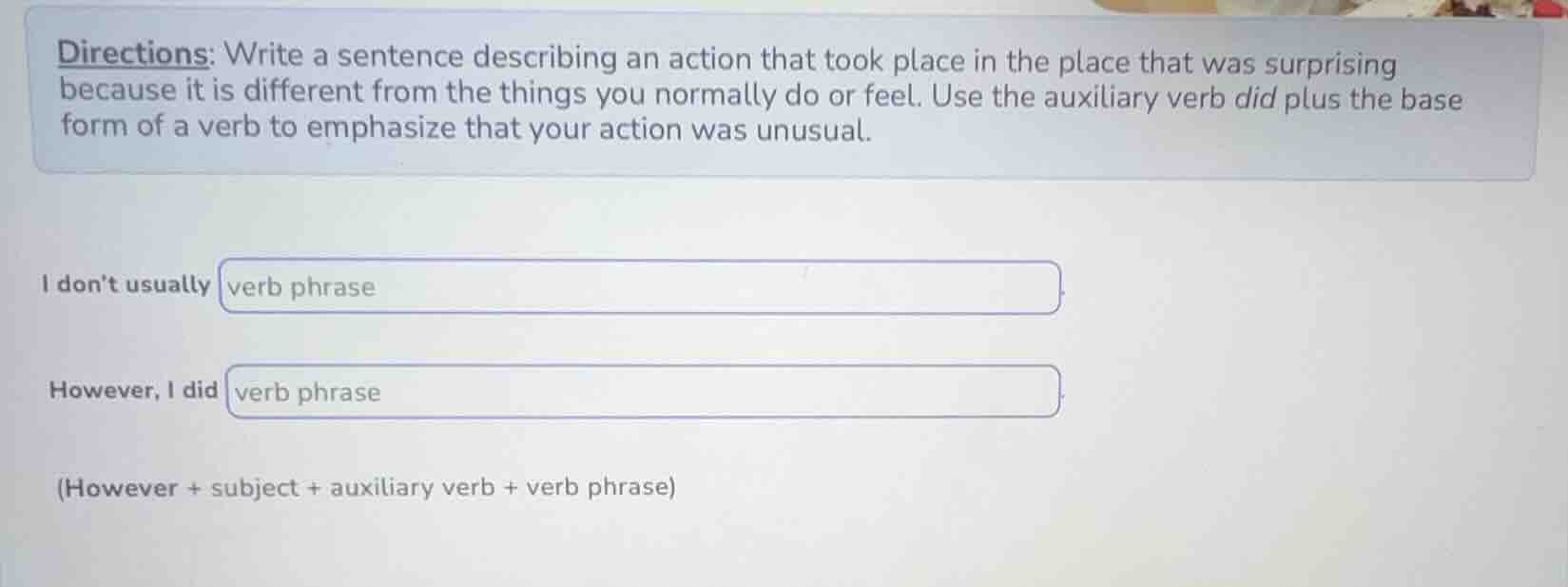
directions: write a sentence describing an action that took place in the place that was surprising because it is different from the things you normally do or feel. use the auxiliary verb did plus the base form of a verb to emphasize that your action was unusual. i dont usually verb phrase. however, i did verb phrase. (however + subject + auxiliary verb + verb phrase)
We need to create a sentence where the first verb phrase represents a usual action (or lack thereof) and the second, using "did", represents an unusual action. Let's choose a context, say, in a library (a place where being loud is unusual). For the first blank, a usual action in a library could be "keep quiet", so "I don't usually shout in the library". For the second, the unusual action: "However, I did shout in the library when I found my lost book." Wait, no, the first part is "I don't usually [verb phrase]", then "However, I did [verb phrase]". Let's structure it properly. Let's pick a place like a museum. Usual: not run. Unusual: run. So:
I don't usually run in the museum. However, I did run in the museum when I saw a friend I hadn't met in years.
Wait, but the blanks are for the verb phrases. So filling the first blank: "run in the museum" (no, "I don't usually run in the museum" – so the verb phrase is "run in the museum"? Wait, no, the first part is "I don't usually [verb phrase]". So the verb phrase for the first blank: let's take "eat in the classroom" (usual: not eat in classroom, maybe). Then unusual: eat in classroom. So:
I don't usually eat in the classroom. However, I did eat in the classroom today because I was too busy to go to the cafeteria.
So the first verb phrase is "eat in the classroom", the second is also "eat in the classroom" (but the "did" emphasizes the unusual action). Wait, the action is the same, but the context is unusual. So the structure is: usual (not do X), but did X (unusual). So let's formalize:
First blank (verb phrase): eat in the classroom (since "I don't usually eat in the classroom" – usual behavior: not eat in classroom).
Second blank (verb phrase): eat in the classroom (since "However, I did eat in the classroom" – unusual, because I don't usually do that).
So putting it together:
I don't usually eat in the classroom. However, I did eat in the classroom today because I had a lot of work to finish and no time to go to the cafeteria.
But the question is to fill the blanks. So the first blank: "eat in the classroom", the second blank: "eat in the classroom".
Alternatively, another example:
I don't usually dance in the library. However, I did dance in the library when my favorite song played unexpectedly.
So first verb phrase: "dance in the library", second: "dance in the library".
The key is that the action (verb phrase) is something you don't usually do, but you did it (unusual), using "did + base verb".
So to fill the blanks:
First blank (I don't usually [verb phrase]): Let's choose "sing in the office" (assuming office is a quiet place, usual: not sing).
Second blank (However, I did [verb phrase]): "sing in the office" (unusual, so did sing there).
So the filled blanks would be:
I don't usually sing in the office. However, I did sing in the office when my team won the big project.
So the verb phrases are "sing in the office" for both blanks.

Snap & solve any problem in the app
Get step-by-step solutions on Sovi AI
Photo-based solutions with guided steps
Explore more problems and detailed explanations
First blank: sing in the office
Second blank: sing in the office
(Note: Other valid examples could be used, e.g., "shout in the library" for both, "run in the museum" for both, etc., as long as the action is unusual for the place.)