QUESTION IMAGE
Question
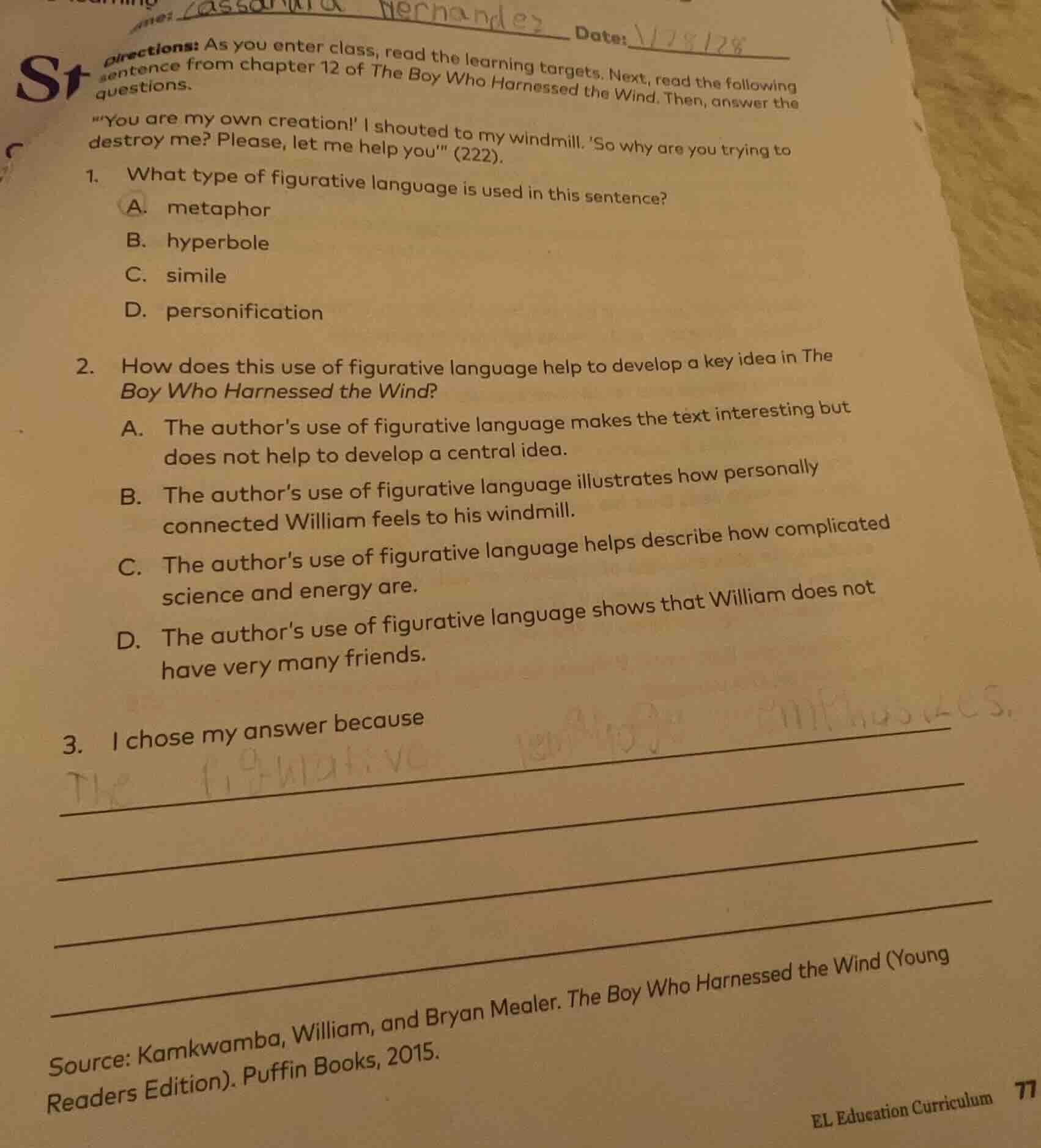
directions: as you enter class, read the learning targets. next, read the following sentence from chapter 12 of the boy who harnessed the wind. then, answer the questions.\you are my own creation! i shouted to my windmill. so why are you trying to destroy me? please, let me help you\ (222).
- what type of figurative language is used in this sentence?
a. metaphor
b. hyperbole
c. simile
d. personification
- how does this use of figurative language help to develop a key idea in the boy who harnessed the wind?
a. the author’s use of figurative language makes the text interesting but does not help to develop a central idea.
b. the author’s use of figurative language illustrates how personally connected william feels to his windmill.
c. the author’s use of figurative language helps describe how complicated science and energy are.
d. the author’s use of figurative language shows that william does not have very many friends.
- i chose my answer because
source: kamkwamba, william, and bryan mealer. the boy who harnessed the wind (young readers edition). puffin books, 2015.
Question 1
To determine the figurative language, we analyze each option:
- Metaphor: Implies a direct comparison without "like" or "as", but here the windmill is addressed as if it can act (not just a comparison).
- Hyperbole: Exaggeration, not applicable here.
- Simile: Uses "like" or "as" for comparison, absent here.
- Personification: Gives human traits (e.g., "trying to destroy", "let me help") to a non - human (windmill). This matches the text.
We analyze each option:
- Option A: Figurative language in literature often develops ideas, so this is incorrect.
- Option B: The quote shows William addressing the windmill as a person he’s connected to (calls it his “creation”, asks to help), so the figurative language (personification) illustrates his personal connection.
- Option C: The quote focuses on William’s relationship with the windmill, not science/energy complexity.
- Option D: The quote is about the windmill, not William’s friendships.
For question 1, I chose D (personification) because the windmill is given human - like actions/abilities (being able to “try to destroy” and being addressed as a creation that can be helped, which is personifying a non - human object). For question 2, I chose B because the personification makes the windmill seem like a personal entity to William, showing his deep connection to it (he treats it as something he created and wants to assist, emphasizing their bond).

Snap & solve any problem in the app
Get step-by-step solutions on Sovi AI
Photo-based solutions with guided steps
Explore more problems and detailed explanations
D. personification