QUESTION IMAGE
Question
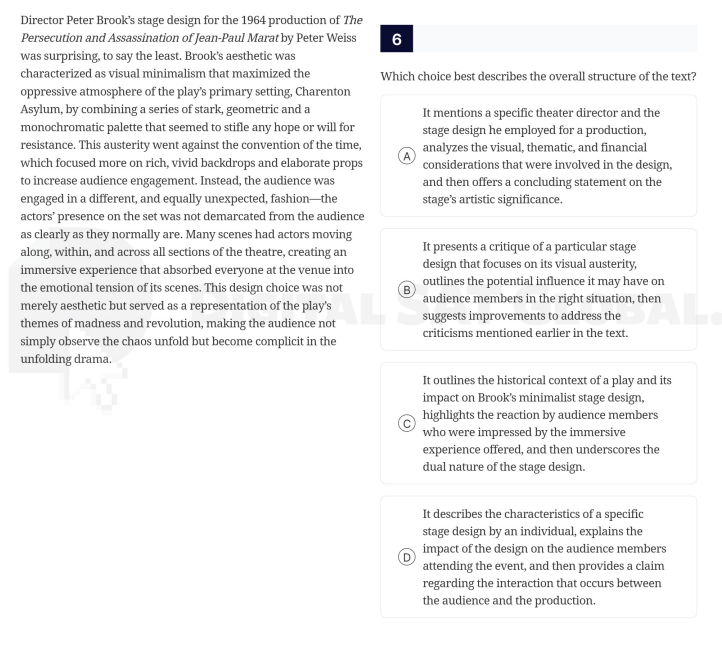
director peter brook’s stage design for the 1964 production of the persecution and assassination of jean - paul marat by peter weiss was surprising, to say the least. brook’s aesthetic was characterized as visual minimalism that maximized the oppressive atmosphere of the play’s primary setting, charenton asylum, by combining a series of stark, geometric and a monochromatic palette that seemed to stifle any hope or will for resistance. this austerity went against the convention of the time, which focused more on rich, vivid backdrops and elaborate props to increase audience engagement. instead, the audience was engaged in a different, and equally unexpected, fashion—the actors’ presence on the set was not demarcated from the audience as clearly as they normally are. many scenes had actors moving along, within, and across all sections of the theatre, creating an immersive experience that absorbed everyone at the venue into the emotional tension of its scenes. this design choice was not merely aesthetic but served as a representation of the play’s themes of madness and revolution, making the audience not simply observe the chaos unfold but become complicit in the unfolding drama.
6 which choice best describes the overall structure of the text?
a it mentions a specific theater director and the stage design he employed for a production, analyzes the visual, thematic, and financial considerations that were involved in the design, and then offers a concluding statement on the stage’s artistic significance.
b it presents a critique of a particular stage design that focuses on its visual austerity, outlines the potential impact it may have on audience members in the right situation, then suggests improvements to address the criticisms mentioned earlier in the text.
c it outlines the historical context of a play and its impact on brook’s minimalist stage design, highlights the reaction by audience members who were impressed by the immersive experience offered, and then underscores the dual nature of the stage design.
d it describes the characteristics of a specific stage design by an individual, explains the impact of the design on the audience members attending the event, and then provides a claim regarding the interaction that occurs between the audience and the production.
- Option A: The text does not offer a concluding statement on the stage’s artistic significance. It focuses on describing the design, its impact on the audience, and the interaction, not a final artistic significance statement. Eliminate A.
- Option B: The text is not a critique of the stage design. It describes the design and its effects positively (how it engaged the audience), not criticizing it or suggesting improvements. Eliminate B.
- Option C: The text does not outline the historical context of the play. It focuses on the stage design, not the play’s historical context. Also, it’s about the design’s impact, not just audience reaction to the design. Eliminate C.
- Option D: The text first describes the characteristics of Peter Brook’s stage design (visual minimalism, stark geometric, monochromatic, etc.). Then it explains the impact on the audience (engaged differently, immersive experience, emotional tension). Finally, it claims the interaction between the audience and the production (audience became complicit in the drama, not just observers). This matches the structure of Option D.

Snap & solve any problem in the app
Get step-by-step solutions on Sovi AI
Photo-based solutions with guided steps
Explore more problems and detailed explanations
D. It describes the characteristics of a specific stage design by an individual, explains the impact of the design on the audience members attending the event, and then provides a claim regarding the interaction that occurs between the audience and the production.