QUESTION IMAGE
Question
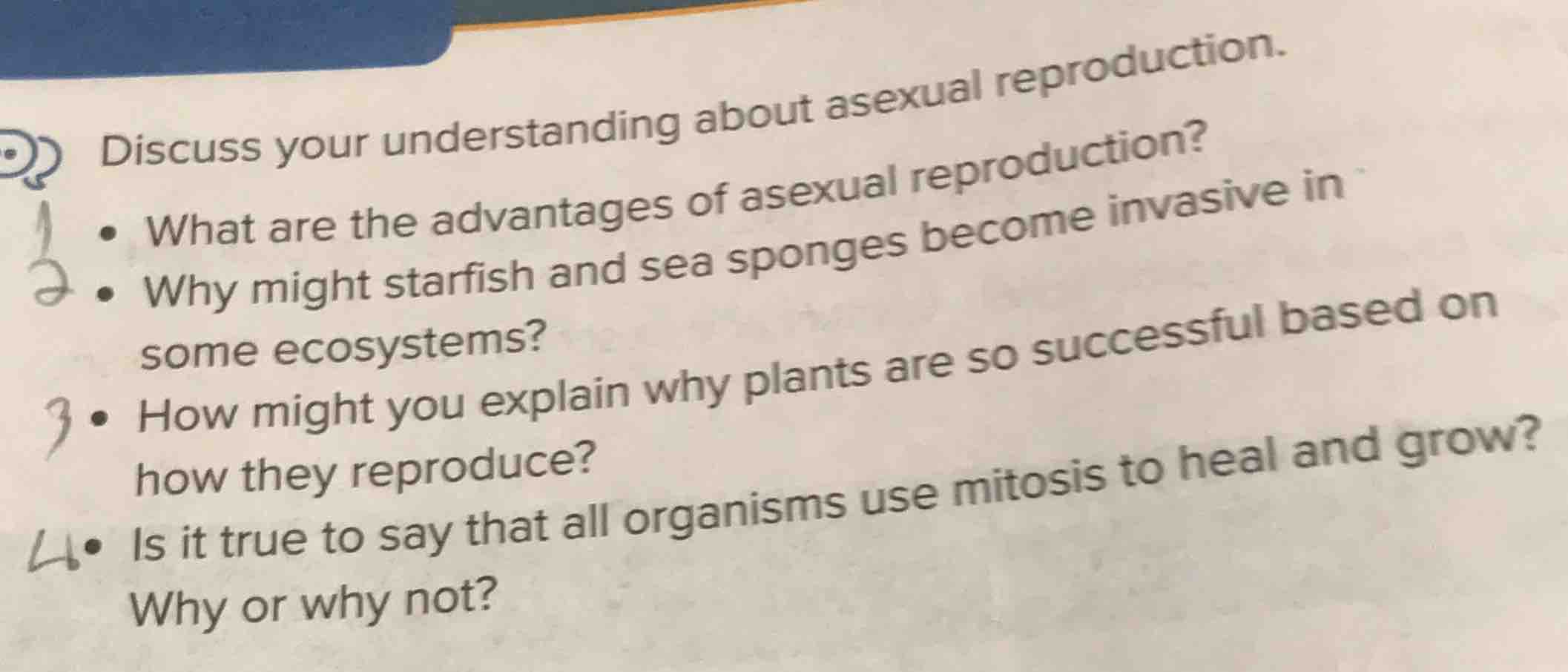
discuss your understanding about asexual reproduction.
- what are the advantages of asexual reproduction?
- why might starfish and sea sponges become invasive in some ecosystems?
- how might you explain why plants are so successful based on how they reproduce?
- is it true to say that all organisms use mitosis to heal and grow? why or why not?
1. Understanding of Asexual Reproduction
Asexual reproduction is a mode of reproduction where offspring arise from a single parent, with no fusion of gametes (sex cells). Offspring are genetically identical (clones) to the parent. Common methods include binary fission (e.g., bacteria), budding (e.g., yeast, hydra), fragmentation (e.g., starfish, flatworms), and vegetative propagation (e.g., plants like strawberries). It is efficient for rapid population growth in stable environments.
2. Advantages of Asexual Reproduction
- Rapid Population Growth: Only one parent is needed, so organisms can reproduce quickly to colonize an area (e.g., bacteria dividing every 20 minutes).
- Energy Efficiency: No need to find a mate, saving energy that would be spent on courtship or gamete production.
- Genetic Stability: Offspring inherit the parent’s successful traits, ensuring survival in a stable environment (e.g., a well - adapted plant clone thrives in its native habitat).
3. Invasiveness of Starfish and Sea Sponges
- Starfish: Use fragmentation (if a limb breaks off, it can regenerate into a new starfish). In new ecosystems, lack of natural predators and abundant resources allow fragmented parts to grow into new individuals rapidly, outcompeting native species.
- Sea Sponges: Reproduce asexually via budding or fragmentation. Invasive sponges can spread quickly as buds detach and establish in new areas, disrupting local ecosystems by outcompeting native filter - feeders for resources like plankton.
4. Plant Success Based on Reproduction
Plants use both sexual (via seeds, introducing genetic variation) and asexual (vegetative propagation: runners, bulbs, cuttings) reproduction. Asexual reproduction allows:
- Rapid Colonization: For example, strawberry plants send out runners (stolons) to quickly cover an area, ensuring access to light, water, and nutrients.
- Preservation of Traits: Well - adapted traits (e.g., drought - resistance in a cactus) are passed unchanged to offspring, ensuring survival in consistent environments.
Sexual reproduction introduces genetic variation, helping plants adapt to new challenges (e.g., pests, climate change), while asexual reproduction provides stability and rapid growth.
5. Mitosis in All Organisms?
No, it is not true. Mitosis is used by eukaryotes (plants, animals, fungi, protists) for growth, repair, and asexual reproduction (in some cases). However:
- Prokaryotes (e.g., bacteria): Use binary fission, not mitosis (they lack a nucleus and mitotic machinery).
- Some Eukaryotes in Sexual Reproduction: Gametes (sperm/egg) are produced via meiosis, not mitosis. Also, some single - celled eukaryotes (e.g., amoeba) use mitosis for asexual reproduction, but the key is that prokaryotes and some reproductive processes in eukaryotes do not rely on mitosis.

Snap & solve any problem in the app
Get step-by-step solutions on Sovi AI
Photo-based solutions with guided steps
Explore more problems and detailed explanations
1. Understanding of Asexual Reproduction
Asexual reproduction is a mode of reproduction where offspring arise from a single parent, with no fusion of gametes (sex cells). Offspring are genetically identical (clones) to the parent. Common methods include binary fission (e.g., bacteria), budding (e.g., yeast, hydra), fragmentation (e.g., starfish, flatworms), and vegetative propagation (e.g., plants like strawberries). It is efficient for rapid population growth in stable environments.
2. Advantages of Asexual Reproduction
- Rapid Population Growth: Only one parent is needed, so organisms can reproduce quickly to colonize an area (e.g., bacteria dividing every 20 minutes).
- Energy Efficiency: No need to find a mate, saving energy that would be spent on courtship or gamete production.
- Genetic Stability: Offspring inherit the parent’s successful traits, ensuring survival in a stable environment (e.g., a well - adapted plant clone thrives in its native habitat).
3. Invasiveness of Starfish and Sea Sponges
- Starfish: Use fragmentation (if a limb breaks off, it can regenerate into a new starfish). In new ecosystems, lack of natural predators and abundant resources allow fragmented parts to grow into new individuals rapidly, outcompeting native species.
- Sea Sponges: Reproduce asexually via budding or fragmentation. Invasive sponges can spread quickly as buds detach and establish in new areas, disrupting local ecosystems by outcompeting native filter - feeders for resources like plankton.
4. Plant Success Based on Reproduction
Plants use both sexual (via seeds, introducing genetic variation) and asexual (vegetative propagation: runners, bulbs, cuttings) reproduction. Asexual reproduction allows:
- Rapid Colonization: For example, strawberry plants send out runners (stolons) to quickly cover an area, ensuring access to light, water, and nutrients.
- Preservation of Traits: Well - adapted traits (e.g., drought - resistance in a cactus) are passed unchanged to offspring, ensuring survival in consistent environments.
Sexual reproduction introduces genetic variation, helping plants adapt to new challenges (e.g., pests, climate change), while asexual reproduction provides stability and rapid growth.
5. Mitosis in All Organisms?
No, it is not true. Mitosis is used by eukaryotes (plants, animals, fungi, protists) for growth, repair, and asexual reproduction (in some cases). However:
- Prokaryotes (e.g., bacteria): Use binary fission, not mitosis (they lack a nucleus and mitotic machinery).
- Some Eukaryotes in Sexual Reproduction: Gametes (sperm/egg) are produced via meiosis, not mitosis. Also, some single - celled eukaryotes (e.g., amoeba) use mitosis for asexual reproduction, but the key is that prokaryotes and some reproductive processes in eukaryotes do not rely on mitosis.