QUESTION IMAGE
Question
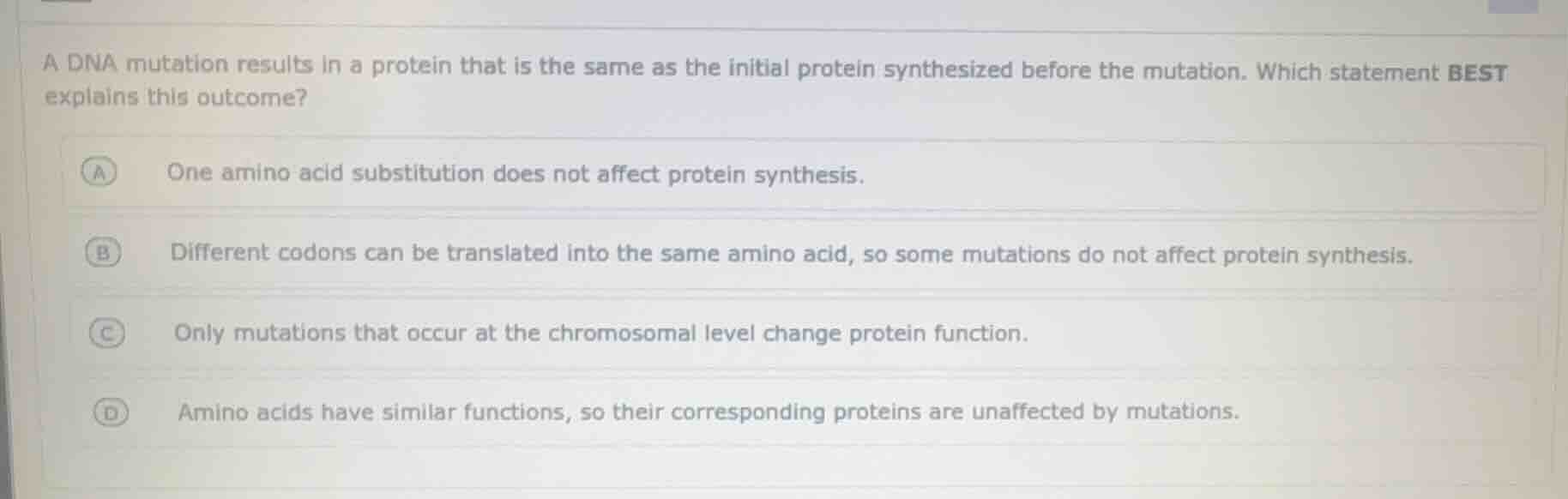
a dna mutation results in a protein that is the same as the initial protein synthesized before the mutation. which statement best explains this outcome? a one amino acid substitution does not affect protein synthesis. b different codons can be translated into the same amino acid, so some mutations do not affect protein synthesis. c only mutations that occur at the chromosomal level change protein function. d amino acids have similar functions, so their corresponding proteins are unaffected by mutations.
To solve this, we analyze each option:
- Option A: Amino acid substitution can affect protein structure/function (e.g., sickle - cell anemia from one substitution), so this is incorrect.
- Option B: The genetic code is degenerate, meaning multiple codons (DNA/RNA triplets) can code for the same amino acid. A DNA mutation that changes a codon to another codon coding for the same amino acid will result in the same protein. This explains why the protein remains unchanged after mutation.
- Option C: Point mutations (not just chromosomal - level) can change protein function, and some mutations (like silent mutations) don't. So this statement is wrong.
- Option D: Amino acids have different functions, and mutations can change the protein's structure/function. This is incorrect.

Snap & solve any problem in the app
Get step-by-step solutions on Sovi AI
Photo-based solutions with guided steps
Explore more problems and detailed explanations
B. Different codons can be translated into the same amino acid, so some mutations do not affect protein synthesis.