QUESTION IMAGE
Question
document analysis
directions: analyze the following text and answer the questions that follow.
the macartney embassy: imperialists set their eyes on china
china had interacted with europeans many times before the age of imperialism. when marco polo arrived in the thirteenth century, he met other europeans that were already there and learning about chinese cultures and traditions. of course, many europeans also went there to try to spread christianity, but these attempts were mostly unsuccessful.
when the spanish and portuguese were dominating the seas during the age of exploration, much thanks to new inventions such as caravels and magnetic compasses, trade routes were set up between europe and china. spain had this advantage over countries like britain because spain had taken silver from the americas, which the chinese took in exchange for silk.
by the 1750s, china limited trade to one port — the port of canton. china insisted on one port because it was easier to collect taxes on the goods traded if all the trade was conducted in one place. it was also easier to keep an eye on the european visitors, as well.
despite the fact that this system worked well, it wasn’t enough for europeans. the british wanted to expand their ports and operate a european - style trading system which caused a conflict with the chinese government, which was still extremely traditional and operating the same way it had operated hundreds of years earlier. british soldiers didn’t understand the traditions of the emperor’s court and didn’t grasp the value of tradition to the chinese government. the more the british persisted on doing things their new, modern, imperialist way, the more the chinese felt insulted, and eventually they felt as though their way of life was under attack.
in 1793, king george iii sent lord george macartney to the emperor’s court to convince the emperor to open ports and an embassy in the northern part of china for trade. he also hoped the emperor would allow british ships to be docked there. king george sent 95 advisors, 50 soldiers, and 600 packages of presents including 90 wagons, 40 barrows, 200 horses, loads of clocks, globes, and porcelain, and 3,000 porters to carry them. however, the emperor in 1793 was the most lavish emperor china had ever seen — and these gifts meant nothing to him.
the emperor dismissed this as a ‘tribute’ and the emperor refused to listen to british demands. instead, he sent macartney back to england with a letter to king george iii in which he dismissed the british as barbarians.
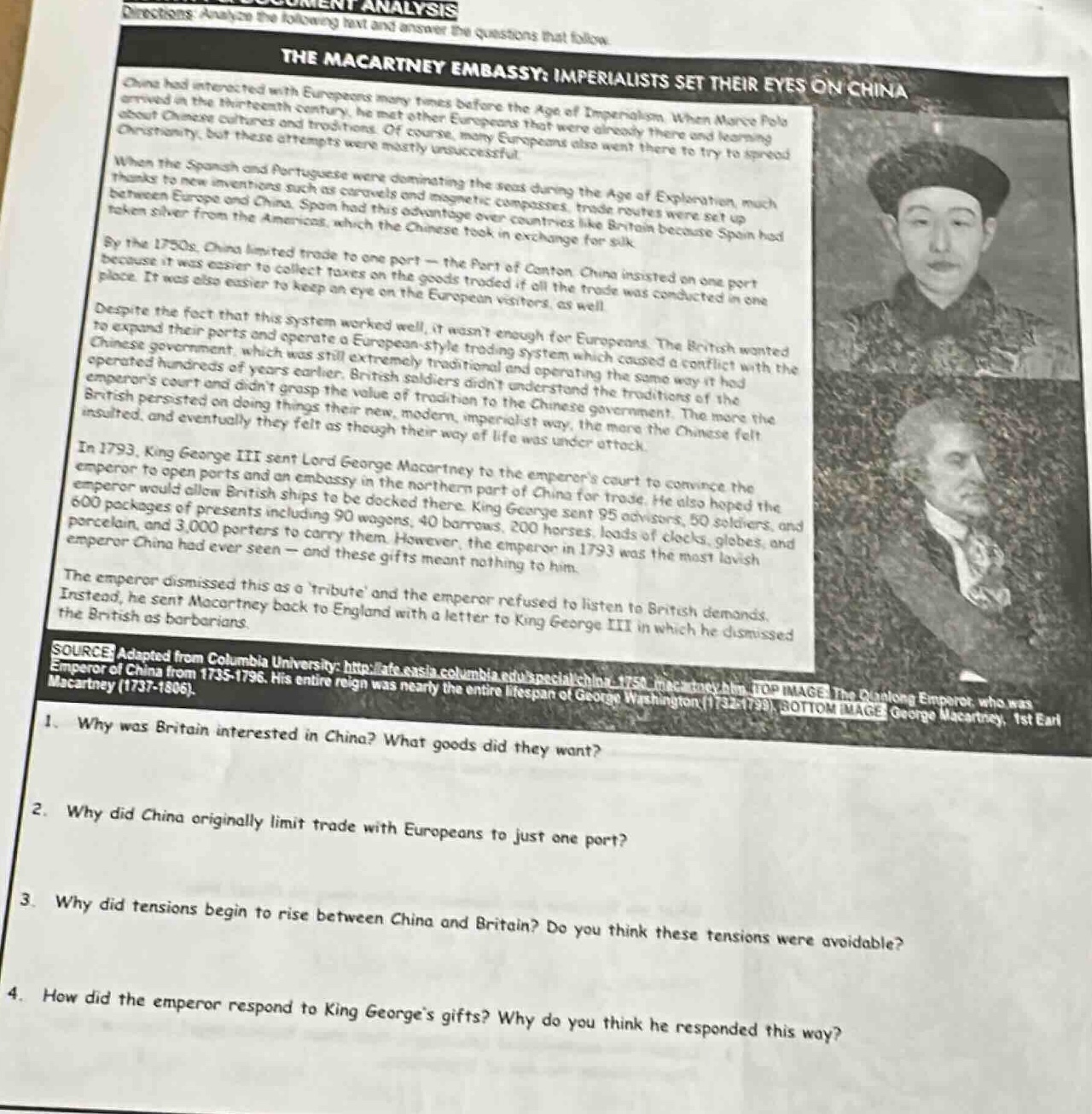
source: adapted from columbia university: http://afe.easia.columbia.edu/special/china_1750_macartney.htm. top image: the qianlong emperor, who was emperor of china from 1735 - 1796. his entire reign was nearly the entire lifespan of george washington (1732 - 1799). bottom image: george macartney, 1st earl macartney (1737 - 1806).
- why was britain interested in china? what goods did they want?
- why did china originally limit trade with europeans to just one port?
- why did tensions begin to rise between china and britain? do you think these tensions were avoidable?
- how did the emperor respond to king george’s gifts? why do you think he responded this way?
- Britain wanted to expand trade with China, as they sought goods like silk (from earlier trade context) and access to a larger market for their own goods, driven by imperialist and commercial interests.
- China limited trade to the Port of Canton because it simplified tax collection on traded goods and made it easier to monitor European visitors, aligning with its traditional, controlled approach to foreign contact.
- Tensions rose because Britain wanted a European-style trading system (expanded ports, new trade rules) that conflicted with China's long-standing traditional trade policies; British disregard for Chinese court traditions also offended the Chinese. These tensions were partially avoidable if Britain had respected Chinese customs and negotiated more gradually, but imperialist ambitions made conflict likely.
- The emperor dismissed the gifts as a "tribute" and rejected British demands, sending Macartney back with a letter calling the British barbarians. He responded this way because China viewed itself as the center of the world (a self-sufficient, superior empire) and saw British goods as unnecessary, while the British failure to follow court protocol reinforced his view of them as uncivilized outsiders.

Snap & solve any problem in the app
Get step-by-step solutions on Sovi AI
Photo-based solutions with guided steps
Explore more problems and detailed explanations
- Britain was interested in China for expanded trade access; they wanted goods like silk, and to sell their own products in China.
- China limited trade to one port to simplify tax collection and monitor Europeans.
- Tensions rose due to conflicting trade systems and British disregard for Chinese traditions. They were partially avoidable with more respectful negotiation, but imperialist goals made conflict probable.
- The emperor dismissed the gifts as tribute, rejected demands, and called the British barbarians. He did this because China saw itself as a self-sufficient, superior empire and viewed British goods and customs as unimportant/uncivilized.