QUESTION IMAGE
Question
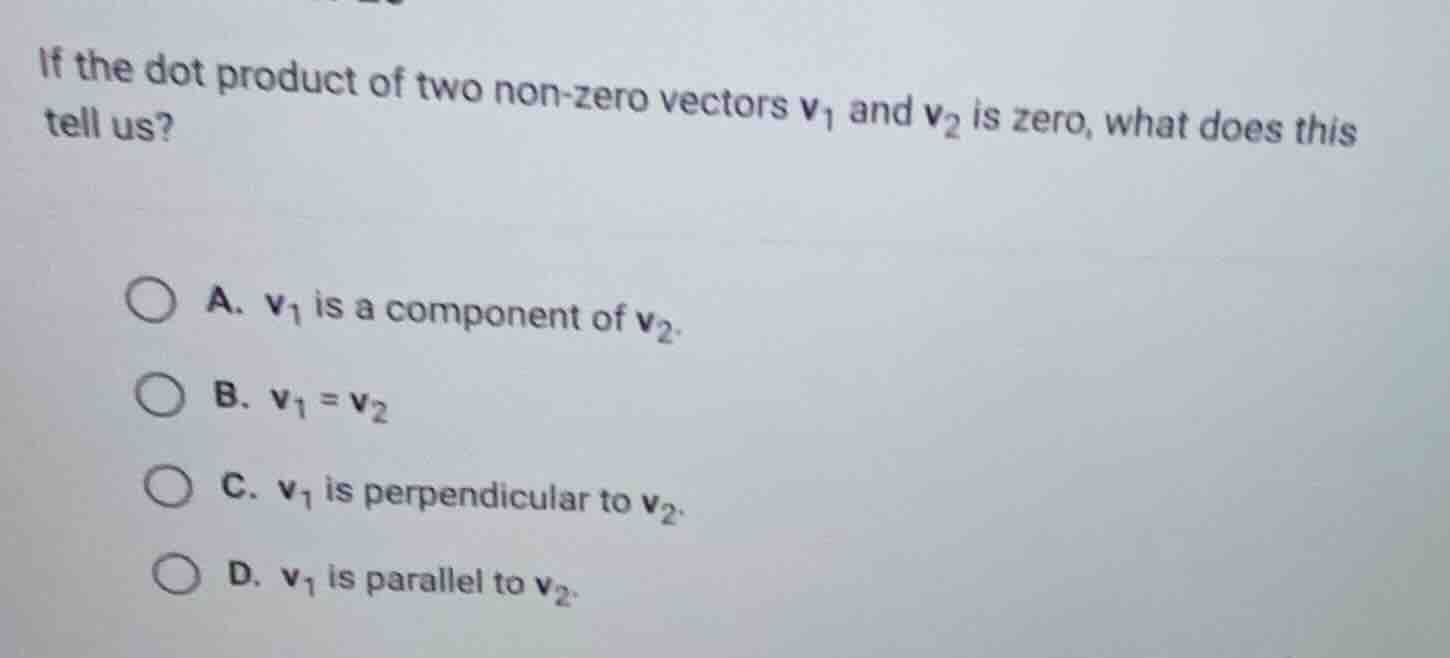
if the dot product of two non - zero vectors \\(\mathbf{v}_1\\) and \\(\mathbf{v}_2\\) is zero, what does this tell us?\
\
a. \\(\mathbf{v}_1\\) is a component of \\(\mathbf{v}_2\\).\
\
b. \\(\mathbf{v}_1 = \mathbf{v}_2\\)\
\
c. \\(\mathbf{v}_1\\) is perpendicular to \\(\mathbf{v}_2\\).\
\
d. \\(\mathbf{v}_1\\) is parallel to \\(\mathbf{v}_2\\).
Step1: Recall dot product formula
The dot product of two vectors $\mathbf{v_1}$ and $\mathbf{v_2}$ is defined as $\mathbf{v_1} \cdot \mathbf{v_2} = \|\mathbf{v_1}\| \|\mathbf{v_2}\| \cos\theta$, where $\theta$ is the angle between the vectors, and $\|\mathbf{v_1}\|, \|\mathbf{v_2}\|$ are the magnitudes of the vectors.
Step2: Apply given condition
We know $\mathbf{v_1} \cdot \mathbf{v_2} = 0$, and $\|\mathbf{v_1}\|
eq 0$, $\|\mathbf{v_2}\|
eq 0$ (non-zero vectors). Substitute into the formula:
$$0 = \|\mathbf{v_1}\| \|\mathbf{v_2}\| \cos\theta$$
Step3: Solve for $\theta$
Since $\|\mathbf{v_1}\| \|\mathbf{v_2}\|
eq 0$, we divide both sides by this product:
$$\cos\theta = 0$$
The angle $\theta$ that satisfies this is $\theta = 90^\circ$ (or $\frac{\pi}{2}$ radians), meaning the vectors are perpendicular.

Snap & solve any problem in the app
Get step-by-step solutions on Sovi AI
Photo-based solutions with guided steps
Explore more problems and detailed explanations
C. $\mathbf{v_1}$ is perpendicular to $\mathbf{v_2}$.