QUESTION IMAGE
Question
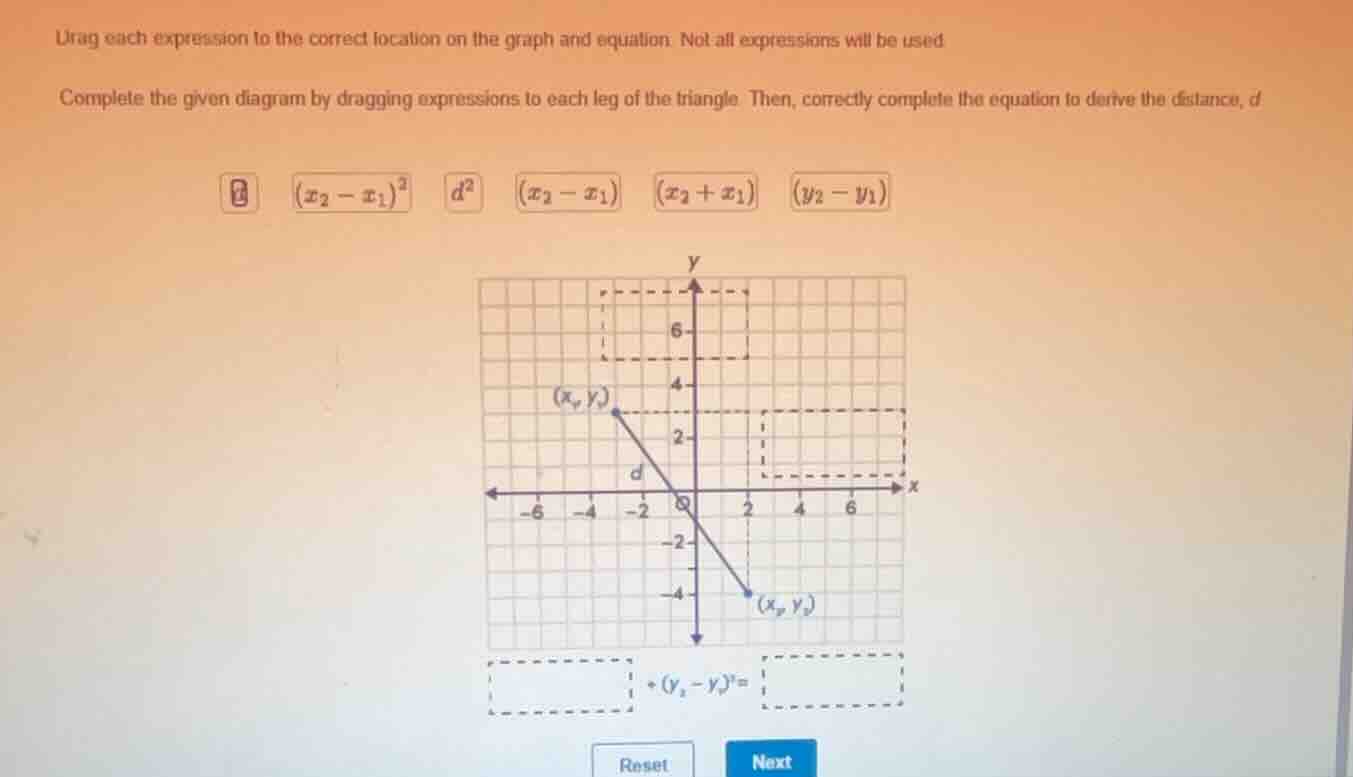
drag each expression to the correct location on the graph and equation. not all expressions will be used
complete the given diagram by dragging expressions to each leg of the triangle. then, correctly complete the equation to derive the distance, ( d )
expressions: ( (x_2 - x_1)^2 ), ( d^2 ), ( (x_2 - x_1) ), ( (x_2 + x_1) ), ( (y_2 - y_1) )
graph with points ( (x_1, y_1) ) and ( (x_2, y_2) ), and a right triangle with hypotenuse ( d ).
equation to complete: ( square + (y_2 - y_1)^2 = square )
Step1: Identify horizontal leg
The horizontal side of the right triangle represents the difference in x-coordinates, so it is $(x_2 - x_1)$. When squared for the Pythagorean theorem, it becomes $(x_2 - x_1)^2$.
Step2: Identify vertical leg
The vertical side of the right triangle represents the difference in y-coordinates, which is $(y_2 - y_1)$.
Step3: Apply Pythagorean theorem
The distance $d$ is the hypotenuse. By the Pythagorean theorem, the sum of the squares of the legs equals the square of the hypotenuse. So the left blank in the equation is $(x_2 - x_1)^2$, and the right blank is $d^2$.

Snap & solve any problem in the app
Get step-by-step solutions on Sovi AI
Photo-based solutions with guided steps
Explore more problems and detailed explanations
- Horizontal leg of the triangle: $(x_2 - x_1)$
- Vertical leg of the triangle: $(y_2 - y_1)$
- Left blank in the equation: $(x_2 - x_1)^2$
- Right blank in the equation: $d^2$
Final completed equation: $(x_2 - x_1)^2 + (y_2 - y_1)^2 = d^2$