QUESTION IMAGE
Question
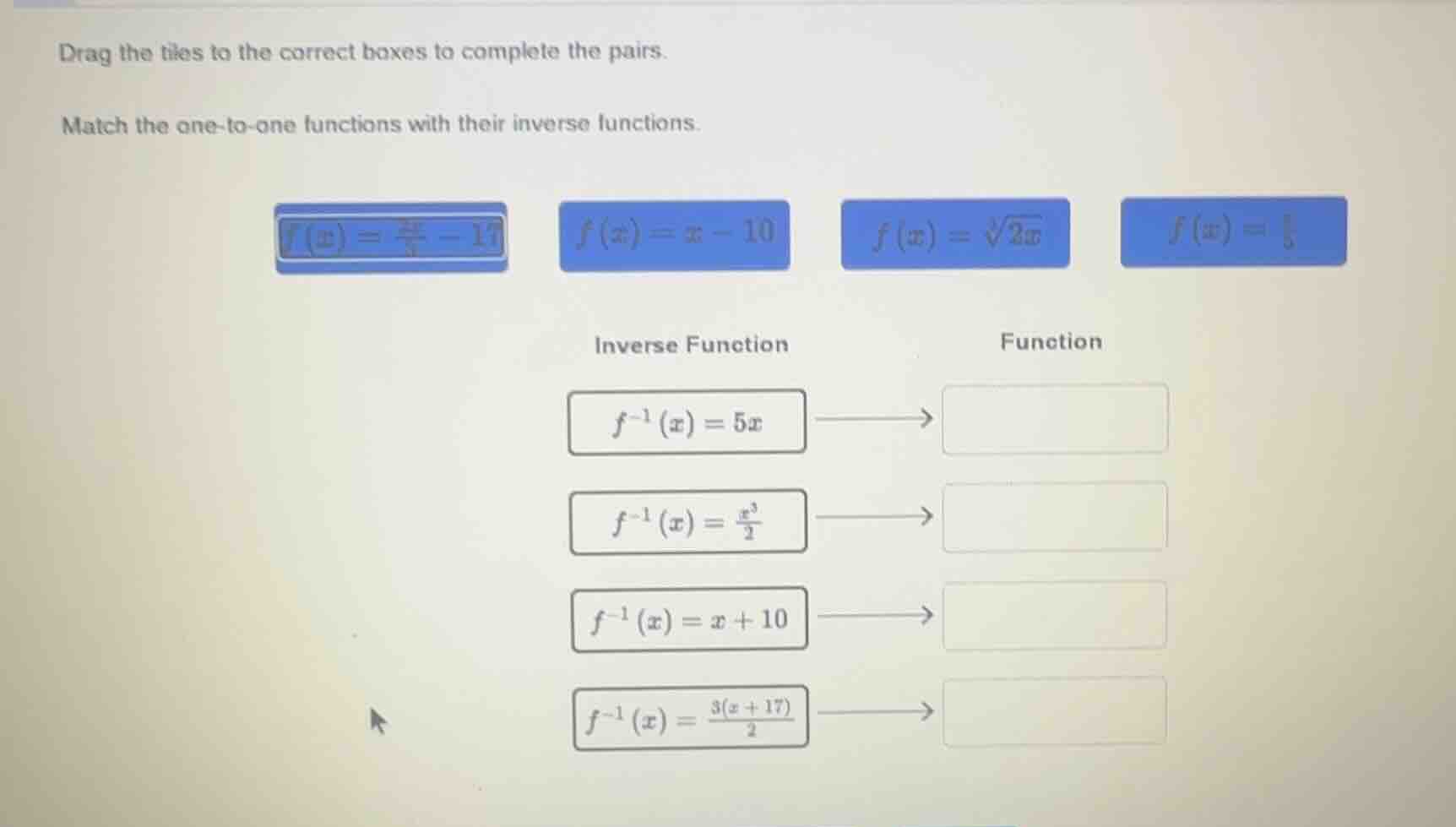
drag the tiles to the correct boxes to complete the pairs.
match the one - to - one functions with their inverse functions.
$f(x)=\frac{2x}{3}-17$ $f(x)=x - 10$ $f(x)=sqrt3{2x}$ $f(x)=\frac{x}{5}$
inverse function function
$f^{-1}(x)=5x$
$f^{-1}(x)=\frac{x^{3}}{2}$
$f^{-1}(x)=x + 10$
$f^{-1}(x)=\frac{3(x + 17)}{2}$
To solve this, we find the inverse of each function by swapping \(x\) and \(y\) (where \(y = f(x)\)) and solving for \(y\).
1. For \( f(x) = \frac{2x}{3} - 17 \)
Let \( y = \frac{2x}{3} - 17 \). Swap \(x\) and \(y\):
\( x = \frac{2y}{3} - 17 \)
Solve for \(y\):
\( x + 17 = \frac{2y}{3} \)
\( 3(x + 17) = 2y \)
\( y = \frac{3(x + 17)}{2} \)
Thus, \( f^{-1}(x) = \frac{3(x + 17)}{2} \) matches \( f(x) = \frac{2x}{3} - 17 \).
2. For \( f(x) = x - 10 \)
Let \( y = x - 10 \). Swap \(x\) and \(y\):
\( x = y - 10 \)
Solve for \(y\):
\( y = x + 10 \)
Thus, \( f^{-1}(x) = x + 10 \) matches \( f(x) = x - 10 \).
3. For \( f(x) = \sqrt[3]{2x} \)
Let \( y = \sqrt[3]{2x} \). Swap \(x\) and \(y\):
\( x = \sqrt[3]{2y} \)
Cube both sides:
\( x^3 = 2y \)
Solve for \(y\):
\( y = \frac{x^3}{2} \)
Thus, \( f^{-1}(x) = \frac{x^3}{2} \) matches \( f(x) = \sqrt[3]{2x} \).
4. For \( f(x) = \frac{x}{5} \) (assuming the last function is \( f(x) = \frac{x}{5} \))
Let \( y = \frac{x}{5} \). Swap \(x\) and \(y\):
\( x = \frac{y}{5} \)
Solve for \(y\):
\( y = 5x \)
Thus, \( f^{-1}(x) = 5x \) matches \( f(x) = \frac{x}{5} \).
Final Matches:
- \( f^{-1}(x) = 5x \) → \( f(x) = \frac{x}{5} \)
- \( f^{-1}(x) = \frac{x^3}{2} \) → \( f(x) = \sqrt[3]{2x} \)
- \( f^{-1}(x) = x + 10 \) → \( f(x) = x - 10 \)
- \( f^{-1}(x) = \frac{3(x + 17)}{2} \) → \( f(x) = \frac{2x}{3} - 17 \)
(Note: If the last function is \( f(x) = \frac{x}{5} \), the matches are as above. If the last function was miswritten, adjust based on the correct original function.)

Snap & solve any problem in the app
Get step-by-step solutions on Sovi AI
Photo-based solutions with guided steps
Explore more problems and detailed explanations
To solve this, we find the inverse of each function by swapping \(x\) and \(y\) (where \(y = f(x)\)) and solving for \(y\).
1. For \( f(x) = \frac{2x}{3} - 17 \)
Let \( y = \frac{2x}{3} - 17 \). Swap \(x\) and \(y\):
\( x = \frac{2y}{3} - 17 \)
Solve for \(y\):
\( x + 17 = \frac{2y}{3} \)
\( 3(x + 17) = 2y \)
\( y = \frac{3(x + 17)}{2} \)
Thus, \( f^{-1}(x) = \frac{3(x + 17)}{2} \) matches \( f(x) = \frac{2x}{3} - 17 \).
2. For \( f(x) = x - 10 \)
Let \( y = x - 10 \). Swap \(x\) and \(y\):
\( x = y - 10 \)
Solve for \(y\):
\( y = x + 10 \)
Thus, \( f^{-1}(x) = x + 10 \) matches \( f(x) = x - 10 \).
3. For \( f(x) = \sqrt[3]{2x} \)
Let \( y = \sqrt[3]{2x} \). Swap \(x\) and \(y\):
\( x = \sqrt[3]{2y} \)
Cube both sides:
\( x^3 = 2y \)
Solve for \(y\):
\( y = \frac{x^3}{2} \)
Thus, \( f^{-1}(x) = \frac{x^3}{2} \) matches \( f(x) = \sqrt[3]{2x} \).
4. For \( f(x) = \frac{x}{5} \) (assuming the last function is \( f(x) = \frac{x}{5} \))
Let \( y = \frac{x}{5} \). Swap \(x\) and \(y\):
\( x = \frac{y}{5} \)
Solve for \(y\):
\( y = 5x \)
Thus, \( f^{-1}(x) = 5x \) matches \( f(x) = \frac{x}{5} \).
Final Matches:
- \( f^{-1}(x) = 5x \) → \( f(x) = \frac{x}{5} \)
- \( f^{-1}(x) = \frac{x^3}{2} \) → \( f(x) = \sqrt[3]{2x} \)
- \( f^{-1}(x) = x + 10 \) → \( f(x) = x - 10 \)
- \( f^{-1}(x) = \frac{3(x + 17)}{2} \) → \( f(x) = \frac{2x}{3} - 17 \)
(Note: If the last function is \( f(x) = \frac{x}{5} \), the matches are as above. If the last function was miswritten, adjust based on the correct original function.)