QUESTION IMAGE
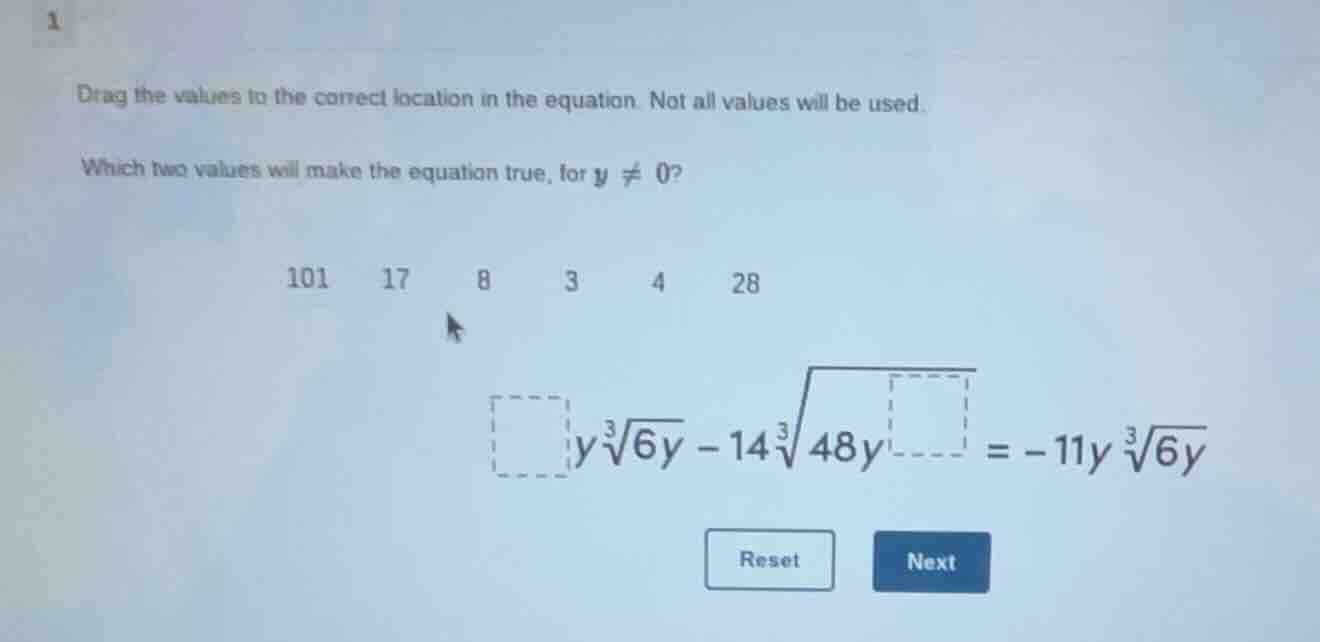
Question
1
drag the values to the correct location in the equation. not all values will be used.
which two values will make the equation true, for ( y
eq 0 )?
101 17 8 3 4 28
( square ysqrt3{6y} - 14sqrt3{48y^square} = -11ysqrt3{6y} )
Step1: Simplify the cube root term
First, simplify \(\sqrt[3]{48y}\). We know that \(48 = 8\times6\), so \(\sqrt[3]{48y}=\sqrt[3]{8\times6y} = 2\sqrt[3]{6y}\) (since \(\sqrt[3]{8} = 2\)).
Step2: Substitute the simplified term
Substitute \(\sqrt[3]{48y}=2\sqrt[3]{6y}\) into the equation: \(\square y\sqrt[3]{6y}- 14\times2\sqrt[3]{6y^{\square}}=- 11y\sqrt[3]{6y}\). Wait, actually, let's re - examine the original equation's structure. The original equation is \(\square y\sqrt[3]{6y}-14\sqrt[3]{48y^{\square}}=-11y\sqrt[3]{6y}\). After simplifying \(\sqrt[3]{48y^n}\) (let's assume the exponent in the cube root is \(n\)), \(48y^n=8\times6y^n\), so \(\sqrt[3]{48y^n}=2\sqrt[3]{6y^n}\).
Let's first look at the left - hand side (LHS) and right - hand side (RHS) in terms of the coefficient of \(y\sqrt[3]{6y}\). Let the first blank be \(a\) and the second blank (the exponent of \(y\) in the cube root) be \(k\). Then the equation is \(a y\sqrt[3]{6y}-14\sqrt[3]{48y^{k}}=-11y\sqrt[3]{6y}\).
Simplify \(\sqrt[3]{48y^{k}}=\sqrt[3]{8\times6y^{k}} = 2\sqrt[3]{6y^{k}}\). So the equation becomes \(a y\sqrt[3]{6y}-14\times2\sqrt[3]{6y^{k}}=-11y\sqrt[3]{6y}\), that is \(a y\sqrt[3]{6y}-28\sqrt[3]{6y^{k}}=-11y\sqrt[3]{6y}\).
For the terms with \(\sqrt[3]{6y}\) to be like terms, the exponent of \(y\) in the cube root must be \(1\) (so that \(\sqrt[3]{6y^{k}}=\sqrt[3]{6y}\) when \(k = 1\), because then we can have terms with \(y\sqrt[3]{6y}\) and \(\sqrt[3]{6y}\) (but we need to match the \(y\) coefficient)). Wait, actually, if \(k = 1\), then \(\sqrt[3]{48y}=\ 2\sqrt[3]{6y}\), and the equation is \(a y\sqrt[3]{6y}-14\times2\sqrt[3]{6y}=-11y\sqrt[3]{6y}\), which is \(a y\sqrt[3]{6y}-28\sqrt[3]{6y}=-11y\sqrt[3]{6y}\). But this is not correct. Wait, maybe the exponent of \(y\) in the cube root is \(1\) and we made a mistake in the coefficient. Wait, let's start over.
Let's consider the equation: \(a y\sqrt[3]{6y}-14\sqrt[3]{48y^{m}}=-11y\sqrt[3]{6y}\).
Simplify \(\sqrt[3]{48y^{m}}=\sqrt[3]{8\times6y^{m}} = 2\sqrt[3]{6y^{m}}\). So the equation is \(a y\sqrt[3]{6y}-14\times2\sqrt[3]{6y^{m}}=a y\sqrt[3]{6y}-28\sqrt[3]{6y^{m}}=-11y\sqrt[3]{6y}\).
For the terms to be like terms, the exponent \(m\) of \(y\) in the cube root must be \(1\), so that \(\sqrt[3]{6y^{m}}=\sqrt[3]{6y}\). Then the equation becomes \(a y\sqrt[3]{6y}-28\sqrt[3]{6y}=-11y\sqrt[3]{6y}\). But we need the terms with \(y\sqrt[3]{6y}\) to combine. Wait, maybe the second term is \(14\sqrt[3]{48y^{4}}\)? No, let's check the values. The given values are \(101,17,8,3,4,28\).
Wait, let's look at the coefficient of \(y\sqrt[3]{6y}\). Let's move the non - \(y\) term to the right: \(a y\sqrt[3]{6y}=-11y\sqrt[3]{6y}+14\sqrt[3]{48y^{k}}\).
If we want the left - hand side to have a coefficient of \(a\) for \(y\sqrt[3]{6y}\) and the right - hand side to also have a term with \(y\sqrt[3]{6y}\), we need to simplify \(\sqrt[3]{48y^{k}}\) such that it has a factor of \(y\sqrt[3]{6y}\) or a factor that can combine with \(y\sqrt[3]{6y}\).
Wait, let's try \(k = 4\)? No, let's try to find \(a\) first. Let's assume that the second term after simplification has a coefficient that when combined with \(a\) gives \(-11\).
Wait, let's consider the equation: \(a y\sqrt[3]{6y}-14\sqrt[3]{48y^{n}}=-11y\sqrt[3]{6y}\). Let's rearrange it as \(a y\sqrt[3]{6y}+11y\sqrt[3]{6y}=14\sqrt[3]{48y^{n}}\). Then \((a + 11)y\sqrt[3]{6y}=14\sqrt[3]{48y^{n}}\).
Simplify \(\sqrt[3]{48y^{n}}=\sqrt[3]{8\times6y^{n}} = 2\sqrt[3]{6y^{n}}\). So \((a + 11)y\sqrt[3]{6y}=14\times2\sqrt[3]{6y^{n}}\), that is \((a + 11)y\sqrt[3]{6y}=28\sqrt[3]{6y^{n…

Snap & solve any problem in the app
Get step-by-step solutions on Sovi AI
Photo-based solutions with guided steps
Explore more problems and detailed explanations
The first blank (coefficient) is \(17\) and the second blank (exponent of \(y\) in the cube root) is \(4\). So the two values are \(17\) and \(4\). The equation becomes \(17y\sqrt[3]{6y}-14\sqrt[3]{48y^{4}}=-11y\sqrt[3]{6y}\) (after substituting the values, we can verify:
Left - hand side: \(17y\sqrt[3]{6y}-14\times2y\sqrt[3]{6y}=17y\sqrt[3]{6y}-28y\sqrt[3]{6y}=(17 - 28)y\sqrt[3]{6y}=-11y\sqrt[3]{6y}\), which matches the right - hand side).