QUESTION IMAGE
Question
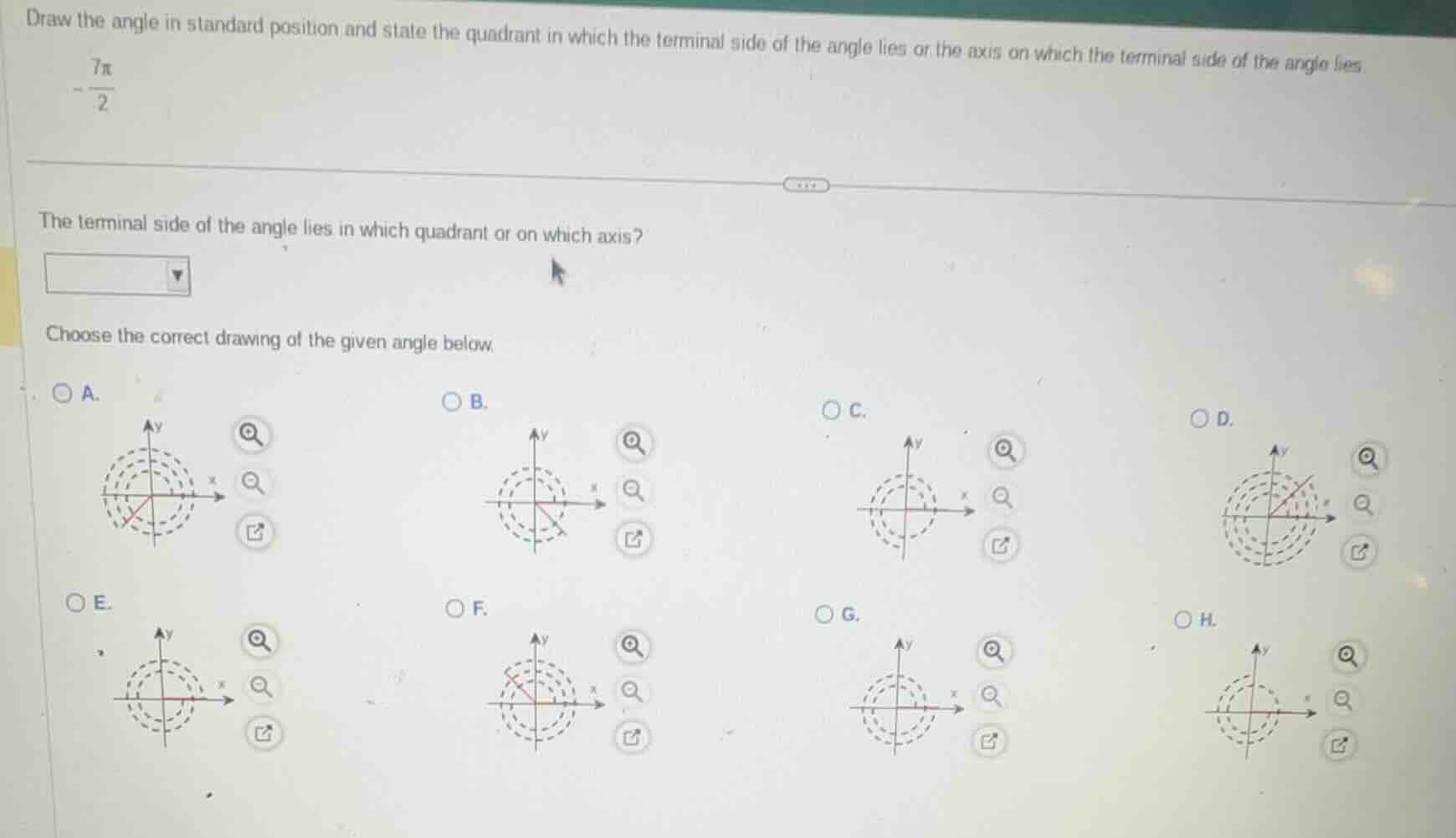
draw the angle in standard position and state the quadrant in which the terminal side of the angle lies or the axis on which the terminal side of the angle lies.
$-\frac{7pi}{2}$
the terminal side of the angle lies in which quadrant or on which axis?
choose the correct drawing of the given angle below.
a.
b.
c.
d.
e.
f.
g.
h.
Step1: Convert negative angle to positive
To find the coterminal angle of $-\frac{7\pi}{2}$, we add multiples of $2\pi$ (since the period of the angle in standard position is $2\pi$). Let's add $4\pi$ (which is $2\times2\pi$) to $-\frac{7\pi}{2}$:
$$-\frac{7\pi}{2}+ 4\pi=-\frac{7\pi}{2}+\frac{8\pi}{2}=\frac{\pi}{2}$$
Step2: Determine the position
The angle $\frac{\pi}{2}$ (or $90^\circ$) in standard position has its terminal side along the positive $y$-axis. Wait, no, wait. Wait, let's check again. Wait, $-\frac{7\pi}{2}$: let's do it step by step. Let's find how many full rotations (each $2\pi$) are in $-\frac{7\pi}{2}$.
The absolute value of $-\frac{7\pi}{2}$ is $\frac{7\pi}{2}= 3\pi+\frac{\pi}{2}= 2\pi + \pi+\frac{\pi}{2}$. So when we rotate clockwise (because the angle is negative) by $\frac{7\pi}{2}$, we can think of it as rotating clockwise $3$ full rotations and then an additional $\pi+\frac{\pi}{2}=\frac{3\pi}{2}$? Wait, no, maybe a better way: add $2\pi$ until we get an angle between $0$ and $2\pi$.
$-\frac{7\pi}{2}+ 2\pi=-\frac{7\pi}{2}+\frac{4\pi}{2}=-\frac{3\pi}{2}$
$-\frac{3\pi}{2}+ 2\pi=-\frac{3\pi}{2}+\frac{4\pi}{2}=\frac{\pi}{2}$
Ah, so the coterminal angle is $\frac{\pi}{2}$, which is $90^\circ$, so the terminal side is along the positive $y$-axis? Wait, no, wait $\frac{\pi}{2}$ is positive $y$-axis. But wait, let's check the direction. A negative angle means clockwise rotation. So starting from the positive $x$-axis, rotating clockwise by $\frac{7\pi}{2}$. Let's see, $\frac{7\pi}{2}= 3\pi+\frac{\pi}{2}= 2\pi+\pi+\frac{\pi}{2}$. So rotating clockwise $2\pi$ (a full circle) brings us back to the positive $x$-axis. Then rotating clockwise another $\pi+\frac{\pi}{2}=\frac{3\pi}{2}$. Rotating clockwise $\pi$ from positive $x$-axis is negative $x$-axis, then rotating clockwise $\frac{\pi}{2}$ more is negative $y$-axis? Wait, I think I made a mistake in the coterminal angle calculation.
Wait, let's calculate the coterminal angle correctly. The formula for coterminal angles is $\theta + 2\pi n$, where $n$ is an integer. We want to find $n$ such that $\theta + 2\pi n$ is between $0$ and $2\pi$.
For $\theta=-\frac{7\pi}{2}$, let's solve for $n$:
$0\leq -\frac{7\pi}{2}+ 2\pi n< 2\pi$
Add $\frac{7\pi}{2}$ to all parts:
$\frac{7\pi}{2}\leq 2\pi n< 2\pi+\frac{7\pi}{2}=\frac{4\pi + 7\pi}{2}=\frac{11\pi}{2}$
Divide all parts by $2\pi$:
$\frac{7\pi}{2}\div(2\pi)\leq n<\frac{11\pi}{2}\div(2\pi)$
$\frac{7}{4}\leq n<\frac{11}{4}$
Since $n$ must be an integer, $n = 2$ (because $\frac{7}{4}=1.75$ and $\frac{11}{4}=2.75$). So $n = 2$:
$\theta + 2\pi\times2=-\frac{7\pi}{2}+ 4\pi=-\frac{7\pi}{2}+\frac{8\pi}{2}=\frac{\pi}{2}$
So the coterminal angle is $\frac{\pi}{2}$, which is $90^\circ$, so the terminal side is along the positive $y$-axis. Wait, but let's visualize the rotation. A negative angle is clockwise. So starting at positive $x$-axis, rotating clockwise by $\frac{7\pi}{2}$. Let's see, $\frac{7\pi}{2}= 3.5\pi$. A full clockwise rotation is $-2\pi$, so $3.5\pi$ clockwise is the same as $3.5\pi - 2\pi=1.5\pi$ clockwise? No, wait, the magnitude of the angle is $\frac{7\pi}{2}$, direction is clockwise. So the terminal side after rotating clockwise $\frac{7\pi}{2}$ is the same as rotating counterclockwise $\frac{\pi}{2}$ (since $\frac{7\pi}{2}- 2\pi\times2=\frac{7\pi}{2}-4\pi=-\frac{\pi}{2}$? Wait, I'm getting confused. Let's use the unit circle.
The standard position: initial side on positive $x$-axis, terminal side determined by rotating counterclockwise (positive angle) or clockwise (negative angle).
For $-\frac…

Snap & solve any problem in the app
Get step-by-step solutions on Sovi AI
Photo-based solutions with guided steps
Explore more problems and detailed explanations
The terminal side of the angle $-\frac{7\pi}{2}$ lies on the positive $y$-axis (or the $y$-axis). For the drawing, the correct diagram should have the terminal side along the positive $y$-axis. (Assuming among the options, the one with terminal side on positive $y$-axis is the correct drawing, e.g., if option G or another option has the terminal side on positive $y$-axis, that's the correct one. But based on the angle calculation, the terminal side is on the $y$-axis.)