QUESTION IMAGE
Question
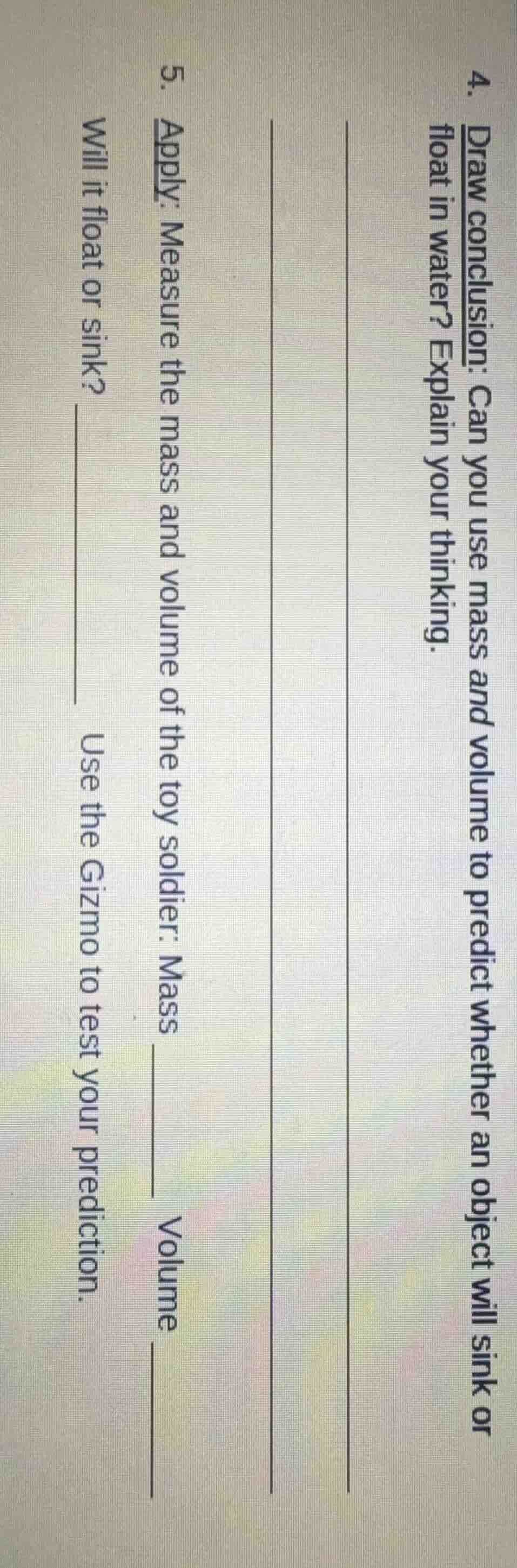
- draw conclusion: can you use mass and volume to predict whether an object will sink or float in water? explain your thinking.
- apply: measure the mass and volume of the toy soldier: mass ____ volume ____
will it float or sink? ______ use the gizmo to test your prediction.
Question 4 (Draw conclusion)
To determine if an object sinks or floats, we use density ($
ho = \frac{m}{V}$, where $m$ is mass and $V$ is volume). If an object’s density ($\frac{\text{mass}}{\text{volume}}$) is less than water’s density ($1\ \text{g/cm}^3$ or $1000\ \text{kg/m}^3$), it floats; if greater, it sinks. So mass and volume (via density) can predict buoyancy.
Step 1: Measure mass/volume
Use a balance (or Gizmo tool) to find the toy soldier’s mass ($m$) and a displacement method (or Gizmo) to find its volume ($V$).
Step 2: Calculate density
Compute density as $
ho = \frac{m}{V}$.
Step 3: Compare to water’s density
Water’s density is $1\ \text{g/cm}^3$ (or $1000\ \text{kg/m}^3$). If $
ho_{\text{soldier}} < 1\ \text{g/cm}^3$, it floats; if $
ho_{\text{soldier}} > 1\ \text{g/cm}^3$, it sinks. Then test with the Gizmo.

Snap & solve any problem in the app
Get step-by-step solutions on Sovi AI
Photo-based solutions with guided steps
Explore more problems and detailed explanations
Yes, we can use mass and volume to predict if an object will sink or float. By calculating the object’s density ($
ho = \frac{\text{mass}}{\text{volume}}$) and comparing it to water’s density ($1\ \text{g/cm}^3$), we determine buoyancy: if $
ho_{\text{object}} < 1\ \text{g/cm}^3$, it floats; if $
ho_{\text{object}} > 1\ \text{g/cm}^3$, it sinks.