QUESTION IMAGE
Question
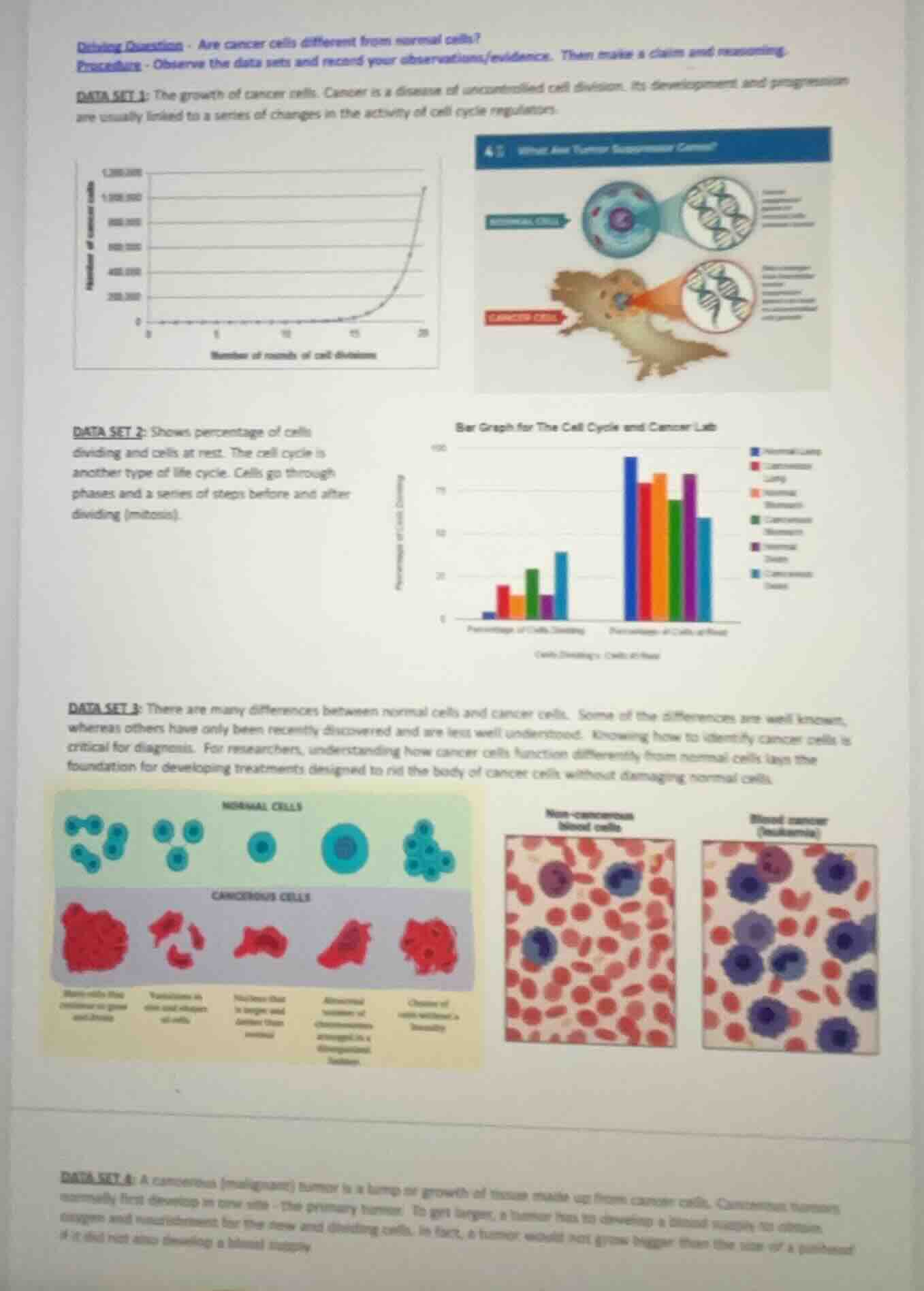
driving question: are cancer cells different from normal cells? procedure: observe the data sets and record your observations/evidence. then make a claim and reasoning. data set 1: the growth of cancer cells. cancer is a disease of uncontrolled cell division. its development and progression are usually linked to a series of changes in the activity of cell cycle regulators. data set 2: shows percentage of cells dividing and cells at rest. the cell cycle is another type of life cycle. cells go through phases and a series of steps before and after dividing (mitosis). data set 3: there are many differences between normal cells and cancer cells. some of the differences are well known, whereas others have only been recently discovered and are less well understood. knowing how to identify cancer cells is critical for diagnosis. for researchers, understanding how cancer cells function differently from normal cells lays the foundation for developing treatments designed to rid the body of cancer cells without damaging normal cells. data set 4: a cancerous (malignant) tumor is a lump or growth of tissue made up from cancer cells. cancerous tumors normally first develop in one site - the primary tumor. to get larger, a tumor has to develop a blood supply to obtain oxygen and nourishment for the new and dividing cells. in fact, a tumor would not grow bigger than the size of a pinhead if it did not also develop a blood supply
- From Data Set 1: Cancer cells undergo uncontrolled, exponential cell division (unlike normal cells which have regulated division), as shown by the steep growth curve of cell numbers with each round of division. Cancer cells also have dysfunctional tumor suppressor genes (which normally limit cell division), while normal cells have functional versions of these genes.
- From Data Set 2: A higher percentage of cancer cells are actively dividing compared to normal cells, and a lower percentage of cancer cells are at rest, meaning cancer cells spend far less time in non-dividing (resting) phases of the cell cycle.
- From Data Set 3: Cancer cells have distinct structural and functional differences: they lack controlled growth/division, have abnormal size/shape, larger nuclei than normal cells, abnormal chromosome arrangement, and can grow without a substrate (anchorage independence). Blood cancer cells also show abnormal, oversized cells compared to non-cancerous blood cells.
- From Data Set 4: Cancer cells form malignant tumors that develop their own blood supply (angiogenesis) to support uncontrolled growth, allowing tumors to grow beyond a tiny size, unlike normal cell growth which is limited and does not form such invasive, blood-feeding masses.

Snap & solve any problem in the app
Get step-by-step solutions on Sovi AI
Photo-based solutions with guided steps
Explore more problems and detailed explanations
Yes, cancer cells are significantly different from normal cells:
- They undergo uncontrolled, exponential cell division due to dysfunctional cell cycle regulators (like non-functional tumor suppressor genes).
- A higher proportion of cancer cells are actively dividing, with far fewer in resting phases of the cell cycle.
- They have abnormal physical traits: irregular size/shape, enlarged nuclei, disorganized chromosomes, and can grow without anchoring to a substrate.
- Cancer cells form malignant tumors that develop their own blood supply to sustain unlimited growth, unlike normal, regulated cell growth.