QUESTION IMAGE
Question
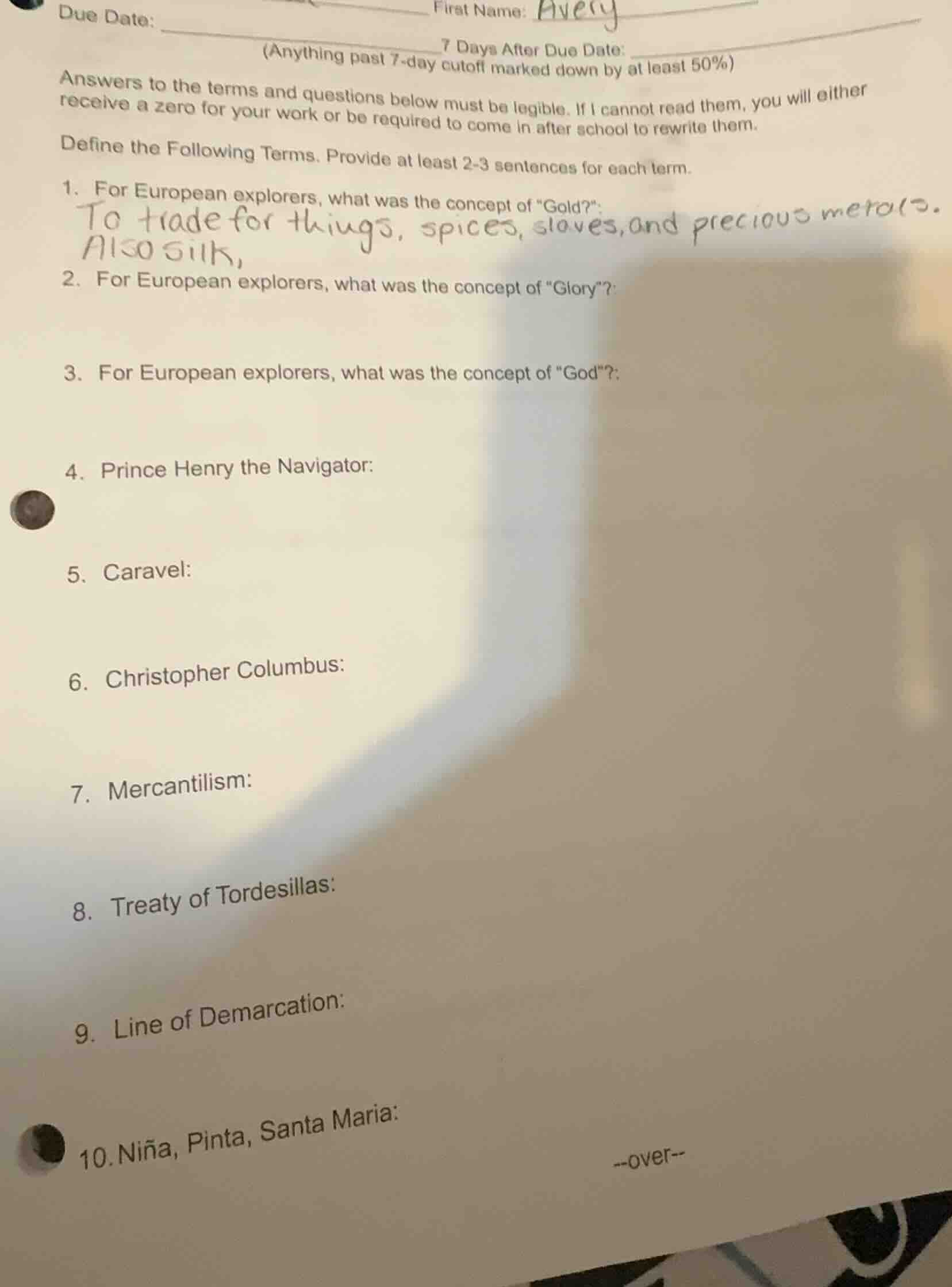
due date: first name: avery
7 days after due date:
(anything past 7 - day cutoff marked down by at least 50%)
answers to the terms and questions below must be legible. if i cannot read them, you will either
receive a zero for your work or be required to come in after school to rewrite them.
define the following terms. provide at least 2 - 3 sentences for each term.
- for european explorers, what was the concept of \gold?\:
to trade for things, spices, slaves, and precious metals.
also silk,
- for european explorers, what was the concept of \glory\?
- for european explorers, what was the concept of \god\?;
- prince henry the navigator:
- caravel:
- christopher columbus:
- mercantilism:
- treaty of tordesillas:
- line of demarcation:
- niña, pinta, santa maria:
--over--
To answer these questions, we'll define each term related to European exploration:
1. For European explorers, what was the concept of “Gold”?
Gold represented wealth and power. Explorers sought gold to enrich their countries, fund further expeditions, and trade for luxury goods (spices, silk) or resources. It symbolized economic prosperity and national prestige.
2. For European explorers, what was the concept of “Glory”?
Glory meant fame, honor, and national pride. Explorers sought glory by claiming new lands, discovering trade routes, or achieving feats that elevated their status (and their country’s) in Europe. It tied to competition between nations.
3. For European explorers, what was the concept of “God”?
“God” reflected religious motivation: spreading Christianity (especially Catholicism) to new lands. Explorers aimed to convert indigenous peoples, believing it was their duty to expand the faith and save souls, often partnering with the Church.
4. Prince Henry the Navigator
Prince Henry (of Portugal) sponsored maritime expeditions. He established a navigation school, promoted mapmaking/shipbuilding, and funded voyages along Africa’s coast. His efforts launched Portugal’s Age of Exploration.
5. Caravel
A caravel was a small, fast sailing ship with triangular (lateen) sails. Used in the Age of Exploration, it handled open seas well, had shallow drafts for coastal exploration, and enabled long-distance voyages (e.g., Columbus’s trips).
6. Christopher Columbus
Columbus was an Italian explorer sailing for Spain. In 1492, he “discovered” the Americas (thinking it was Asia), sparking European colonization. His voyages opened transatlantic trade and colonization of the New World.
7. Mercantilism
Mercantilism was an economic system where nations sought to accumulate wealth (gold/silver) via trade. Colonies existed to supply raw materials and buy finished goods, maximizing exports and minimizing imports. It drove colonial expansion.
8. Treaty of Tordesillas
A 1494 treaty between Spain and Portugal, mediated by the Pope. It divided newly discovered lands: Spain got most of the Americas, Portugal got Brazil and Africa/Asia territories, avoiding conflict.
9. Line of Demarcation
A line (set by the Treaty of Tordesillas) at ~370 leagues west of Cape Verde. Lands east went to Portugal, west to Spain, defining colonial claims in the Americas/Asia.
10. Niña, Pinta, Santa Maria
These were Columbus’s three ships on his 1492 voyage. The Santa Maria was his flagship (a carrack), while Niña and Pinta were caravels. They carried him to the Caribbean, launching European contact with the Americas.
(Note: For the original handwritten answer to “Gold,” it mentions trading for goods, spices, slaves, precious metals, and silk—this aligns with the economic motives of “Gold” in exploration.)

Snap & solve any problem in the app
Get step-by-step solutions on Sovi AI
Photo-based solutions with guided steps
Explore more problems and detailed explanations
To answer these questions, we'll define each term related to European exploration:
1. For European explorers, what was the concept of “Gold”?
Gold represented wealth and power. Explorers sought gold to enrich their countries, fund further expeditions, and trade for luxury goods (spices, silk) or resources. It symbolized economic prosperity and national prestige.
2. For European explorers, what was the concept of “Glory”?
Glory meant fame, honor, and national pride. Explorers sought glory by claiming new lands, discovering trade routes, or achieving feats that elevated their status (and their country’s) in Europe. It tied to competition between nations.
3. For European explorers, what was the concept of “God”?
“God” reflected religious motivation: spreading Christianity (especially Catholicism) to new lands. Explorers aimed to convert indigenous peoples, believing it was their duty to expand the faith and save souls, often partnering with the Church.
4. Prince Henry the Navigator
Prince Henry (of Portugal) sponsored maritime expeditions. He established a navigation school, promoted mapmaking/shipbuilding, and funded voyages along Africa’s coast. His efforts launched Portugal’s Age of Exploration.
5. Caravel
A caravel was a small, fast sailing ship with triangular (lateen) sails. Used in the Age of Exploration, it handled open seas well, had shallow drafts for coastal exploration, and enabled long-distance voyages (e.g., Columbus’s trips).
6. Christopher Columbus
Columbus was an Italian explorer sailing for Spain. In 1492, he “discovered” the Americas (thinking it was Asia), sparking European colonization. His voyages opened transatlantic trade and colonization of the New World.
7. Mercantilism
Mercantilism was an economic system where nations sought to accumulate wealth (gold/silver) via trade. Colonies existed to supply raw materials and buy finished goods, maximizing exports and minimizing imports. It drove colonial expansion.
8. Treaty of Tordesillas
A 1494 treaty between Spain and Portugal, mediated by the Pope. It divided newly discovered lands: Spain got most of the Americas, Portugal got Brazil and Africa/Asia territories, avoiding conflict.
9. Line of Demarcation
A line (set by the Treaty of Tordesillas) at ~370 leagues west of Cape Verde. Lands east went to Portugal, west to Spain, defining colonial claims in the Americas/Asia.
10. Niña, Pinta, Santa Maria
These were Columbus’s three ships on his 1492 voyage. The Santa Maria was his flagship (a carrack), while Niña and Pinta were caravels. They carried him to the Caribbean, launching European contact with the Americas.
(Note: For the original handwritten answer to “Gold,” it mentions trading for goods, spices, slaves, precious metals, and silk—this aligns with the economic motives of “Gold” in exploration.)