QUESTION IMAGE
Question
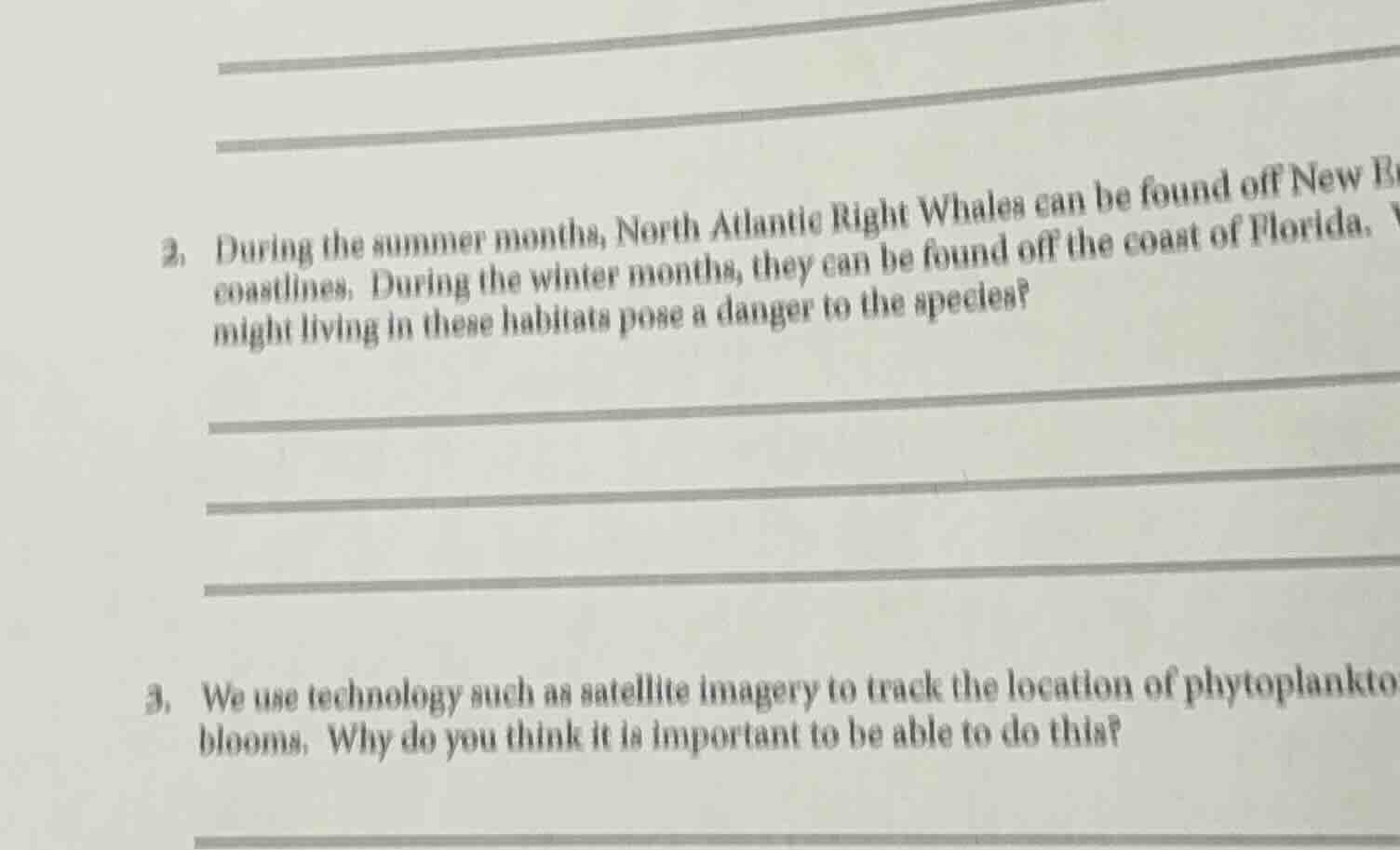
- during the summer months, north atlantic right whales can be found off new b coastlines. during the winter months, they can be found off the coast of florida. might living in these habitats pose a danger to the species?
- we use technology such as satellite imagery to track the location of phytoplankto blooms. why do you think it is important to be able to do this?
Brief Explanations
For Question 2:
- Coastal Human Activity: Both New England and Florida coasts have heavy commercial shipping, fishing, and recreational boating. Collisions with ships and entanglement in fishing gear are major threats to right whales.
- Habitat Degradation: Coastal development, pollution (runoff, plastic waste), and noise pollution from human activities disrupt feeding, mating, and calving behaviors.
- Climate Shifts: Warming ocean temperatures in these regions can alter prey availability (right whales feed on zooplankton that depend on cold, nutrient-rich waters), leading to food scarcity.
For Question 3:
- Marine Food Web Support: Phytoplankton are the base of the marine food web; tracking blooms helps monitor food availability for zooplankton, fish, whales, and other marine life.
- Ecosystem Health Indicator: Changes in phytoplankton bloom timing, location, or size signal shifts in ocean conditions (e.g., nutrient levels, temperature, ocean acidification), indicating overall marine ecosystem health.
- Fisheries Management: Phytoplankton blooms support fish larvae and commercial fish stocks; tracking them helps predict fish population trends and inform sustainable fishing practices.
- Climate Change Monitoring: Phytoplankton absorb large amounts of carbon dioxide; monitoring blooms helps study ocean carbon cycling and the ocean's role in mitigating climate change.

Snap & solve any problem in the app
Get step-by-step solutions on Sovi AI
Photo-based solutions with guided steps
Explore more problems and detailed explanations
Question 2:
Living in these coastal habitats endangers North Atlantic Right Whales primarily due to:
- High risk of ship collisions and entanglement in commercial fishing gear in busy coastal waters.
- Habitat disruption and pollution from coastal human activities that interfere with feeding, mating, and calving.
- Potential prey scarcity as ocean warming alters the distribution of their cold-water zooplankton food source in these regions.
Question 3:
Tracking phytoplankton blooms is important because:
- They form the base of the marine food web, so monitoring them supports understanding food availability for all higher marine organisms.
- They act as key indicators of overall marine ecosystem health, reflecting changes in ocean chemistry, temperature, and nutrient levels.
- They help inform fisheries management by predicting the health of commercial fish stocks that rely on phytoplankton-supported food chains.
- They play a critical role in global carbon cycling, so tracking them aids in studying the ocean's ability to sequester carbon and mitigate climate change.