QUESTION IMAGE
Question
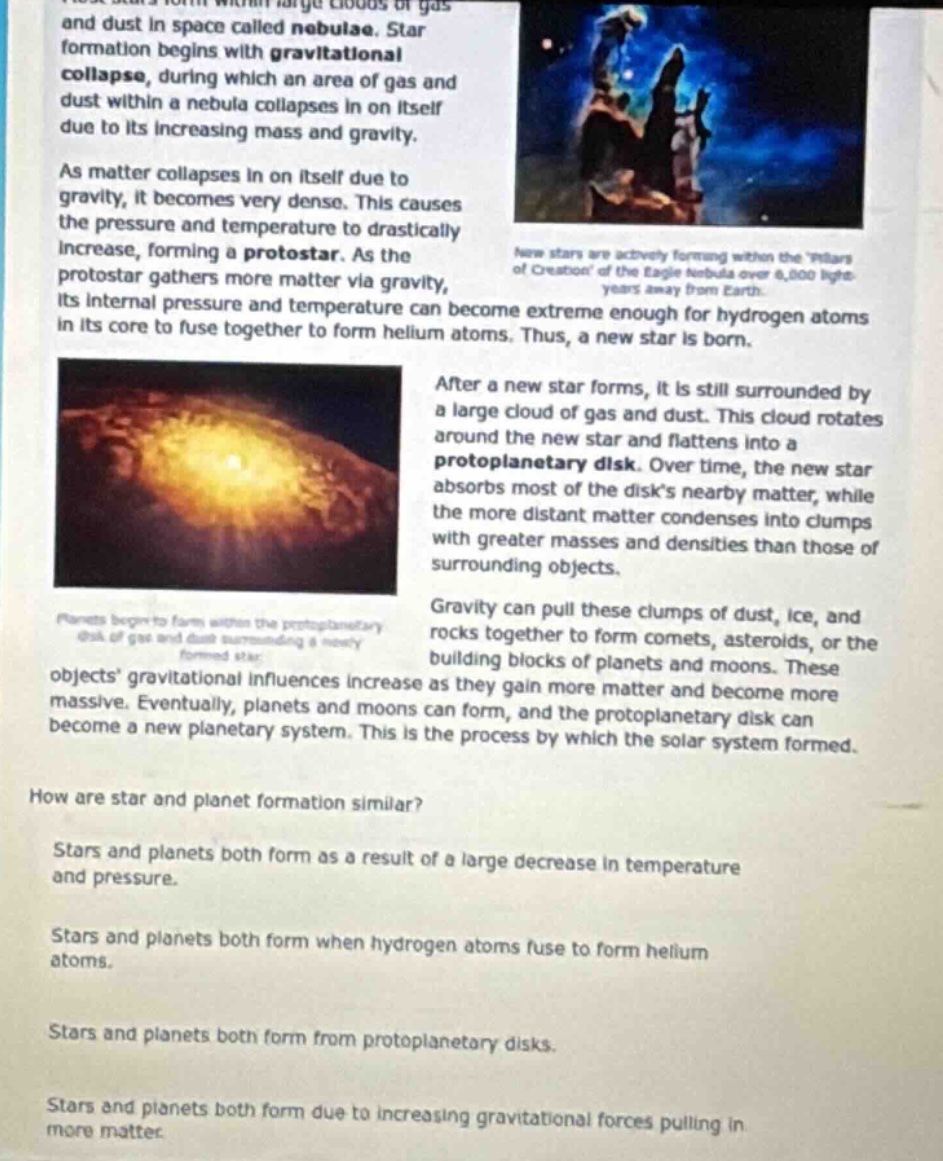
and dust in space called nebulae. star formation begins with gravitational collapse, during which an area of gas and dust within a nebula collapses in on itself due to its increasing mass and gravity.
as matter collapses in on itself due to gravity, it becomes very dense. this causes the pressure and temperature to drastically increase, forming a protostar. as the protostar gathers more matter via gravity, its internal pressure and temperature can become extreme enough for hydrogen atoms in its core to fuse together to form helium atoms. thus, a new star is born.
after a new star forms, it is still surrounded by a large cloud of gas and dust. this cloud rotates around the new star and flattens into a protoplanetary disk. over time, the new star absorbs most of the disk’s nearby matter, while the more distant matter condenses into clumps with greater masses and densities than those of surrounding objects.
gravity can pull these clumps of dust, ice, and rocks together to form comets, asteroids, or the building blocks of planets and moons. these objects’ gravitational influences increase as they gain more matter and become more massive. eventually, planets and moons can form, and the protoplanetary disk can become a new planetary system. this is the process by which the solar system formed.
how are star and planet formation similar?
stars and planets both form as a result of a large decrease in temperature and pressure.
stars and planets both form when hydrogen atoms fuse to form helium atoms.
stars and planets both form from protoplanetary disks.
stars and planets both form due to increasing gravitational forces pulling in more matter.
new stars are actively forming within the \pillars of creation\ of the eagle nebula over 6,000 light - years away from earth.
planets begin to form within the protoplanetary disk of gas and dust surrounding a newly formed star:
- Analicemos cada opción:
- Opción 1: La formación de estrellas implica un aumento de presión y temperatura, no una disminución. Entonces, esta opción es incorrecta.
- Opción 2: La fusión de hidrógeno para formar helio ocurre solo en el núcleo de las estrellas, no en la formación de planetas. Por lo tanto, esta opción es errónea.
- Opción 3: Las estrellas se forman a partir de nebulosas (nubes de gas y polvo), y los planetas se forman a partir de discos protoplanetarios que rodean a las estrellas recién formadas. Las estrellas no se forman a partir de discos protoplanetarios. Así, esta opción es incorrecta.
- Opción 4: Para la formación de estrellas, la gravedad hace que el gas y el polvo en una nebulosa colapsen (atraen más materia). Para la formación de planetas, la gravedad atrae masas de polvo, hielo y rocas (clumps) para formar planetas y lunas. En ambos casos, la gravedad incrementa y atrae más materia. Esta opción es correcta.

Snap & solve any problem in the app
Get step-by-step solutions on Sovi AI
Photo-based solutions with guided steps
Explore more problems and detailed explanations
D. Stars and planets both form due to increasing gravitational forces pulling in more matter.