QUESTION IMAGE
Question
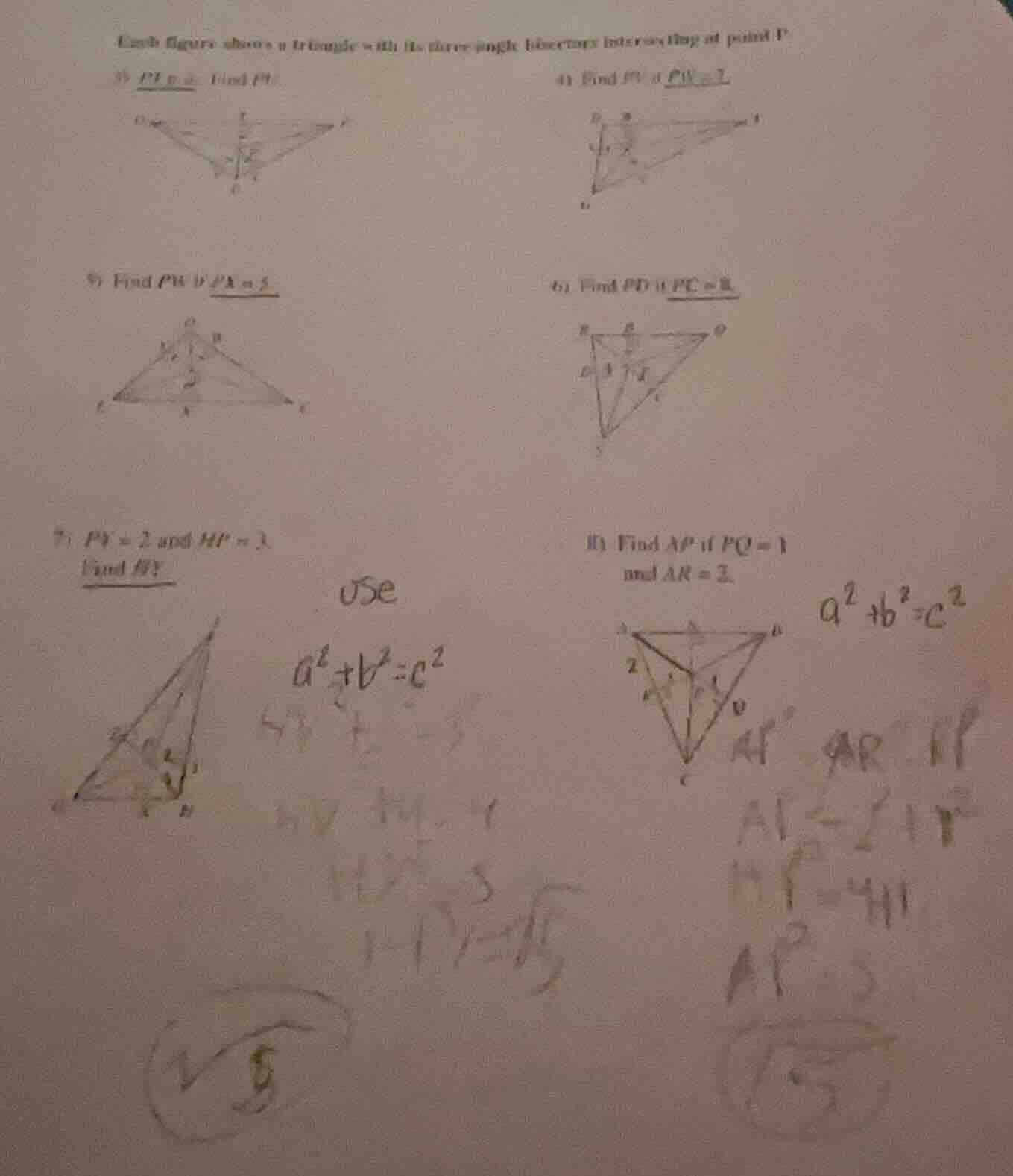
each figure shows a triangle with its three angle bisectors intersecting at point p
- ( pl = 6 ). find ( ph ).
- find ( pv ) if ( pw = 3 ).
- find ( pr ) if ( pa = 5 ).
- find ( pd ) if ( pc = 8 ).
- ( pv = 2 ) and ( hp = 3 ). find ( hy ).
- find ( ap ) if ( pq = 1 ) and ( ar = 2 ).
Let's take problem 7: \( PY = 2 \) and \( HP = 3 \), find \( HY \). We can use the Pythagorean theorem here.
Step 1: Identify the right triangle
We have a right triangle \( \triangle HPY \) where \( PY = 2 \) (one leg), \( HP = 3 \) (another leg), and \( HY \) is the hypotenuse. The Pythagorean theorem states that for a right triangle with legs \( a \) and \( b \), and hypotenuse \( c \), \( a^2 + b^2 = c^2 \).
Step 2: Apply the Pythagorean theorem
Let \( a = PY = 2 \), \( b = HP = 3 \), and \( c = HY \). Then:
\[
HY^2 = PY^2 + HP^2
\]
Substitute the values:
\[
HY^2 = 2^2 + 3^2
\]
\[
HY^2 = 4 + 9
\]
\[
HY^2 = 13
\]
Take the square root of both sides:
\[
HY = \sqrt{13}
\]

Snap & solve any problem in the app
Get step-by-step solutions on Sovi AI
Photo-based solutions with guided steps
Explore more problems and detailed explanations
\( \sqrt{13} \)