QUESTION IMAGE
Question
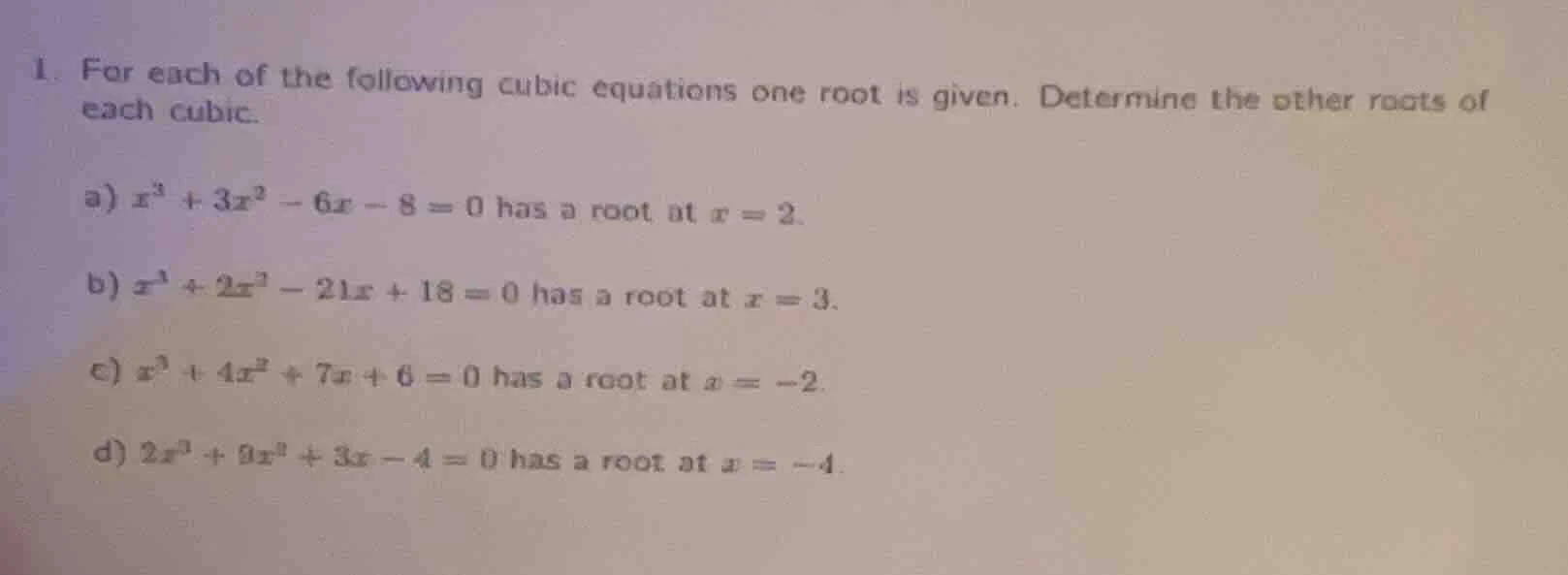
- for each of the following cubic equations one root is given. determine the other roots of each cubic.
a) $x^3 + 3x^2 - 6x - 8 = 0$ has a root at $x = 2$.
b) $x^3 + 2x^2 - 21x + 18 = 0$ has a root at $x = 3$.
c) $x^3 + 4x^2 + 7x + 6 = 0$ has a root at $x = -2$.
d) $2x^3 + 9x^2 + 3x - 4 = 0$ has a root at $x = -4$.
Part (a)
Step1: Factor the cubic using the given root
Since \( x = 2 \) is a root, \( (x - 2) \) is a factor. We perform polynomial division or use synthetic division. Let's use synthetic division for \( x^3 + 3x^2 - 6x - 8 \) with root \( 2 \):
\[
\]
So the cubic factors as \( (x - 2)(x^2 + 5x + 4) \).
Step2: Factor the quadratic
Factor \( x^2 + 5x + 4 \): \( x^2 + 5x + 4=(x + 1)(x + 4) \).
Step3: Find the roots
Set each factor to zero: \( x - 2 = 0 \) (given), \( x + 1 = 0 \) (so \( x=-1 \)), \( x + 4 = 0 \) (so \( x=-4 \)).
Step1: Factor the cubic using the given root
Since \( x = 3 \) is a root, \( (x - 3) \) is a factor. Use synthetic division for \( x^3 + 2x^2 - 21x + 18 \) with root \( 3 \):
\[
\]
So the cubic factors as \( (x - 3)(x^2 + 5x - 6) \).
Step2: Factor the quadratic
Factor \( x^2 + 5x - 6 \): \( x^2 + 5x - 6=(x + 6)(x - 1) \).
Step3: Find the roots
Set each factor to zero: \( x - 3 = 0 \) (given), \( x + 6 = 0 \) (so \( x=-6 \)), \( x - 1 = 0 \) (so \( x=1 \)).
Step1: Factor the cubic using the given root
Since \( x = -2 \) is a root, \( (x + 2) \) is a factor. Use synthetic division for \( x^3 + 4x^2 + 7x + 6 \) with root \( -2 \):
\[
\]
So the cubic factors as \( (x + 2)(x^2 + 2x + 3) \).
Step2: Solve the quadratic
For \( x^2 + 2x + 3 = 0 \), use the quadratic formula \( x=\frac{-b\pm\sqrt{b^2 - 4ac}}{2a} \) where \( a = 1 \), \( b = 2 \), \( c = 3 \):
\[
x=\frac{-2\pm\sqrt{4 - 12}}{2}=\frac{-2\pm\sqrt{-8}}{2}=\frac{-2\pm2i\sqrt{2}}{2}=-1\pm i\sqrt{2}
\]

Snap & solve any problem in the app
Get step-by-step solutions on Sovi AI
Photo-based solutions with guided steps
Explore more problems and detailed explanations
The other roots are \( \boldsymbol{x=-1} \) and \( \boldsymbol{x=-4} \).