QUESTION IMAGE
Question
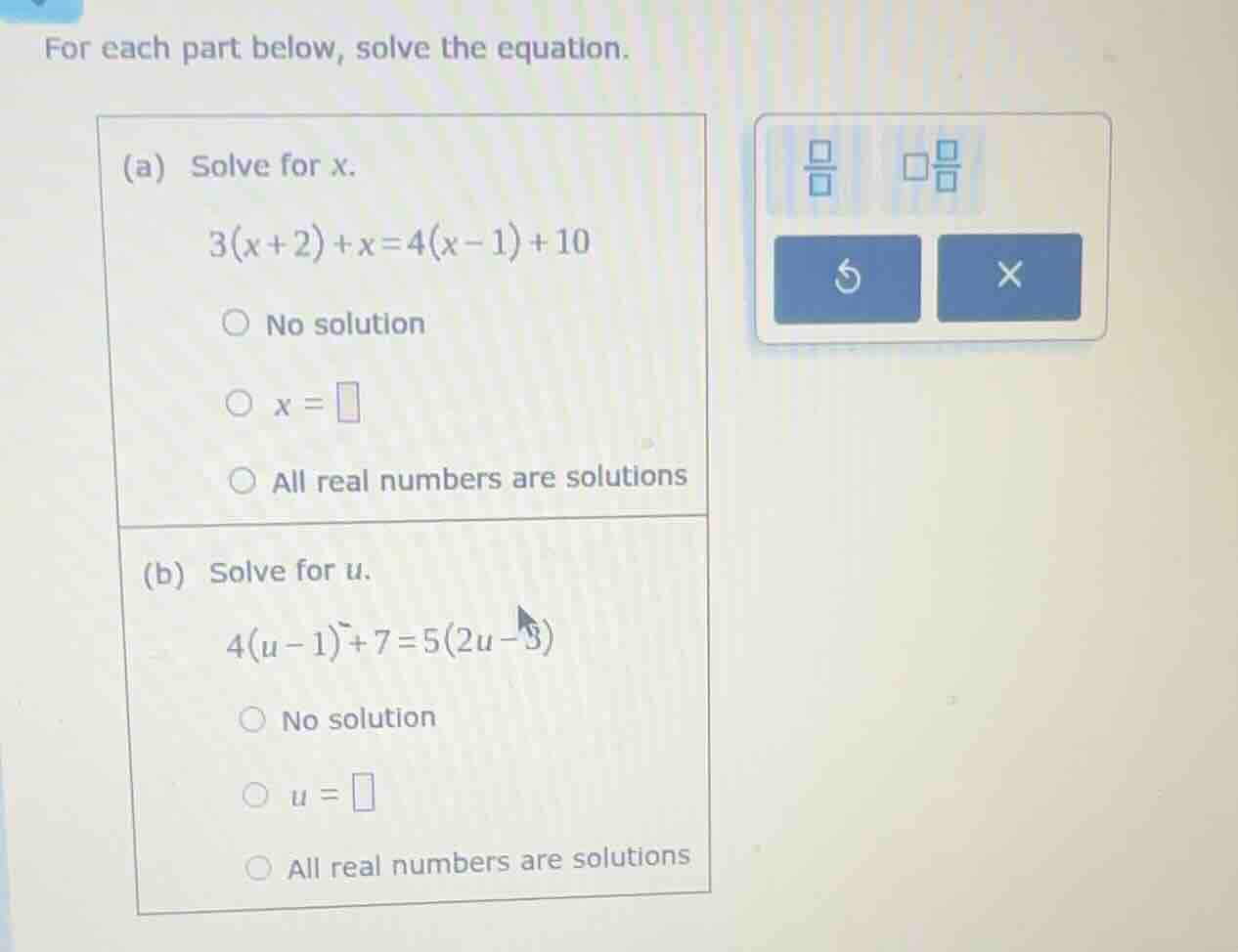
for each part below, solve the equation.
(a) solve for x.
3(x+2)+x=4(x−1)+10
no solution
x =
all real numbers are solutions
(b) solve for u.
4(u−1)+7=5(2u−3)
no solution
u =
all real numbers are solutions
Step1: Expand both sides (part a)
$3x + 6 + x = 4x - 4 + 10$
Step2: Combine like terms (part a)
$4x + 6 = 4x + 6$
Step3: Simplify to check consistency (part a)
Subtract $4x$ from both sides: $6=6$
Step4: Expand both sides (part b)
$4u - 4 + 7 = 10u - 15$
Step5: Combine like terms (part b)
$4u + 3 = 10u - 15$
Step6: Isolate u terms (part b)
Subtract $4u$ from both sides: $3 = 6u - 15$
Step7: Isolate constant terms (part b)
Add 15 to both sides: $18 = 6u$
Step8: Solve for u (part b)
Divide by 6: $u = \frac{18}{6}=3$

Snap & solve any problem in the app
Get step-by-step solutions on Sovi AI
Photo-based solutions with guided steps
Explore more problems and detailed explanations
(a) All real numbers are solutions
(b) $u=3$