QUESTION IMAGE
Question
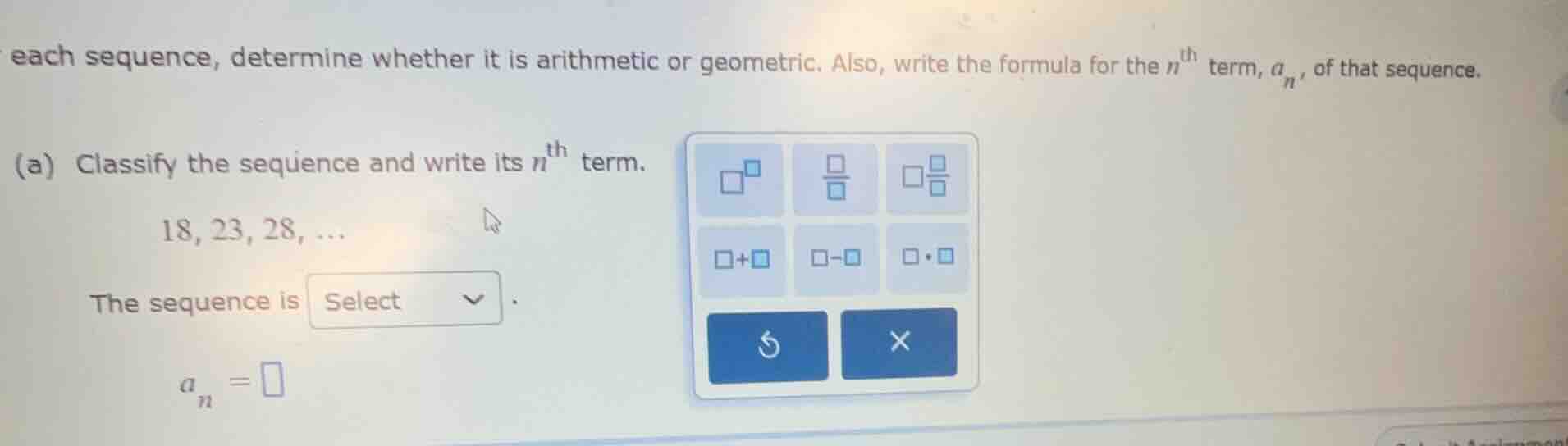
each sequence, determine whether it is arithmetic or geometric. also, write the formula for the ( n^{\text{th}} ) term, ( a_n ), of that sequence. (a) classify the sequence and write its ( n^{\text{th}} ) term. 18, 23, 28, ... the sequence is select ( \boldsymbol{vee} ). ( a_n = square )
Step1: Identify the sequence type
To determine if the sequence \(18, 23, 28, \dots\) is arithmetic or geometric, we check the differences and ratios between consecutive terms.
For the difference between the second and first term: \(23 - 18 = 5\).
For the difference between the third and second term: \(28 - 23 = 5\).
Since the common difference \(d = 5\) is constant, the sequence is arithmetic.
Step2: Find the formula for the \(n^{\text{th}}\) term
The formula for the \(n^{\text{th}}\) term of an arithmetic sequence is \(a_n = a_1 + (n - 1)d\), where \(a_1\) is the first term and \(d\) is the common difference.
Here, \(a_1 = 18\) and \(d = 5\). Substituting these values into the formula:
\(a_n = 18 + (n - 1) \times 5\)
Simplify the expression:
\(a_n = 18 + 5n - 5 = 5n + 13\)

Snap & solve any problem in the app
Get step-by-step solutions on Sovi AI
Photo-based solutions with guided steps
Explore more problems and detailed explanations
The sequence is arithmetic. \(a_n = 5n + 13\)