QUESTION IMAGE
Question
ecology - biome
levels of organization
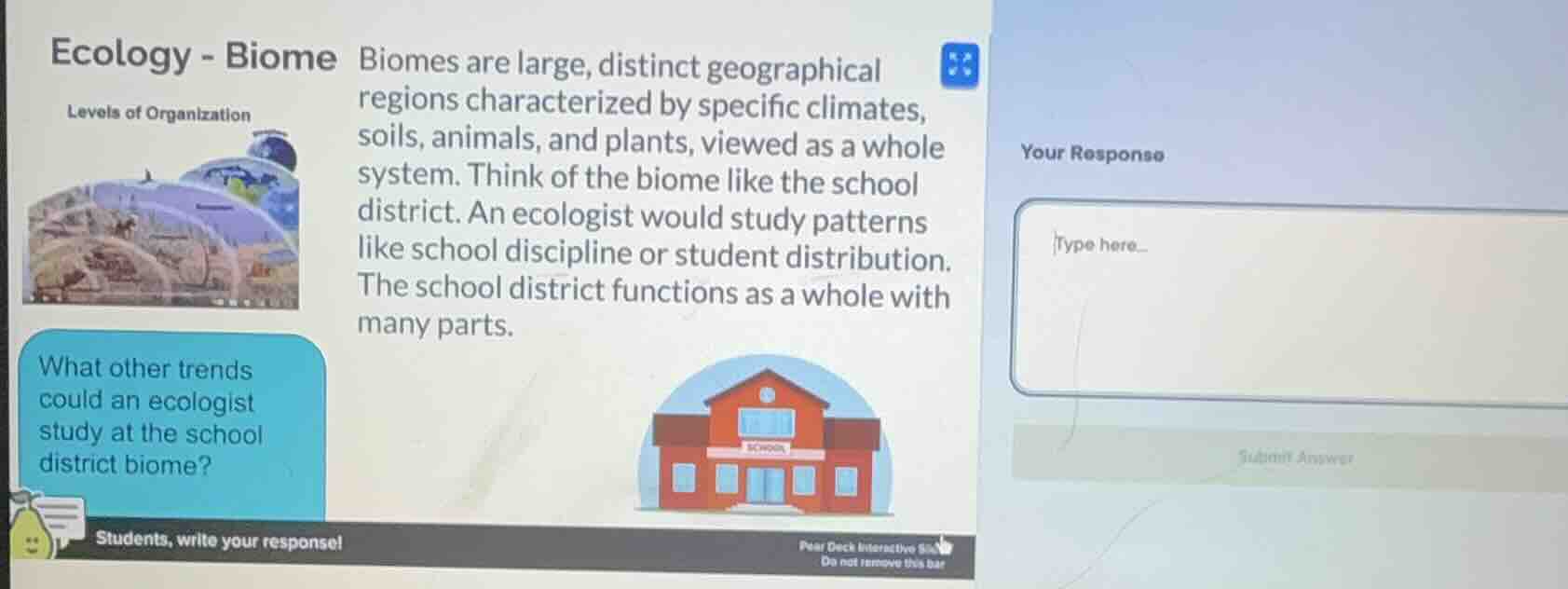
biomes are large, distinct geographical regions characterized by specific climates, soils, animals, and plants, viewed as a whole system. think of the biome like the school district. an ecologist would study patterns like school discipline or student distribution. the school district functions as a whole with many parts.
what other trends could an ecologist study at the school district biome?
students, write your response!
your response
type here_
submit answer
The question draws an analogy between a biome (an ecological system with interconnected climate, organisms, and environment) and a school district. Ecologists study interactions and patterns in biomes, so applying this to the school district analogy, we look for interconnected, system-wide trends similar to ecological studies. Examples include resource use (like how schools use supplies/energy, analogous to resource cycling in biomes), interaction patterns between different groups (students, staff, analogous to species interactions), and how the district adapts to changes (like enrollment shifts, analogous to ecological resilience).

Snap & solve any problem in the app
Get step-by-step solutions on Sovi AI
Photo-based solutions with guided steps
Explore more problems and detailed explanations
An ecologist could study trends such as:
- How "resources" (like school funding, classroom space, or supplies) are distributed across the district, similar to how nutrients or water cycle in a biome.
- Interactions between different "groups" (students, teachers, staff, and administrative teams), analogous to species interactions (predation, mutualism) in a natural biome.
- How the district adapts to changes (like shifts in student enrollment, budget cuts, or new policies), similar to how a biome responds to environmental changes like drought or temperature shifts.
- Patterns of "energy flow" (like how information, policies, or support services move from central administration to individual schools and classrooms, analogous to energy transfer between trophic levels in an ecosystem).