QUESTION IMAGE
Question
this was economic, social, political, or environmental?
what movement led to the passage of the prohibition amendment, the 18th amendment and who mostly led it? (one-two complete sentences)
what unintended consequences did prohibition have? and describe those consequences. (two-three complete sentences minimum.)
how was prohibition a noble experiment? why did it fail? (two-three complete sentences minimum.)
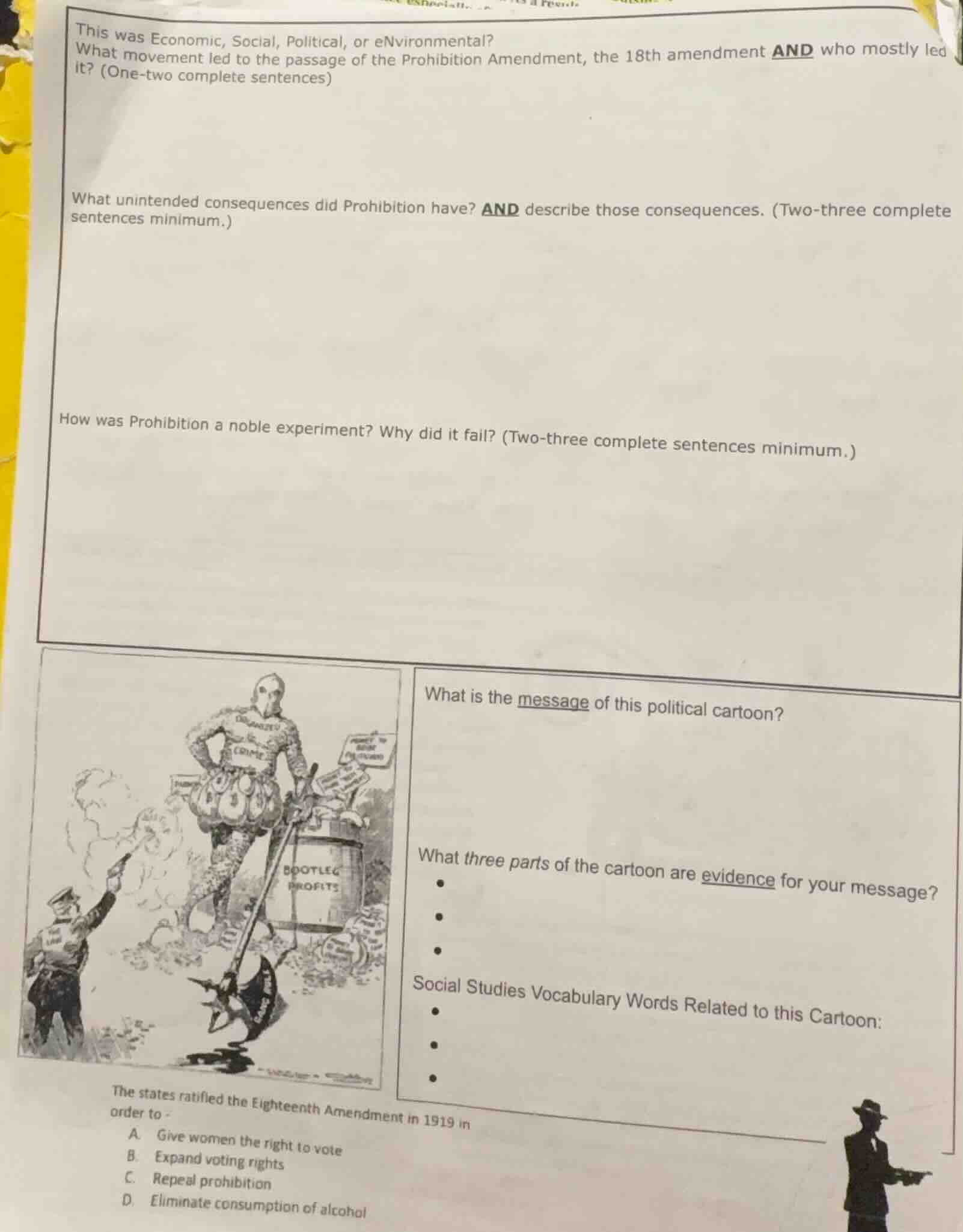
what is the message of this political cartoon?
what three parts of the cartoon are evidence for your message?
•
•
•
social studies vocabulary words related to this cartoon:
•
•
•
the states ratified the eighteenth amendment in 1919 in order to -
a. give women the right to vote
b. expand voting rights
c. repeal prohibition
d. eliminate consumption of alcohol
- First question (movement/leaders): The temperance movement, focused on reducing alcohol use, pushed for the 18th Amendment; it was mostly led by white, middle-class Protestant reformers, including groups like the Woman's Christian Temperance Union (WCTU) and the Anti-Saloon League, who argued alcohol harmed families and society.
- Unintended consequences: Prohibition led to the rise of organized crime syndicates that profited from illegal alcohol production and distribution, such as bootlegging and speakeasies. It also eroded respect for the law, as many ordinary citizens ignored the amendment, and created a black market that generated massive, untaxed profits for criminal groups. Additionally, it led to the production of dangerous, unregulated alcohol that caused illness and death.
- Noble experiment & failure: Prohibition was called a "noble experiment" because it was motivated by the genuine goal of reducing social ills like domestic violence, poverty, and workplace issues linked to alcohol. It failed because it was nearly impossible to enforce, lacked public support from a large portion of the population, and the illegal alcohol trade empowered criminal organizations, creating more social problems than it solved.
- Cartoon message: The political cartoon conveys that Prohibition empowered organized crime, making it wealthy and powerful while law enforcement was powerless to stop it, and that the supposed benefits of Prohibition were overshadowed by these criminal gains.
- Cartoon evidence points:
- The large figure labeled "Organized Crime" standing over a barrel marked "Bootleg Profits," showing criminal groups profiting from illegal alcohol.
- The small, powerless-looking police officer firing at the giant crime figure, illustrating law enforcement's inability to combat the rise of organized crime.
- The figure's foot crushing a sign related to Prohibition, symbolizing how crime undermined the amendment's goals.
- Related vocabulary words:
- Bootlegging: The illegal production or distribution of alcohol during Prohibition.
- Organized crime: Structured criminal groups that profited from illegal alcohol trade.
- Prohibition: The nationwide ban on alcohol production, sale, and transportation via the 18th Amendment.
- Multiple-choice question: The 18th Amendment's core purpose was to ban alcohol consumption and trade in the U.S.

Snap & solve any problem in the app
Get step-by-step solutions on Sovi AI
Photo-based solutions with guided steps
Explore more problems and detailed explanations
- The temperance movement, led primarily by middle-class Protestant reform groups like the Woman's Christian Temperance Union and the Anti-Saloon League, resulted in the passage of the 18th (Prohibition) Amendment.
- Unintended consequences of Prohibition included the rise of powerful organized crime syndicates that controlled the illegal production and sale of alcohol through bootlegging and speakeasies; widespread disregard for federal law as many ordinary citizens broke the amendment to access alcohol; and the creation of a dangerous black market where unregulated, toxic alcohol caused thousands of illnesses and deaths.
- Prohibition was called a noble experiment because it was driven by well-meaning goals to reduce alcohol-fueled social harms like domestic abuse, poverty, and workplace inefficiency. It failed due to widespread public noncompliance, lack of sufficient enforcement resources, and the explosion of organized crime that profited from illegal alcohol, creating more social instability than it resolved.
- The message of the political cartoon is that Prohibition inadvertently empowered organized crime, making it incredibly wealthy and dominant, while law enforcement was helpless to curb its growth, and the amendment's intended benefits were overwhelmed by criminal activity.
- Three pieces of evidence from the cartoon:
- The towering figure labeled "Organized Crime" adorned with symbols of wealth and power
- The barrel marked "Bootleg Profits" at the figure's feet, representing illegal alcohol earnings
- The small, outmatched police officer unable to stop the large crime figure
- Related social studies vocabulary:
- Bootlegging
- Organized crime
- Prohibition
- D. Eliminate consumption of alcohol