QUESTION IMAGE
Question
effects of the great depression: a primary sources analysis activity
primary sources are first hand accounts of an event or situation in history. these accounts can be
verbal (a quote, journal, or other written piece) or they may be visual (an image, sign, video...). the
person providing the information in the account actually lived through and experienced the history. this
makes primary sources very important for understanding history. still, you must consider the source, its
relevance for the time period, the reliability of the account, and any bias that may be held by the person
providing the information.
\my grandfather owned a car during the great
depression but it never left the garage... gasoline
was just too expensive. he told how he polished
the car once a week. how he took good care of it,
but he never drove it. couldnt afford it.
ben, hard times
- why doesnt bens grandfather drive his car
during the great depression?
- if he cant drive the car, why would he keep
it? what value do you think the car had for
bens grandfather?
- what other possessions do you think people
cherished during the great depression?
\mom would go to the butcher
at the end of the day and buy
the bones he had left over from
his sales that day. she made
soup with those bones to serve
all of us children, giving us a bit
of protein we otherwise would
not have had.\
lillie,
interviews with grandma
- what does this quote suggest about the diets of children
during the great depression?
- how do you think the parents of these children felt about their
situation?
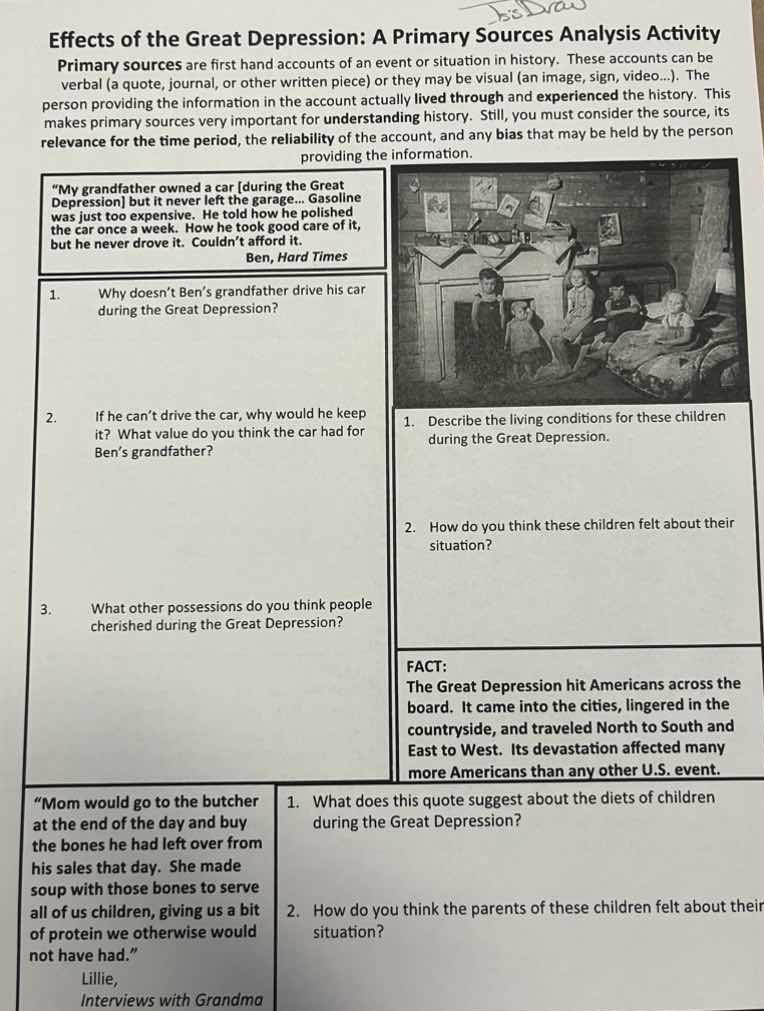
image of children in a room
- describe the living conditions for these children
during the great depression.
- how do you think these children felt about their
situation?
fact:
the great depression hit americans across the
board. it came into the cities, lingered in the
countryside, and traveled north to south and
east to west. its devastation affected many
more americans than any other u.s. event.
All answers are based on context of the Great Depression, primary source accounts, and typical historical impacts of the era.
- Ben's Grandfather Questions
- The text explicitly states gasoline was too expensive for him to afford driving the car.
- The car likely held sentimental value as a pre-Depression possession, or represented stability/normalcy he wanted to hold onto; maintaining it let him preserve a connection to his life before the economic collapse.
- People likely cherished practical, durable items (like tools, clothing, household goods) that could be reused/repurposed, or small sentimental items (family photos, heirlooms) that provided emotional comfort.
- Children in Photo Questions
- The children live in an overcrowded, sparse home with minimal furniture, few personal items, and appear to share a single bed, indicating severe poverty and lack of resources.
- They likely felt insecure, deprived, and possibly ashamed, but may have also had a sense of camaraderie from relying on each other in their difficult circumstances.
- Lillie's Quote Questions
- The quote suggests children's diets were extremely limited and lacking in adequate, regular protein; families had to rely on discarded, cheap scraps to get even basic nutrients.
- The parents likely felt guilty, helpless, and stressed that they could not provide enough or proper food for their children, while also trying to do whatever they could to keep their family fed.

Snap & solve any problem in the app
Get step-by-step solutions on Sovi AI
Photo-based solutions with guided steps
Explore more problems and detailed explanations
- Ben's Grandfather:
- Gasoline was too expensive to afford.
- The car likely held sentimental value, representing stability from before the Depression, so he preserved it as a connection to his past life.
- People likely cherished practical, reusable items (tools, durable clothing) and small sentimental family keepsakes.
- Children in Photo:
- They lived in severe poverty: overcrowded quarters, very few belongings, shared sleeping space, and a lack of basic, comfortable furniture.
- They likely felt insecure, deprived, and possibly embarrassed, but may have had a sense of solidarity with their siblings.
- Lillie's Quote:
- Children's diets were severely inadequate, lacking regular access to protein; families had to rely on discarded, cheap scraps to get minimal nutrients.
- The parents likely felt intense guilt, helplessness, and stress at being unable to provide proper food for their children, while also desperate to do what they could to sustain their family.