QUESTION IMAGE
Question
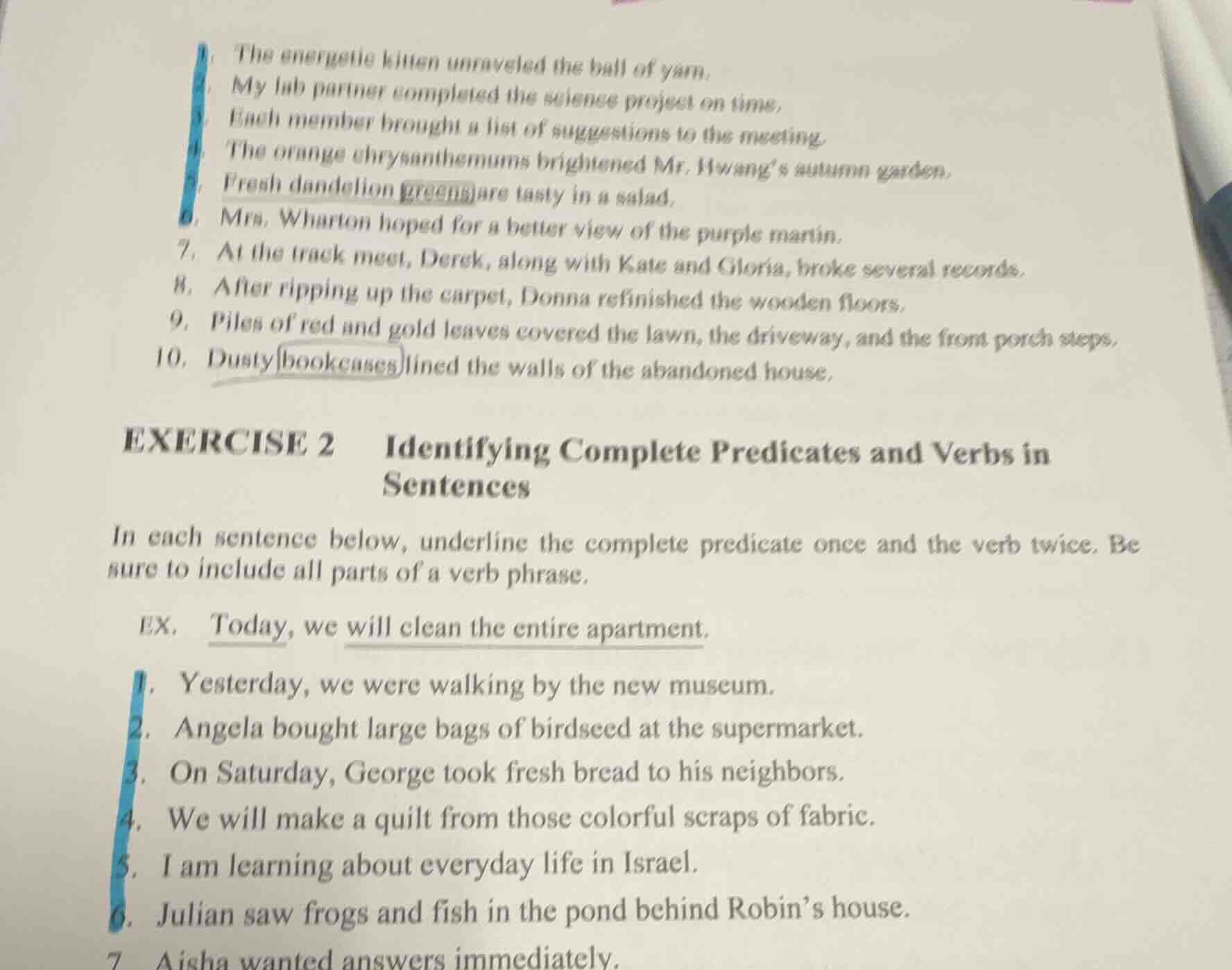
- the energetic kitten unraveled the ball of yarn.
- my lab partner completed the science project on time.
- each member brought a list of suggestions to the meeting.
- the orange chrysanthemums brightened mr. hwang’s autumn garden.
- fresh dandelion greens are tasty in a salad.
- mrs. wharton hoped for a better view of the purple martin.
- at the track meet, derek, along with kate and gloria, broke several records.
- after ripping up the carpet, donna refinished the wooden floors.
- piles of red and gold leaves covered the lawn, the driveway, and the front porch steps.
- dusty bookcases lined the walls of the abandoned house.
exercise 2 identifying complete predicates and verbs in sentences
in each sentence below, underline the complete predicate once and the verb twice. be sure to include all parts of a verb phrase.
ex. today, we will clean the entire apartment.
- yesterday, we were walking by the new museum.
- angela bought large bags of birdseed at the supermarket.
- on saturday, george took fresh bread to his neighbors.
- we will make a quilt from those colorful scraps of fabric.
- i am learning about everyday life in israel.
- julian saw frogs and fish in the pond behind robin’s house.
- aisha wanted answers immediately.
To solve this, we identify the complete predicate (all words that tell what the subject does) and the verb (the action word, including verb phrases) for each sentence:
Sentence 1: Yesterday, we were walking by the new museum.
- Complete Predicate: were walking by the new museum (describes what "we" did)
- Verb: $\boldsymbol{\underline{\underline{were\ walking}}}$ (verb phrase showing the action)
Sentence 2: Angela bought large bags of birdseed at the supermarket.
- Complete Predicate: bought large bags of birdseed at the supermarket (describes what "Angela" did)
- Verb: $\boldsymbol{\underline{\underline{bought}}}$ (action word)
Sentence 3: On Saturday, George took fresh bread to his neighbors.
- Complete Predicate: took fresh bread to his neighbors (describes what "George" did)
- Verb: $\boldsymbol{\underline{\underline{took}}}$ (action word)
Sentence 4: We will make a quilt from those colorful scraps of fabric.
- Complete Predicate: will make a quilt from those colorful scraps of fabric (describes what "we" will do)
- Verb: $\boldsymbol{\underline{\underline{will\ make}}}$ (verb phrase showing the action)
Sentence 5: I am learning about everyday life in Israel.
- Complete Predicate: am learning about everyday life in Israel (describes what "I" am doing)
- Verb: $\boldsymbol{\underline{\underline{am\ learning}}}$ (verb phrase showing the action)
Sentence 6: Julian saw frogs and fish in the pond behind Robin’s house.
- Complete Predicate: saw frogs and fish in the pond behind Robin’s house (describes what "Julian" did)
- Verb: $\boldsymbol{\underline{\underline{saw}}}$ (action word)
Sentence 7: Aisha wanted answers immediately.
- Complete Predicate: wanted answers immediately (describes what "Aisha" did)
- Verb: $\boldsymbol{\underline{\underline{wanted}}}$ (action word)
(Note: For underlining, in text form, we use single underline for complete predicate and double underline for verb, as shown above.)

Snap & solve any problem in the app
Get step-by-step solutions on Sovi AI
Photo-based solutions with guided steps
Explore more problems and detailed explanations
To solve this, we identify the complete predicate (all words that tell what the subject does) and the verb (the action word, including verb phrases) for each sentence:
Sentence 1: Yesterday, we were walking by the new museum.
- Complete Predicate: were walking by the new museum (describes what "we" did)
- Verb: $\boldsymbol{\underline{\underline{were\ walking}}}$ (verb phrase showing the action)
Sentence 2: Angela bought large bags of birdseed at the supermarket.
- Complete Predicate: bought large bags of birdseed at the supermarket (describes what "Angela" did)
- Verb: $\boldsymbol{\underline{\underline{bought}}}$ (action word)
Sentence 3: On Saturday, George took fresh bread to his neighbors.
- Complete Predicate: took fresh bread to his neighbors (describes what "George" did)
- Verb: $\boldsymbol{\underline{\underline{took}}}$ (action word)
Sentence 4: We will make a quilt from those colorful scraps of fabric.
- Complete Predicate: will make a quilt from those colorful scraps of fabric (describes what "we" will do)
- Verb: $\boldsymbol{\underline{\underline{will\ make}}}$ (verb phrase showing the action)
Sentence 5: I am learning about everyday life in Israel.
- Complete Predicate: am learning about everyday life in Israel (describes what "I" am doing)
- Verb: $\boldsymbol{\underline{\underline{am\ learning}}}$ (verb phrase showing the action)
Sentence 6: Julian saw frogs and fish in the pond behind Robin’s house.
- Complete Predicate: saw frogs and fish in the pond behind Robin’s house (describes what "Julian" did)
- Verb: $\boldsymbol{\underline{\underline{saw}}}$ (action word)
Sentence 7: Aisha wanted answers immediately.
- Complete Predicate: wanted answers immediately (describes what "Aisha" did)
- Verb: $\boldsymbol{\underline{\underline{wanted}}}$ (action word)
(Note: For underlining, in text form, we use single underline for complete predicate and double underline for verb, as shown above.)