QUESTION IMAGE
Question
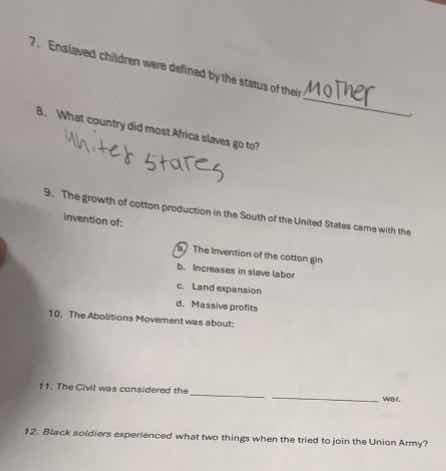
- enslaved children were defined by the status of their _______8. what country did most africa slaves go to?9. the growth of cotton production in the south of the united states came with the invention of:a. the invention of the cotton ginb. increases in slave laborc. land expansiond. massive profits10. the abolitionist movement was about:11. the civil war was considered the _______ war.12. black soldiers experienced what two things when the tried to join the union army?
Brief Explanations
- Under the partus sequitur ventrem legal doctrine in the US, enslaved children took the enslaved status of their mother, not their father.
- While enslaved Africans were sent to multiple Americas colonies, the United States (then British North American colonies that became the US) received a large portion, and it was a primary destination for enslaved people forced into cotton and tobacco labor systems.
- The cotton gin, invented by Eli Whitney, mechanized the separation of cotton seeds from fiber, making large-scale cotton production profitable and feasible in the US South, directly driving its growth.
- The Abolitionist Movement was a social and political effort focused on ending the institution of chattel slavery across the United States.
- The American Civil War is widely referred to as the "first modern" war due to its use of industrialized warfare technology, railroads, and modern military tactics.
- Black men seeking to join the Union Army faced two major barriers: first, initial exclusion (the Union Army initially refused to accept Black soldiers, only changing policy in 1862), and second, systemic discrimination once allowed to serve, including lower pay, segregated units, and being assigned to dangerous, non-combat work more often than white soldiers.

Snap & solve any problem in the app
Get step-by-step solutions on Sovi AI
Photo-based solutions with guided steps
Explore more problems and detailed explanations
- Mother
- United States
- a. The invention of the cotton gin
- ending chattel slavery in the United States
- first modern
- 1. Initial exclusion from the Union Army; 2. Systemic discrimination (lower pay, segregated units, dangerous non-combat assignments) once allowed to serve