QUESTION IMAGE
Question
enter each answer as a whole number (like -4, 0, or 253) or dne for undefined or does not exist.
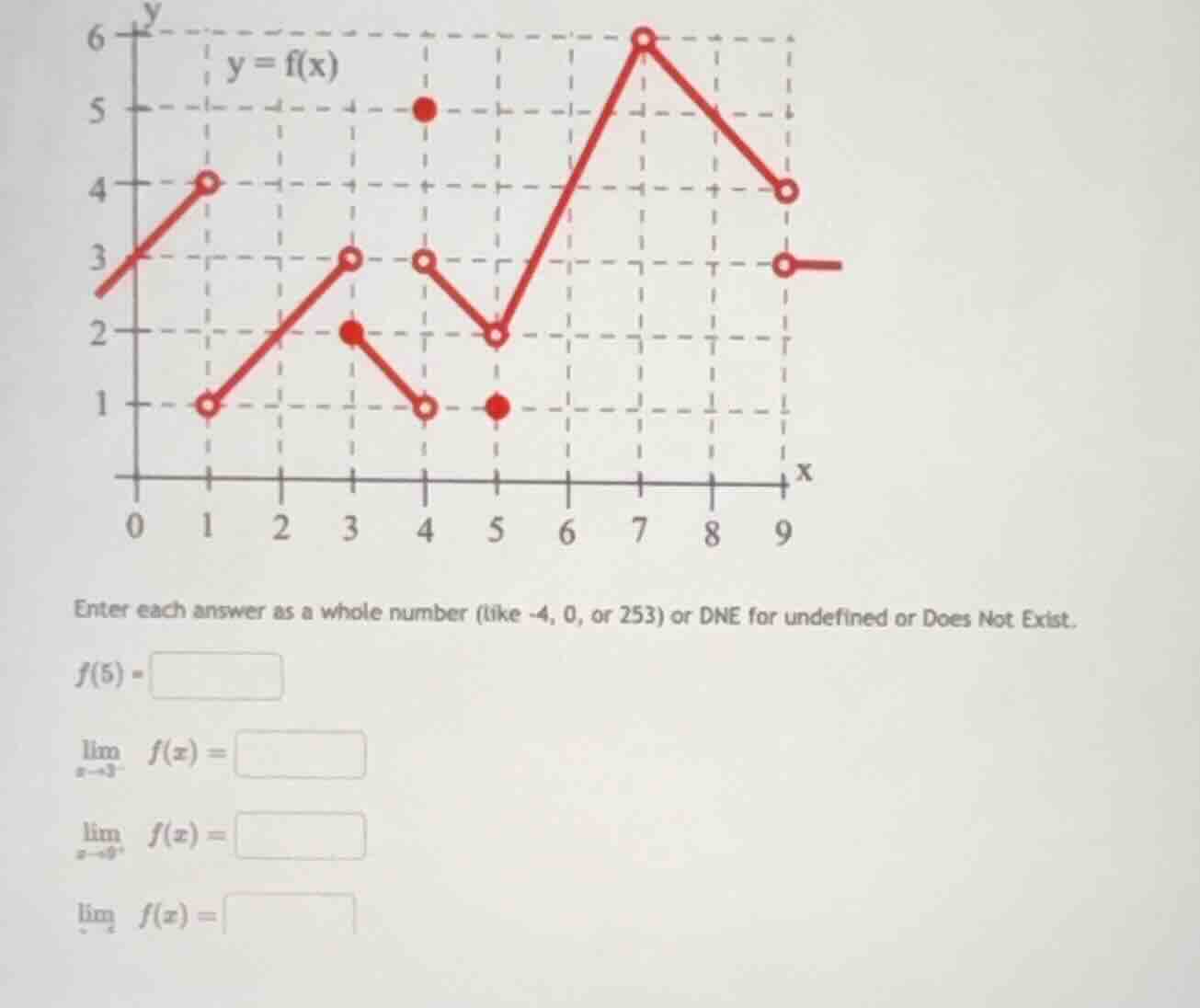
$f(5) = \square$
$\lim\limits_{x \to 3^-} f(x) = \square$
$\lim\limits_{x \to 9^+} f(x) = \square$
$\lim\limits_{x \to 7} f(x) = \square$
1. Solve \( f(5) \)
Step1: Find the point at \( x = 5 \)
To find \( f(5) \), we look at the graph of \( y = f(x) \) and find the \( y \)-value corresponding to \( x = 5 \). From the graph, at \( x = 5 \), the filled dot (representing the function's value) is at \( y = 1 \)? Wait, no, wait. Wait, the open circle and closed circle: at \( x = 5 \), the closed dot (the solid point) is at \( y = 1 \)? Wait, no, looking again: at \( x = 5 \), there's a closed dot (solid) at \( y = 1 \) and an open dot (hollow) at \( y = 2 \). Wait, no, the function's value \( f(5) \) is the value of the solid dot (the defined point) at \( x = 5 \). Wait, no, actually, in piecewise functions, the solid dot is the one that defines the function's value. Wait, looking at the graph: at \( x = 5 \), the solid (filled) circle is at \( y = 1 \), and the open circle is at \( y = 2 \). Wait, no, maybe I misread. Wait, the graph: at \( x = 5 \), there's a filled dot (red solid) at \( y = 1 \) and an open dot (red hollow) at \( y = 2 \). So \( f(5) \) is the value of the solid dot, which is \( 1 \)? Wait, no, wait, maybe I got it wrong. Wait, let's check again. Wait, the open circles are the limits, and the closed circles are the function's value. Wait, no, actually, in a graph, the closed dot (filled circle) represents the point that is included in the function, so \( f(x) \) at \( x = a \) is the \( y \)-value of the closed dot at \( x = a \). Wait, at \( x = 5 \), the closed dot (solid) is at \( y = 1 \), and the open dot (hollow) is at \( y = 2 \). So \( f(5) = 1 \)? Wait, no, maybe I made a mistake. Wait, let's look at the coordinates: at \( x = 5 \), the solid point (filled) is at \( (5, 1) \), and the open point (hollow) is at \( (5, 2) \). So \( f(5) = 1 \).
Step2: Confirm the value
So from the graph, when \( x = 5 \), the function's value (the filled dot) is \( 1 \). So \( f(5) = 1 \).
Step1: Understand left-hand limit
The left-hand limit as \( x \to 3^- \) means we approach \( x = 3 \) from the left (values less than 3). So we look at the graph as \( x \) approaches 3 from the left side.
Step2: Analyze the graph from the left of \( x = 3 \)
From the left of \( x = 3 \) (i.e., as \( x \) gets closer to 3 from values like 2, 2.5, etc.), the graph is a line going from \( x = 1 \) (open dot at \( (1, 1) \)) to \( x = 3 \) (open dot at \( (3, 3) \))? Wait, no, at \( x = 1 \), there's an open dot at \( (1, 1) \) and a line going up to \( x = 3 \), open dot at \( (3, 3) \). Wait, when approaching \( x = 3 \) from the left, the \( y \)-value approaches 3? Wait, no, let's see: from \( x = 1 \) (open dot at \( (1, 1) \)) to \( x = 3 \) (open dot at \( (3, 3) \)), the line is increasing. So as \( x \) approaches 3 from the left (values less than 3, moving towards 3), the \( y \)-value approaches the open dot at \( x = 3 \), which is 3. Wait, the open dot at \( x = 3 \) (left side) is at \( y = 3 \)? Wait, at \( x = 3 \), there's an open dot (hollow) at \( y = 3 \) and a closed dot (filled) at \( y = 2 \). Wait, no, when approaching \( x = 3 \) from the left, we follow the line that comes from the left. The line from \( x = 1 \) (open dot \( (1, 1) \)) to \( x = 3 \) (open dot \( (3, 3) \)): so as \( x \to 3^- \), the limit is the \( y \)-value of the open dot at \( x = 3 \) from the left, which is 3.
Step3: Confirm the left-hand limit
So \( \lim_{x \to 3^-} f(x) = 3 \).
Step1: Understand right-hand limit
The right-hand limit as \( x \to 9^+ \) means we approach \( x = 9 \) from the right (values greater than 9). From the graph, at \( x = 9 \), there's a closed dot (filled circle) at \( y = 3 \), and the graph continues to the right as a horizontal line. So as \( x \) approaches 9 from the right (values like 9.1, 9.2, etc.), the \( y \)-value remains 3, because the graph is horizontal at \( y = 3 \) for \( x \geq 9 \).
Step2: Confirm the right-hand limit
Thus, \( \lim_{x \to 9^+} f(x) = 3 \).

Snap & solve any problem in the app
Get step-by-step solutions on Sovi AI
Photo-based solutions with guided steps
Explore more problems and detailed explanations
\( 1 \)