QUESTION IMAGE
Question
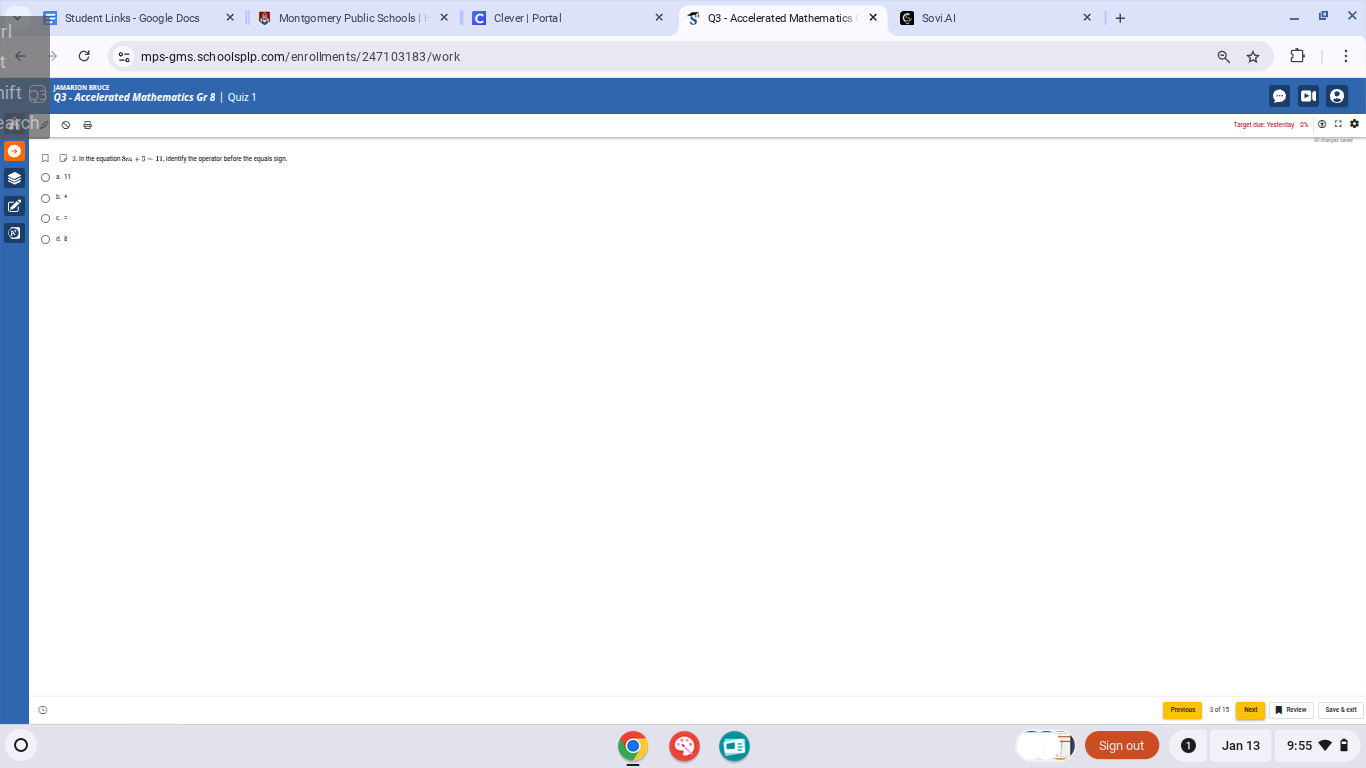
- in the equation \\(\text{box} = - 11\\), identify the operator before the equals sign.\
\\(\circ\\) a. 11\
\\(\circ\\) b. +\
\\(\circ\\) c. =\
\\(\circ\\) d. 8
Step1: Analyze the equation structure
In an equation like \( x = -11 \), the symbol before the equals sign is the "=" (equality) operator, but looking at the options (assuming the equation was maybe a typo or misrendered, and the options are about the operation leading to the equation, but if we consider the standard operator before = in a simple equation, but maybe the original problem had a different form. Wait, maybe the equation was \( x \ [operator] = -11 \)? Wait, the user's image shows "In the equation box, \( x = -11 \), identify the operator before the equals sign." Wait, the options are a. 11, b. +, c. =, d. 8? Wait, no, maybe a typo. Wait, the options: a. 11 (not an operator), b. + (operator), c. = (operator), d. 8 (not an operator). Wait, in the equation \( x = -11 \), the operator before the equals sign? Wait, no, the equals sign is the operator. Wait, maybe the equation was \( x \ [op] -11 \) but written as \( x = -11 \). Wait, no, the equals sign is the equality operator. So the operator before the equals sign (i.e., the symbol just before "=") – but in \( x = -11 \), the part before "=" is "x", then "=", so maybe the question is about the operator in the equation, like if it was \( x + = -11 \) (invalid), but no. Wait, maybe the correct operator before the equals sign (the symbol that is the operator) – the equals sign itself is the operator, but if the options include "=", then c. = is the operator. Wait, the options: a. 11 (number), b. + (plus), c. = (equals), d. 8 (number). So the operator before the equals sign in the equation \( x = -11 \) is "=", so option c.
Step2: Confirm operator types
Operators are symbols that represent operations (like +, -, =, etc.). Numbers (11, 8) are not operators. "+" is an addition operator, "=" is an equality operator. In the equation \( x = -11 \), the symbol immediately before "=" is "x" (a variable), but that's not an operator. Wait, maybe the question was misphrased, and it's the operator in the equation that relates x to -11, so the equality operator "=". So among the options, c. = is the operator.

Snap & solve any problem in the app
Get step-by-step solutions on Sovi AI
Photo-based solutions with guided steps
Explore more problems and detailed explanations
c. =